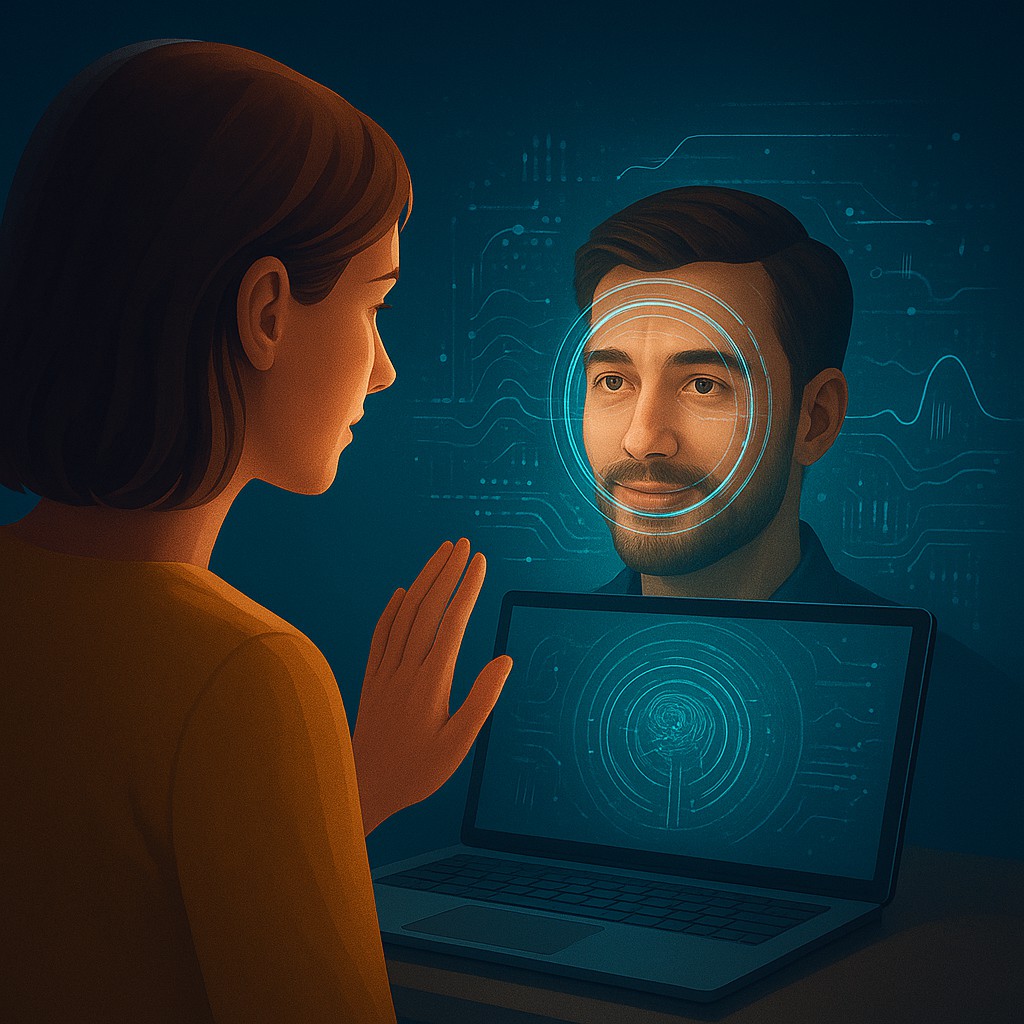
Imagine sitting across from someone during a video call, watching the familiar tilt of their head and the warmth in their eyes. Every pixel on the screen tells you it is your best friend or perhaps a trusted colleague. However, in today’s digital world, the "person" on the screen might be nothing more than a sophisticated mathematical illusion created by a special type of AI known as a generative adversarial network. For years, we have been told to look for glitches, such as slightly blurred earlobes, unnatural strands of hair, or backgrounds that warp when the person moves. But as artificial intelligence improves, those visual errors are vanishing. We are left with a terrifyingly perfect digital mask that can fool both the naked eye and traditional security software.
This evolution has sparked a fascinating arms race in the world of cybersecurity. Instead of looking at the surface of an image, researchers are now diving deep into the biological mechanics of being human. We are entering the era of soft biometrics. Here, the secret to unmasking a fake lies not in what a person looks like, but in how their body functions at a microscopic level. It turns out that while AI can replicate your smile, it has a much harder time mimicking the way blood flows through your tiny vessels or the exact millisecond duration of a subconscious eye-flick. We are moving from a world where "seeing is believing" to one where "biology is verifying." We are using the tiny, involuntary movements of the human body as our most secure digital passwords.
The Invisible Rhythm of the Human Pulse
One of the most impressive developments in deepfake detection is the use of remote photoplethysmography, or rPPG. While the name is a mouthful, the concept is quite simple. Every time your heart beats, it pushes a fresh wave of oxygen-rich blood through your body, including the tiny vessels in your face. This surge of blood causes your skin to change color slightly. This reddening is completely invisible to the human eye, but high-resolution camera sensors can pick it up. By analyzing how pixels change over time, researchers can actually pull a person’s heart rate directly from a video file without any physical sensors attached to the subject.
This creates a massive hurdle for deepfake creators. Generating a realistic face is one thing, but syncing that face with a consistent, biologically accurate pulse is a monumental task. In many deepfakes, the pulse is either entirely missing or is "noisy" and inconsistent because the AI is stitching together frames from various sources with different heart rates. When a detection tool maps the blood flow across a forehead or cheek, a real human shows a rhythmic, steady signal that proves they are alive. A deepfake, by contrast, usually looks like a chaotic mess of data or a flatline. It is a brilliant irony of the digital age: our most primitive biological functions are becoming our most advanced shields.
Micro-Flicks and the Mystery of the Blink
Beyond the pulse, our eyes offer a wealth of data that AI struggles to mimic with precision. Most people know that humans blink, and early deepfake detectors famously looked for a "lack of blinking" to spot a fake. Naturally, AI developers fixed this quickly by teaching their models to blink at regular intervals. However, the move toward soft biometrics goes much deeper than just whether or not the eyelids close. It looks at the microscopic details of those movements, such as the specific duration of a blink, which usually lasts between 100 to 400 milliseconds, and the subtle "micro-flicks" the eyes make when shifting focus.
These movements are involuntary and deeply tied to the human nervous system. When we speak or listen, our eyes constantly react to our thoughts and surroundings in ways that follow complex neurological patterns. Deepfakes often struggle with the coordination of these movements. For example, the eyes might not move in perfect harmony with the head, or the blink might be a fraction of a second too slow or too symmetrical. By tracking these micro-movements, detectors can identify a "synthetic" quality that feels wrong to a computer even if it looks normal to a human. It turns out the soul may be hard to find, but the nervous system leaves a very clear trail.
The Physical Signature Challenge
To help visualize how these new detection methods differ from the old ways of spotting fakes, we can compare the "visual glitch" era with the "biological signature" era. The following table highlights how security experts are moving away from looking for mistakes and toward looking for life.
| Feature |
Old Detection Focus |
Soft Biometric Focus |
| Blood Flow |
Not monitored or ignored. |
Analyzes pulse signals and skin color changes. |
| Eye Movement |
Simple blink counts (on or off). |
Tiny eye movements and millisecond timing. |
| Skin Texture |
Looking for blurring or smudging. |
Looking for pores reacting to sweat and heat. |
| Head Movement |
Looking for unnatural "bobblehead" effects. |
Tracking tiny jitters in posture caused by the pulse. |
| Speech Sync |
Looking for lips that don't match words. |
Analyzing the movement of the throat and voice box. |
This transition is essentially moving from a game of "Where's Waldo?" to a medical check-up. The goal is no longer to find one wrong pixel, but to verify that the person on the screen has the complex, rhythmic markers of a living organism. When a detector looks at a video, it is essentially asking, "Does this person have a heartbeat, do their eyes move like a human's, and does their blood flow in a way that makes sense?"
The Obstacles of Low Resolution and Noise
Despite how foolproof this sounds, there is a significant catch that keeps security experts up at night. These soft biometric signals are incredibly faint. We are talking about color shifts at the pixel level and movements that last only milliseconds. This means the quality of the video matters immensely. In a high-definition video call with perfect lighting, a soft biometric detector can spot a deepfake with incredible accuracy. However, once you add the "noise" of real-world internet connections, things get difficult.
Low resolution, video compression, and poor lighting can easily hide these tiny signals. If a video is grainy, the pulse-detection algorithm might not be able to "see" the heartbeat through the digital static. This creates a dangerous loophole: a fraudster could intentionally lower the quality of a deepfake video, claiming they have a "bad connection," to hide the fact that they lack a biological signature. This is known as a false negative, where the tool fails to flag a fake because the evidence has been washed away. As we lean more on these tools, the industry must find ways to tell the difference between "someone with a bad camera" and "an AI trying to hide its lack of a heartbeat."
The Future of Digital Identity and Trust
As we look toward the future, the concept of a "digital identity" is being rewritten. We are moving toward a world where your face is no longer your password, but your biology is. This shift has massive implications for banking, government communications, and even our personal relationships. Imagine a world where your video call software has a small "Liveness Verified" badge in the corner, giving you peace of mind that the person you are talking to is actually breathing and not just a very convincing puppet. It adds a layer of security that is deeply personal and incredibly difficult to steal.
However, this also means the bar for deepfake creators is being raised. We are already seeing research into "physiological deepfakes" that attempt to fake a pulse or mimic realistic eye-flicks. The battle is constant, but by focusing on soft biometrics, we are forcing AI to compete with millions of years of biological evolution. It is one thing to mimic the way a person looks after viewing a thousand hours of training data; it is quite another to perfectly simulate the chaotic, beautiful, and specific irregularities of a human heart.
As you navigate an increasingly digital world, remember that your most powerful defense against deception isn't a complex password or a special software patch. Instead, it is the very thing that makes you human. Those tiny, unintentional blinks, the rhythmic thrum of your pulse, and the way your skin reacts to the world are more than just biological functions. They are your unique signature in an age of replicas. By embracing these imperfections, we aren't just making our technology more secure; we are rediscovering what it actually means to be a "real" person in a sea of simulated voices. Stand tall and breathe deep, because your very existence is a code that no machine has truly mastered yet.