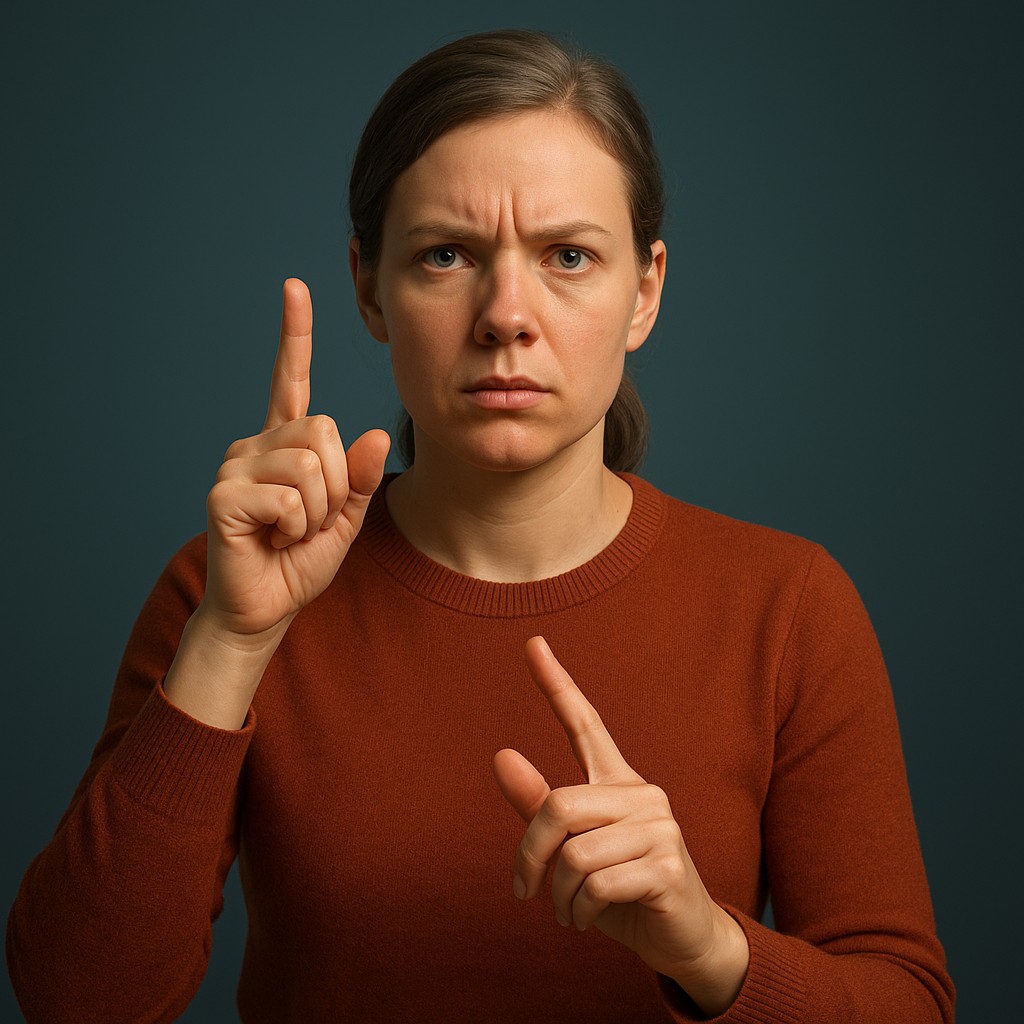
Imagine you are watching a high-stakes performance where the lead actor uses incredibly expressive hand gestures, but their face remains as frozen as a palace guard's. You would likely find the acting confusing, wooden, and perhaps a bit unsettling. In the world of sign languages, this is more than just a stylistic critique; it is a matter of fundamental grammar. If you only look at a signer's hands, you are essentially trying to read a long book that has had every comma, period, and question mark scrubbed from its pages. You might recognize the words, but you will have a very difficult time figuring out where one thought ends and the next begins, or whether the speaker is making a statement or asking a frantic question.
The common misconception is that sign languages are a simple collection of "pictures in the air" or a mechanical code for the English alphabet. In reality, languages like American Sign Language (ASL), British Sign Language (BSL), and dozens of others across the globe are sophisticated, three-dimensional linguistic systems. The "secret sauce" that gives these languages their depth is something linguists call non-manual markers, or NMMs. These consist of eyebrow movements, the tilt of the head, the shift of the shoulders, and the shape of the mouth. Far from being mere "emotional acting," these movements are mandatory grammatical rules. If you do not move your eyebrows at the right moment, you are effectively speaking with the monotonous, robotic tone of an old computer program.
The Architectural Blueprint of the Face
To understand how non-manual markers work, we first need to move past the idea that the face is only there to show emotion. While we certainly use our faces to show we are happy or sad, NMMs function as the "syntax," or the structural rules, of the language. In spoken English, we use our vocal cords to change our pitch, which signals to the listener that we have reached the end of a sentence or that we are asking a question. For example, say the word "really" out loud. If your pitch goes up at the end, it is a question. If it stays flat or drops, it is an exclamation of disbelief or a simple statement of fact. In sign language, the hands provide the vocabulary, but the face provides this "intonation."
These markers are so vital that they often change the entire meaning of a sign. Think of the face as the primary processor for the sentence's structure. If you sign the word for "finish" with a neutral face, it is a simple verb. If you sign it while sharply snapping your head back and narrowing your eyes, it becomes a forceful "stop it!" or a marker for a completed action. This creates a multi-layered communication stream where information travels through two different channels at once: the manual channel (hands) and the non-manual channel (face and body). This allows sign languages to be incredibly efficient, often conveying complex ideas in half the time it would take to speak them.
Decoding the Syntax of the Eyebrows
The eyebrows are arguably the hardest working muscles in any sign language. They function as the primary indicators for sentence types, specifically when it comes to questions. In English, we often start questions with "Who," "What," or "Where," but in ASL, your eyebrows tell the listener what kind of question you are asking before you even finish the sentence. There are two main categories of eyebrow movement that every student of sign language must master: the "Yes/No" question and the "WH-" question.
When you ask a question that can be answered with a simple yes or no, like "Are you hungry?", your eyebrows should be raised and your head should lean forward slightly. This signals to your conversation partner that you are looking for a confirmation or a denial. Conversely, for questions that require more detail (the "Who, What, When, Where, Why" questions), the eyebrows are furrowed or squeezed together. If you were to use the "Who" sign but kept your eyebrows raised instead of furrowed, the sentence would feel grammatically "off" to a native signer, much like asking "Who are you?" with the overly cheerful, rising tone of a movie cheerleader.
Conditional Logic and Spatial Relationships
Beyond just asking questions, non-manual markers handle the complex logic of "if" and "then" statements. In linguistics, these are called conditionals. In a spoken language, we rely on the word "if" to set the stage for a result. In many sign languages, the "if" part of the sentence is marked by a specific physical posture: the eyebrows are raised, the head tilts slightly, and there is often a short pause before the second half of the thought. This tells the listener, "Everything I just signed is a hypothetical condition."
This facial logic extends to how signers describe the physical world. If someone is describing a very large object, they might use the sign for "big," but the true scale is communicated by their mouth and eyes. Squinting the eyes and pursing the lips (a "cha" mouth shape) indicates that something is massive. On the flip side, an "mmm" mouth shape with relaxed eyes might indicate that something is of a regular, average size. This is not the signer trying to be funny or expressive; it is a precise system for adjectives that lives on the face.
| Grammatical Function |
Non-Manual Marker (NMM) |
English Equivalent |
| Yes/No Question |
Eyebrows raised, head forward |
Rising pitch at the end of a sentence |
| WH- Question |
Eyebrows furrowed, head tilted |
Question words (Who, What, Why) |
| Rhetorical Question |
Eyebrows raised, slight head shake |
"The reason is..." or "Because..." |
| Negation |
Head shake, side-to-side |
The word "not" or "never" |
| Topicalization |
Eyebrows raised, slight pause |
"As for [Topic]..." |
| Small / Thin |
"oo" mouth shape, squinted eyes |
Adjectives like "tiny" or "slight" |
| Large / Thick |
"cha" mouth shape, wide eyes |
Adjectives like "huge" or "massive" |
The Mandatory Nature of Facial Grammar
One of the most difficult hurdles for new learners is overcoming the feeling of "overacting." Because many hearing cultures value facial restraint, learners often feel self-conscious when they are told to furrow their brows or tilt their heads. However, in the Deaf community, failing to use these markers is the linguistic equivalent of whispering or speaking in a flat, monotone mumble. It isn't just a matter of "flavor" or "personality"; it is a matter of clarity. Without NMMs, the signs themselves become ambiguous.
Consider the act of negation. In English, we insert the word "not" into a sentence. In sign language, you can take a positive sign (like "want") and simply shake your head slightly while performing it. The head shake is the grammatical marker that flips the meaning to its opposite. If you sign "want" but don't shake your head, you have expressed a desire. If you shake your head while signing "want," you have expressed a lack of desire. If you try to sign "I don't want that" by using a separate sign for "not" while keeping your head perfectly still, it feels clunky and unnatural to a native signer. The face and hands must work in a synchronized dance to create a single, cohesive meaning.
Navigating the Nuance of Mouth Morphemes
The mouth also plays a specific role that goes far beyond just mimicking spoken words. In fact, many signers do not mouth English words at all while they sign. Instead, they use "mouth morphemes," which are specific shapes that add meaning to a verb or noun. For example, if you are signing about a car driving down a road, the way you shape your mouth tells the listener how that car is moving. A "th" sound (tongue slightly between teeth) might indicate that the driving was careless, while a pursed "pucker" might indicate that the driving was done with great precision.
These mouth shapes are consistent across the language and are learned just like vocabulary. They allow a signer to pack an enormous amount of descriptive detail into a single movement. Instead of using three separate signs for "The man walked clumsily," a signer can use the sign for "man," the sign for "walk," and a specific "th" mouth shape simultaneously. This "simultaneity" is one of the most beautiful aspects of sign language. While spoken languages are linear (one sound must follow another), sign languages are multi-dimensional, allowing different types of information to be layered on top of each other at the exact same moment.
Seeing the System Beyond the Gesture
When you start to notice these non-manual markers, your perception of sign language shifts from seeing "gestures" to seeing "language structure." You begin to see the eyebrows as punctuation marks, the head tilts as conjunctions, and the mouth shapes as adverbs. This realization is a crucial step in respecting sign languages as full, natural languages with the same complexity as any spoken tongue. It also highlights why digital technologies, like sign language recognition software, have struggled for so long; it is relatively easy for a camera to track a hand, but it is much harder to track the subtle, rapid-fire grammatical shifts of the eyebrows and mouth in real time.
Understanding the role of the face also helps bridge the gap between different cultures. While the specific hand signs vary wildly between American Sign Language and, for instance, French or Japanese Sign Language, many of the non-manual markers for things like questions and negation are remarkably similar across different countries. There seems to be something intuitively human about using the face to organize our thoughts and signal our intentions to others.
The next time you see a sign language interpreter on television or witness a conversation in public, try to shift your focus away from just the hands. Watch the synchronized movements of the eyes, the subtle shifts in the shoulders, and the rhythmic nodding of the head. You are witnessing a high-speed, multi-channel data transfer that uses the entire upper body as a canvas for human thought. Sign language is not a quiet version of speaking; it is a full-bodied symphony of grammar, where the face leads the orchestra. Embracing this complexity allows us to appreciate the true brilliance of human communication in all its diverse and expressive forms.