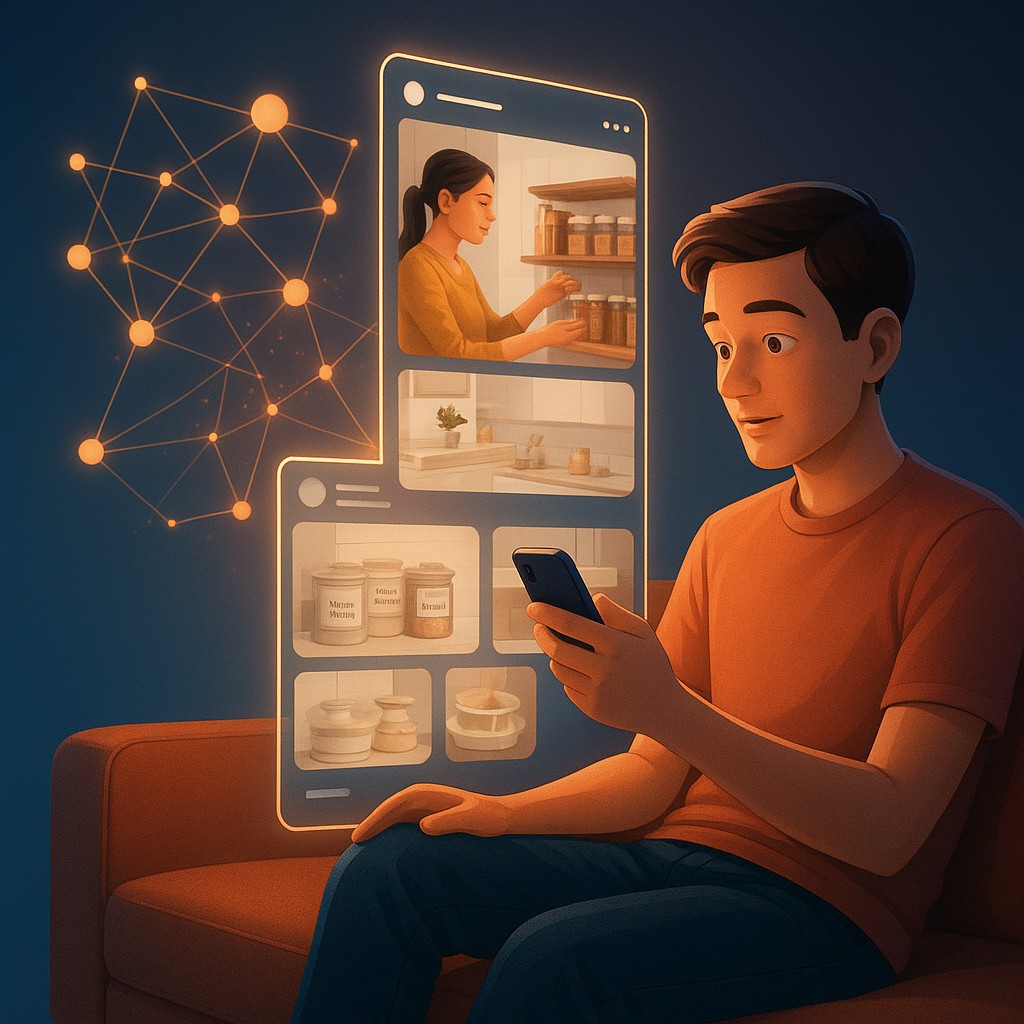
You are sitting on your couch, scrolling through a video app, when something strange happens. You spent just a few extra seconds watching someone organize a spice rack, and suddenly, your entire feed is packed with minimalist kitchen hacks, custom pantry labels, and high-end rotating carousels. It feels as if the app has peered into your soul, or at least into the junk drawer you have been meaning to clean for three years. This isn't magic, and it isn't just a list of things your friends like. It is a sophisticated, invisible choreographer moving at the speed of thought.
We used to live in a digital world governed by the "Social Graph," where your experience was defined by who you followed. If a high school friend posted a photo of their brunch, you saw it because you were connected to them. Today, that model has been largely replaced by the "Interest Graph," powered by high-velocity re-ranking. This system does not care who your friends are; it cares about every micro-second of your attention. By tracking how long you linger on a frame or whether you re-watched a specific three-second loop, the algorithm builds a mathematical portrait of your subconscious desires in real-time. It often discovers what you like before you even realize it yourself.
The Shift from Static Collections to Living Streams
In the early days of social media, algorithms were relatively sluggish. They operated on "batch processing," meaning the system would gather data about your likes and comments over several hours or even a full day. It would then "re-calculate" your feed the next time you logged in. If you liked a cat video on Tuesday, you might start seeing more cats on Wednesday. This created a predictable, if somewhat repetitive, experience. However, modern video apps operate on a fundamentally different clock. They use "stream processing," where every single interaction is a data point that triggers an immediate adjustment.
High-velocity re-ranking means the "ranker" - the part of the code that decides which video comes next - is constantly shuffling the deck. It is no longer looking for a broad category like "cooking." Instead, it identifies a specific content cluster, perhaps "outdoor fire-pit cooking with soothing background sounds." If the system detects that your interest stays high during these clips, it will push everything else aside. This creates a feedback loop that is far more aggressive than old recommendation engines because it prioritizes what you want "right now" over what you "usually" like.
This transition represents a move away from networks curated by humans toward discovery driven by algorithms. In the old model, the burden was on you to find interesting people to follow. If your feed was boring, it was your fault for following boring people. In the new model, the burden is on the algorithm to find interesting content for you. This frees you from the work of searching, but it also hands the keys to your attention over to a machine that values engagement above all else. The result is a digital experience that feels hyper-personalized but can also feel mysteriously out of your control.
The Data Points of Your Digital Body Language
To understand how these systems work so fast, we have to look at what they actually measure. Most people assume that "liking" a video or leaving a comment is the main way the algorithm learns. While those actions matter, they are actually "noisy" signals. People often like things because they want to support a friend or because they think they should like something. The high-velocity system is much more interested in your "passive" signals, which mirror your true, unvarnished attention.
| Interaction Type |
Signal Strength |
What It Tells the Algorithm |
| Explicit Like |
Medium |
You want to see more from this creator or this "vibe." |
| Follow |
High |
You want a long-term relationship with this style of content. |
| Completion Rate |
Very High |
This video successfully held your focus until the end. |
| Re-watch |
Extreme |
You found something specific in the video worth seeing twice. |
| Three-Second Pause |
Medium-High |
Even if you scrolled past, something caught your eye. |
| Share |
Extreme |
You believe this is valuable enough to define your identity to others. |
By gathering thousands of these tiny interactions every minute, the algorithm builds a profile based on your "revealed preferences" rather than your "stated preferences." You might tell people you love history documentaries, but if you consistently stop scrolling to watch videos of people pressure-washing their driveways, the re-ranking mechanism will ignore your claims. It will feed you more pressure-washing content because that is where your "digital body language" shows your true interest. This creates a "content cluster" around your specific niche that can be incredibly narrow and deeply satisfying.
Navigating Content Clusters and Sub-Cultures
The primary goal of a high-speed algorithm is to place you into a "content cluster." Think of a cluster as a neighborhood in a massive digital city. One neighborhood might be for people who love 1990s Japanese car culture, while another is for fans of amateur pottery failures. These clusters are created by grouping videos that are watched by the same sets of people. If Users A, B, and C all watched a video about sourdough starters and a video about handmade leather boots, the algorithm assumes those two topics are "neighbors." If you watch the sourdough video, the system will immediately test the leather boot video on you to see if you belong in that same neighborhood.
This is how niche interests surface so quickly. You don't have to search for "cottagecore" to see that style of content. You simply have to show interest in a video about herb gardening, and the re-ranking engine will start testing related clusters like floral arrangement or vintage fashion. Within minutes, you have moved from a general interest to a highly specific sub-culture. This mechanism is incredibly efficient at breaking the "filter bubble" of your social circle, but it replaces it with an "interest bubble" that can be just as difficult to escape.
The "high-velocity" aspect means the algorithm is constantly running experiments on you. It will occasionally throw in a "wildcard" video - something completely unrelated to your current interests - to see how you react. If you ignore it, the system retreats. If you engage, it has found a new bridge to a different cluster. This constant probing and re-calculating ensures the feed stays fresh. It prevents the boredom that used to happen on older platforms where you would see the same type of content for weeks until you grew tired and left the app.
The Illusion of Mind Reading and the Reality of Retention
It is a common myth that social media apps "listen" to your private conversations through your phone's microphone to show you ads. While that makes for a great ghost story, the reality is more impressive and slightly more unsettling. The high-velocity re-ranking mechanism is so good at recognizing patterns that it can predict your needs based on the behavior of millions of other users who look just like you mathematically. If five thousand people who share your specific interests suddenly started watching videos about "beginner watercolor painting," the algorithm will offer it to you too, guessing that you are on the same path.
This predictive power creates the illusion of mind reading. If you were thinking about buying a new coffee maker and then see a coffee maker ad, it is likely not because the phone heard you. It is more likely because your recent behavior - watching a video on kitchen organization, pausing on a clip of someone making a latte, and searching for "morning routines" - followed the exact pattern of someone who eventually buys a coffee maker. The algorithm is not looking at your intent; it is looking at the statistical probability of your next move based on data gathered in the last ten minutes.
The danger of this system lies in its total indifference to your long-term well-being. The algorithm is built for "retention" (keeping you on the app) and "watch time." It does not distinguish between "I am watching this because it is helpful" and "I am watching this because it makes me angry." In fact, high-velocity systems often discover that negative emotions produce longer watch times. This is how "rabbit holes" are formed. If the system detects that you cannot look away from a controversial topic, it will keep serving it to you, regardless of whether it makes you happy or leaves you feeling drained.
Mastering the Algorithm for a Better Digital Life
Once you understand that the algorithm is essentially a mirror of your split-second impulses, you can begin to use it more intentionally. You can "train" your feed by being conscious of your digital body language. If you find yourself in a content cluster that makes you feel anxious or bored, the best thing you can do is not to "dislike" the video - which is still a form of engagement - but to scroll past it instantly. The high-velocity system is looking for completion rates. By denying it those precious seconds of your attention, you are sending a clear signal that this cluster is a dead end.
You can also proactively "feed" the algorithm the versions of yourself that you want to grow. If you want to learn a new language, search for videos in that language and watch them all the way to the end, even if you don't understand everything yet. Re-watch the parts where the creator speaks slowly. The re-ranking engine will pick up on this high-value interaction and start prioritizing that cluster. Within a few sessions, your feed will transform from a source of idle distraction into a curated learning environment, all because you took control of the signals you were sending.
Ultimately, these algorithms are neither good nor evil; they are simply high-speed mirrors of human attention. They provide a window into a vast diversity of sub-cultures and allow us to discover passions we never knew we had. By understanding the mechanics of high-velocity re-ranking, you move from being a passive consumer to an active participant. You can enjoy the thrill of discovery while remembering that you are the one who decides where the focus goes next.
Go forth and explore the digital landscape with a sharp eye, knowing that every scroll is a vote for the person you want to become. The algorithm is listening, not to your voice, but to your curiosity. If you feed it your best interests and your genuine thirst for knowledge, it will reward you with a world of inspiration. You have the power to turn a simple scrolling habit into a path of meaningful discovery. Give the machine something wonderful to reflect back at you.