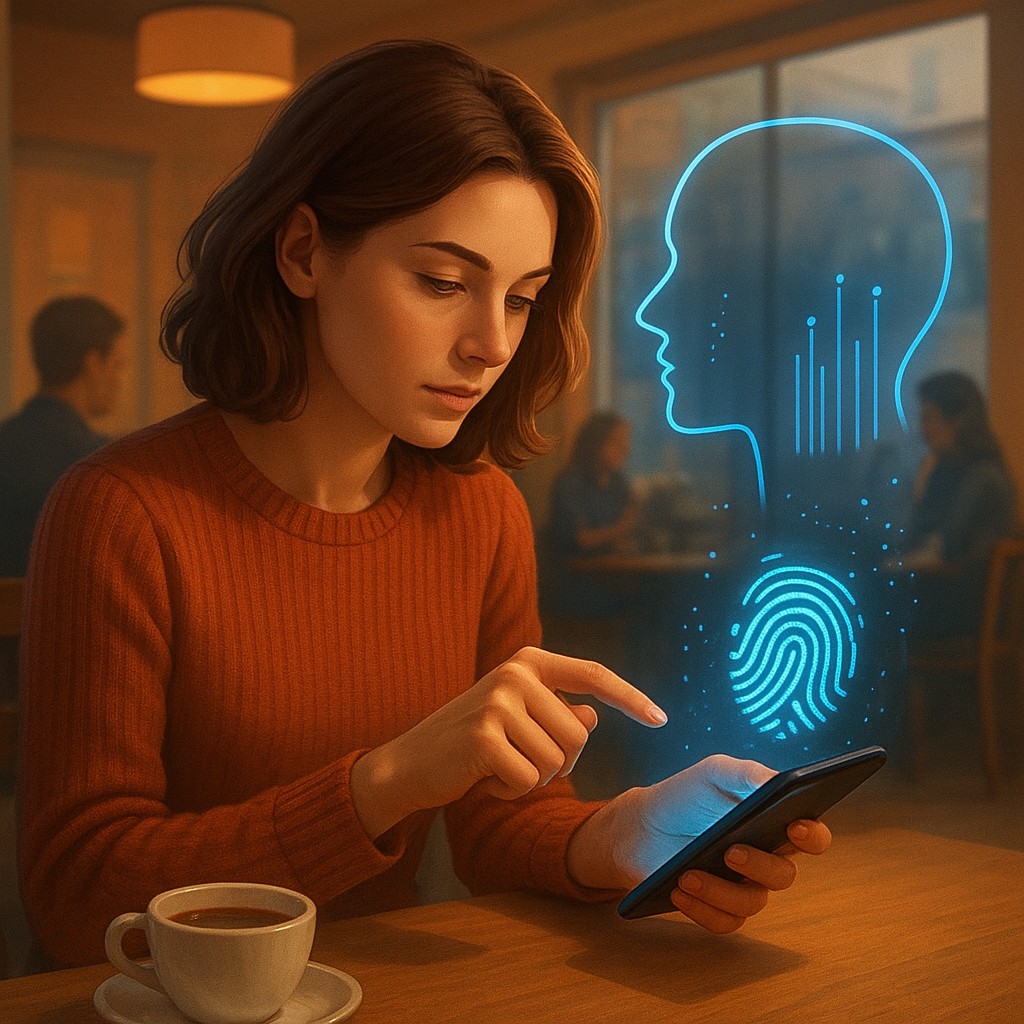
Imagine you are sitting in a busy coffee shop, focus on your own business, when you decide to check your bank balance. You pull out your phone and tap the app icon. Within seconds, you are looking at your recent transactions. You did not have to type a long password, and this time, you might not have even used a thumbprint or a face scan. To you, it felt like nothing happened. Behind the glass screen, however, a complex, silent symphony was playing out. Your phone was quietly noting the exact angle at which you held the device, the specific pressure of your index finger, and the unique, choppy rhythm of your typing. It recognized you not by what you know or what you look like, but by how you move.
This is the world of behavioral biometrics. It is a new frontier of cybersecurity that turns our unconscious habits into a digital signature. While traditional security relies on fixed markers, like a secret code or a physical trait, this new approach treats your behavior as a living password. It is a shift from "who you are" in a biological sense to "how you act" in a functional sense. Modern financial technology apps are weaving this into their software to create a security layer that is nearly impossible to fake because it is based on the subtle, instinctive way your body moves.
The Shift From Physical Locks to Fluid Identity
For decades, digital security has worked like a gatekeeper. You show a key, such as a password or a PIN, and if it matches the lock, you are let in. Even modern tools like FaceID or fingerprint scanners follow this logic; they check a single physical feature at the moment you enter. However, once that gate is open, the gatekeeper usually stops watching. If a clever thief bypasses that initial check or grabs your phone while it is already unlocked, they have a free pass to your entire digital life. Static security is "one and done," which makes it vulnerable to scams or physical theft.
Behavioral biometrics changes the model from a single gate to a continuous, invisible escort. Instead of checking your ID once at the door, the system watches how you walk through the building. It creates a profile of your "digital DNA" based on thousands of data points collected during a single session. This is known as continuous authentication. Because the system is always watching, it can detect if the person using the app suddenly changes. If a thief snatches your phone while you are logged in, the system will immediately notice that the new user holds the phone at a different tilt or taps the screen harder than you do. It can then lock the app before any damage is done.
Decoding the Physics of a Swipe
To understand how this works, we have to look at the hardware in your pocket. Your smartphone is packed with tiny, sensitive sensors like accelerometers, which measure speed and motion, and gyroscopes, which track which way the phone is pointing. When you use an app, these sensors are constantly active. Behavioral software takes this raw data and turns it into a personality profile. For example, some people hold their phone with their left hand and scroll with their right thumb, creating a specific sideways wobble. Others hold it firmly with both hands, creating a very stable, flat profile. These habits are so deep that we do not even realize we have them, but to a computer, they are as distinct as a handwritten signature.
The software goes even deeper by looking at "touch dynamics." This includes how much of your fingertip touches the screen, the speed of your swipes, and your "flight time," which is how long your finger stays in the air between taps. Even the way you type a number is telling. A fraudster trying to enter a stolen credit card number often hesitates as they look at a cheat sheet, whereas a real user enters their own familiar information with a smooth, rhythmic flow. By analyzing these tiny movements, the system can tell the difference between a human and a computer program, or between the rightful owner and a stranger.
| Security Layer |
Identifying Factor |
Pros |
Cons |
| Knowledge-Based |
Passwords, PINs, Security Questions |
Cheap to set up, easy to change |
Easy to forget; prone to scams and leaks |
| Physical Biometrics |
Fingerprints, FaceID, Iris Scans |
Very high accuracy; hard to fake |
Needs specific hardware; cannot be reset if stolen |
| Behavioral Biometrics |
Typing rhythm, stride, phone tilt, swipe speed |
Invisible to user; constant protection |
Can be affected by injuries or wearing gloves |
| Device Intelligence |
IP address, GPS location, WiFi network |
Good for stopping automated bot attacks |
Privacy concerns; fails if the user travels |
Catching the Ghost in the Machine
One of the most powerful uses for behavioral biometrics is spotting non-human users, often called bots. In the game of financial fraud, criminals use automated scripts to test thousands of stolen passwords in seconds. Standard security tries to block these through "CAPTCHAs," those annoying boxes that ask you to click on traffic lights. Behavioral biometrics makes these unnecessary. A bot does not have a human hand; it talks to an app's code directly or moves a virtual cursor with perfect mathematical precision. It does not shake, it does not get tired, and it does not hold a phone at a 15-degree angle.
When an algorithm sees a login attempt where the "user" moves through screens with 100% efficiency and no physical errors, it knows it is dealing with a machine. The system can even flag advanced attacks where a human criminal tries to control your session from a remote location. It can detect if the input is coming from a mouse and keyboard instead of a touchscreen, or if there is a tiny delay that suggests the signal is being routed through a remote server. This creates a difficult environment for fraudsters because they cannot mimic the messy, imperfect reality of a human being using a physical device.
The Challenge of a Changing Body
While behavioral biometrics is a massive leap forward, it has its quirks. The main challenge is that humans are not robots. Our behaviors change based on where we are, our health, or even what we are wearing. If you use your phone while lying on your side in bed, the sensors will report a very different angle than when you are standing at a bus stop. If you wear thick winter gloves, your touch area increases and your swipe speed might slow down. Even a broken finger or an ear infection that ruins your balance could change your profile enough to trigger a security alert.
To solve this, developers use machine learning models that are "fuzzy" rather than rigid. Instead of looking for a perfect match, the system looks for a high probability. It also learns over time. If you always use your banking app while lying down at 11:00 PM, the system adds that "bedtime profile" to its memory of you. This flexibility is key to preventing "false positives," where a real user is locked out of their own account. The goal is a system smart enough to know that a shaky hand after too much coffee is still you, but a perfectly steady, mechanical swipe is a red flag.
Privacy and the Ethics of Invisible Tracking
As with any technology that monitors our every move, behavioral biometrics raises questions about privacy. Because the tracking is invisible, users may not even realize they are being "profiled." Unlike a fingerprint, which you provide on purpose, behavioral data is collected in the background. This has started a debate about how this data is stored and who can see it. If a company knows exactly how you hold your phone and how fast you type, could they use that data for other things? For instance, could it be used to guess your stress levels, your age, or even early signs of health issues like Parkinson's disease?
Most finance companies argue that the data is heavily encrypted and "anonymized." This means the system does not store a video of you, but rather a math-based map of your movements. Furthermore, the data is usually "tokenized," meaning it only works within that specific app. Despite these safety measures, moving to a world where our unconscious movements act as a form of ID requires more transparency. The challenge will be balancing the security benefits with the need for users to control their own digital footprints.
The Future of a Frictionless Life
The ultimate promise of this technology is the end of the password. For years, experts have complained that passwords are a weak link, but they stayed because there was no better way to prove who you are without causing a headache. Behavioral biometrics offers a way out by providing high-level security with no effort from the user. Imagine a future where your digital life just "knows" it is you because of the rhythm of your walk or the way your hand naturally rests on a laptop.
As these systems grow, we may see the end of frustrating "forgot password" emails. Security will no longer be something you do, but something you are. By turning our most boring physical habits into our strongest defenses, we are taking back control of our digital identities in a way that feels natural. The next time you tilt your phone to see the screen better, remember that you are not just adjusting your view; you are essentially signing your name in a language only your phone can understand. Our own unique imperfections are exactly what will keep us safe.