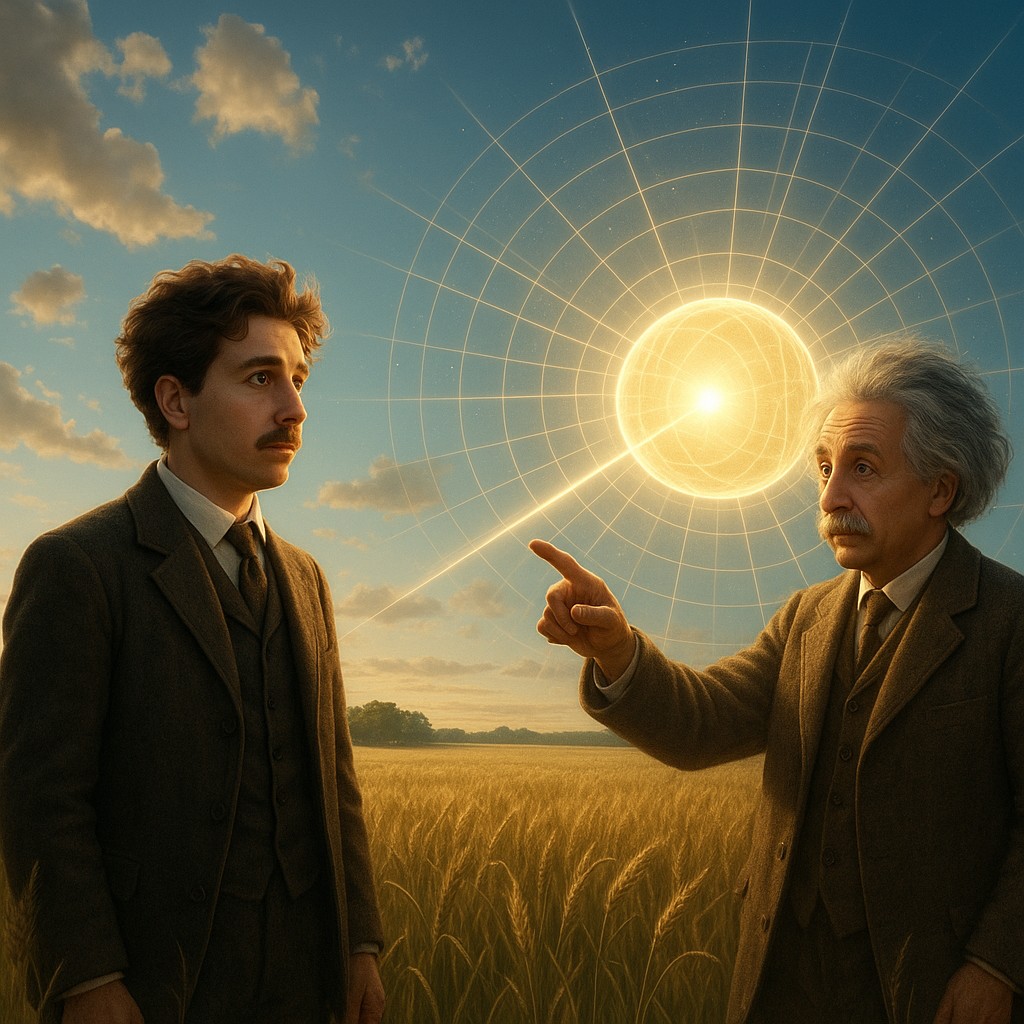
Imagine you are standing in a vast, sun-drenched field in 1905. At this time, the world is governed by the rigid, comforting laws of Isaac Newton. In this view, time is a steady, ticking metronome that beats the same for everyone, everywhere. Space is just a stage - a fixed backdrop where actors perform their roles. But then, a young patent clerk named Albert Einstein walks onto that stage and suggests something so radical it sounds like science fiction. He proposes that the stage itself is flexible, that time can stretch like a rubber band, and that your perspective on the universe depends entirely on how fast you are moving.
This transition from a familiar, clockwork universe to the mind-bending reality of Special Relativity is one of the greatest "eureka" moments in human history. It isn't just about math or abstract physics; it is a fundamental shift in how we perceive our existence. As we peel back the layers of this cosmic onion, you will realize that your intuition about the world is a charming illusion created by the fact that humans move very, very slowly. When things start moving fast, the rules of the game change entirely, and reality becomes far more interesting than we ever dared to imagine.
The Constant Speed of Light and the End of Intuition
At the heart of Einstein’s revolution is a single, stubborn fact: the speed of light is always the same, no matter who is looking at it. In our everyday lives, speeds add up. If you are on a train moving at 50 miles per hour and you throw a baseball forward at 10 miles per hour, someone standing on the side of the tracks sees the ball moving at 60 miles per hour. This makes perfect sense to our brains. However, light refuses to play by these rules. If you are on a spaceship traveling at 99 percent the speed of light and you turn on a flashlight, you will see the light beam zip away from you at exactly the speed of light. Meanwhile, a person standing still on a nearby planet will also see that same light beam traveling at exactly the speed of light, not at 199 percent of it.
This consistency creates a massive logical problem. Since speed is just distance divided by time, and the speed of light cannot change, then distance and time must be the things that change to keep the equation balanced. This is the foundation of Special Relativity. If light must always travel at roughly 300,000 kilometers per second for every observer, then space and time have to literally warp and twist to make that true. It is as if the universe is a master accountant that will fudge every other number in the ledger just to ensure that the "Speed of Light" column remains perfectly constant.
Why Your Clock and My Clock Don't Agree
Since we've established that the speed of light is the only true constant, we have to deal with the fallout, starting with Time Dilation. Imagine two identical clocks that are perfectly synced. If you take one clock and send it on a high-speed journey through space while the other stays on Earth, they will no longer show the same time when they are reunited. For the clock that moved quickly, time actually slowed down. This isn't a mechanical error or a trick of the light; the moving clock literally experienced fewer seconds than the stationary one. Time is not a universal river flowing at a steady pace for everyone. Instead, everyone carries their own personal "proper time" that ticks at a rate depending on their speed.
To visualize this, imagine a "light clock" consisting of two mirrors and a single photon - a particle of light - bouncing between them. Each bounce is one "tick." If the clock is stationary, the photon moves straight up and down. But if the clock is moving sideways at a high speed, a stationary observer sees the photon moving in a diagonal, zigzag path. Since a diagonal path is longer than a straight vertical one, and light cannot speed up to cover that extra distance, it takes longer for the photon to complete one "tick." For the person moving with the clock, everything feels normal, but for the outside observer, time for the traveler has noticeably slowed. This effect is happening to you right now, but because humans move so much slower than light, the difference is too small for our senses to detect.
The Universe Shrinks When You Run Fast Enough
If time stretching sounds weird, wait until you hear what happens to space. To ensure the speed of light remains constant for everyone, the universe engages in something called Length Contraction. As an object moves faster and faster, it actually begins to shorten in the direction it is traveling. If you were to watch a 100-foot-long spaceship fly past you at 90 percent the speed of light, it would look like it had been squashed into a much shorter version of itself. Interestingly, the people inside the ship wouldn't feel squashed at all. To them, the ship looks perfectly normal, but they would look out the window and see the rest of the universe shrinking in front of them.
This creates a fascinating balance in physics. For a traveler moving near the speed of light, a journey to a distant star might only take a few weeks according to their own clock. They aren't "cheating" the speed limit; rather, the distance to the star has physically shrunk for them. What we see as time slowing down for them, they see as the distance shortening for themselves. Both perspectives are equally "true" because there is no such thing as a "correct" frame of reference. Relativity teaches us that "here" and "now" are subjective terms that depend entirely on the observer's motion.
| Concept |
What It Means |
Effect on Observer |
| Time Dilation |
Time slows down for objects moving at high speeds. |
A clock on a spaceship ticks slower than a clock on Earth. |
| Length Contraction |
Objects become shorter in the direction they are moving. |
A fast-moving car would look shorter to a bystander. |
| Relativistic Mass |
It becomes harder to move an object as it gets faster. |
An object requires infinite energy to reach light speed. |
| Simultaneity |
Two events happening at once is not a universal truth. |
You see two flashes at once; a moving observer sees them one by one. |
The Sacred Link Between Energy and Mass
Perhaps the most famous result of Einstein's work is the equation E=mc². Before this, scientists thought that mass (physical matter) and energy (the capacity to do work) were two completely different things. Einstein showed that they are actually two sides of the same coin. Mass is essentially super-concentrated energy. This realization helps explain why the speed of light is the ultimate speed limit of the universe. As you push an object faster and faster, the energy you put into it doesn't just increase its speed; some of that energy actually adds to its "relativistic mass," making it heavier.
The heavier an object gets, the harder it is to make it go faster. As you approach the speed of light, the object's mass becomes nearly infinite, requiring an infinite amount of energy to give it that final push. Since there isn't an infinite amount of energy in the universe, nothing with mass can ever reach or exceed the speed of light. This isn't just a rule of thumb; it is a hard boundary built into the fabric of reality. Only particles without mass, like photons, can travel at that speed because they don't have any weight to hold them back. This conversion of mass to energy is also the secret behind the power of stars, where tiny bits of matter are converted into the immense light and heat that sustains life.
Why We Don't Notice the Weirdness at Home
You might wonder why you don't see cars shrinking or your friends aging slower when they run a marathon. The reason lies in the extreme scale of the speed of light. Light travels at 670 million miles per hour. Even our fastest spacecraft reach only a tiny fraction of that speed. At earthly speeds, the effects of relativity are so small they are practically zero. However, our technology has reached a point where we have to account for these "weird" effects every single day. The most prominent example is the GPS system in your smartphone.
The satellites that power your GPS move at high speeds in orbit. Because they are moving fast relative to your phone, their internal atomic clocks tick slightly slower than yours. If engineers didn't use Einstein's equations to correct for this time difference, your GPS would be off by several kilometers within just twenty-four hours. Every time you successfully navigate to a new coffee shop, you are using the mind-bending principles of Special Relativity to get there. It is proof that even though these concepts feel like magic, they are the very real gears that turn the universe.
Embracing the Relativistic Perspective
Learning about Special Relativity is like waking up from a lifelong dream where everything was solid and predictable. It invites us to stop thinking of space and time as separate, rigid containers and instead see them as a single, woven fabric called spacetime. This fabric is dynamic and deeply connected to the energy and matter within it. By letting go of our "common sense" intuition, we gain access to a universe that is far more magnificent and flexible than we ever imagined.
As you go about your day, remember that you are a traveler through this four-dimensional playground. While you may never personally feel the rush of length contraction or the slow-motion grace of time dilation, knowing these principles exist changes how you see your place in the cosmos. You are part of a reality where the impossible is just a matter of perspective, and where the speed of light serves as a golden thread connecting every observer in existence. Carry this curiosity with you, look up at the stars, and realize that the universe is not just stranger than we think, but stranger than we can think - and that is exactly what makes exploring it so rewarding.