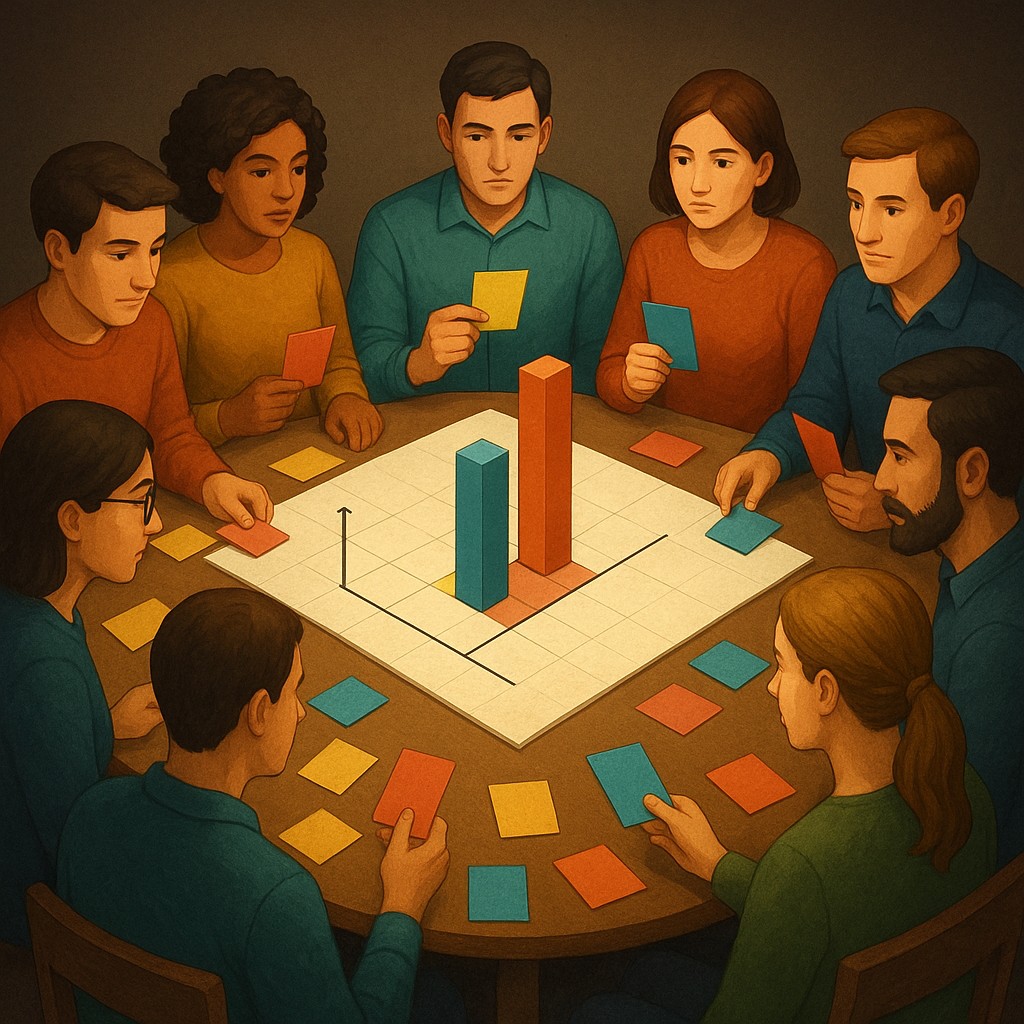
Imagine you are at a dinner party with ten friends, and the group has to choose a single pizza topping for three large pies. Seven people would slightly prefer pepperoni, but three people have a severe, life-long allergy to mushrooms. In a standard "one-person, one-vote" system, if a prankster suggests a mushroom pizza and the seven pepperoni lovers do not actually mind mushrooms, they might just shrug and vote for it. The three allergic friends are outvoted, and they spend the rest of the night hungry and frustrated. This is the "tyranny of the majority" in its simplest form, where a lukewarm majority overrides a passionate minority with a lot at stake. The result is a choice that causes the group's total happiness to plummet.
Our current democratic and organizational tools are often blunt instruments. We ask people if they like Option A or Option B, but we rarely ask them how much they like them. This lack of nuance creates "deadweight loss" in society - a term for resources wasted on projects that nobody truly loves, or vital interests of small groups being steamrolled because they lack the numbers to win a head-to-head tally. We have been taught that "one person, one vote" is the gold standard of fairness, but in reality, it is a low-resolution snapshot of a high-definition world. It treats a voter who is mildly annoyed by a policy the exact same way it treats a voter whose entire livelihood depends on that policy’s success or failure.
The Mathematical Glitch in Traditional Democracy
To understand why public agencies are turning to new systems, we first have to admit that our traditional voting methods are built on a mathematical lie. Traditional voting assumes that all preferences carry the same weight, regardless of their intensity. Think of it as a flat pricing model. If you go to a market where every item costs exactly one dollar, from a stick of gum to a luxury watch, the inventory will be cleared out in minutes. The people who actually needed the watch for work will be out of luck because someone else bought it just because it was cheap. This is exactly what happens in local city council meetings or corporate boardrooms when we use simple majority rule.
The problem is made worse by "tactical voting." In a standard system, if you know your favorite candidate or project is unlikely to win, you often cast your vote for a "lesser of two evils" rather than expressing your true desire. This masks the real needs of the community and gives policymakers a distorted view of what people actually want. By failing to account for the "strength of preference," we create a "winner-take-all" environment where the loudest, most numerous group wins everything. Meanwhile, minority groups lose everything, even when they have a much higher stake in the outcome. This leads to social friction, resentment, and, ultimately, policies that fail to address the core needs of a diverse population.
Enter the Quadratic Price Tag
Quadratic voting (QV) solves this by introducing a "cost" to voting that is not linear, but exponential. It works like this: every voter is given a budget of "voice credits" or "tokens." You can spend these tokens to buy votes on various issues. If you feel lukewarm about a park renovation, you might spend one token to get one vote. However, if you are a local business owner and a proposed street closure would bankrupt you, you might want to cast more votes against it. Here is the catch: the cost of those votes is the square of the number of votes you want to cast.
One vote costs one token (1x1=1). Two votes cost four tokens (2x2=4). Three votes cost nine tokens (3x3=9). By the time you want to cast ten votes for a single issue, it costs you one hundred tokens (10x10=100). This radical pricing structure forces every participant to become a strategist. You cannot be "vaguely in favor" of everything. You have to look at your limited bucket of tokens and decide what truly matters to you. It creates a self-regulating system where people only "buy" a high number of votes for the things they are truly passionate about, because the cost of being "extreme" is intentionally and prohibitively high.
How the Costs Scale
| Number of Votes Desired |
Credit Cost (Square of Votes) |
Marginal Cost of the Next Vote |
| 1 Vote |
1 Credit |
1 Credit |
| 2 Votes |
4 Credits |
3 Credits |
| 3 Votes |
9 Credits |
5 Credits |
| 4 Votes |
16 Credits |
7 Credits |
| 5 Votes |
25 Credits |
9 Credits |
| 10 Votes |
100 Credits |
19 Credits |
The "marginal cost" column in the table above - the cost of adding just one more vote - is the real magic of quadratic voting. Each additional vote you want to cast on the same topic becomes increasingly more "expensive" than the last one. This prevents any one person from totally dominating a decision unless they are willing to sacrifice their influence on every other topic. It mimics a real-world economy where resources are scarce and choices involve trade-offs. This makes the results reflect the "aggregate utility," or the total satisfaction of the group, far better than a simple head count ever could.
Protecting the Edges of Society
One of the most compelling reasons public agencies, such as the Nashville Metro Council or community groups in New York City, are exploring these frameworks is to protect minority interests. In a standard majority-rule vote, a small group of residents concerned about a specific environmental hazard in their neighborhood would consistently be outvoted by a city-wide majority that wants a cheaper waste-disposal solution. The majority "wins," but the harm is concentrated on a small, voiceless group.
Quadratic voting flips this script. Because the majority of the city only has a "mild" preference for the cheaper solution, they will likely only spend one or two tokens each on that issue. However, the residents living near the hazard have an "intense" preference for safety. Even though they are fewer in number, they will be willing to spend a large portion of their token budget to cast multiple votes on that specific issue. In many cases, the high-intensity "expensive" votes of the minority can outweigh the low-intensity "cheap" votes of the majority. This ensures that the people who have the most to lose have the loudest voice in the final decision.
This is not just about being "fair" in a sentimental sense; it is about efficiency. When a small group is intensely harmed by a policy, it creates long-term social and economic costs for the whole city. By allowing that group to "signal" the intensity of their pain through the quadratic cost mechanism, the system naturally steers the community away from policies that cause high levels of concentrated distress. It turns the voting booth into a heat map of human priority, showing leaders not just where people stand, but how firmly they are planted.
Misconceptions about "Buying" Influence
A common knee-jerk reaction to quadratic voting is the fear that it allows "the rich" to buy more votes. This is a misunderstanding of how public-sector QV is actually used. In these systems, "credits" are not equivalent to real money. Every citizen is given the exact same number of credits for free. You cannot go to a bank and buy more voting tokens with your savings account. The "currency" in this system is your personal influence and your attention, not your net worth.
Another frequent concern is that the system is "too complicated" for the average person. Critics argue that people will struggle with the math of squaring numbers. In practice, however, the digital interfaces used for quadratic voting handle all the math in the background. A user simply sees a plus and minus sign next to an issue. As they click the "plus" button to add more votes, an animation shows their remaining "token bucket" draining faster and faster. People intuitively understand the concept of "spending more to get more" even if they do not remember their middle-school algebra. The psychological effect is immediate: when you see your credits disappearing rapidly, you naturally pause and ask yourself, "Is this issue really worth it to me?"
From Budgeting to Better Neighborhoods
We are already seeing this work in the real world. In participatory budgeting, where cities set aside a few million dollars for residents to spend on local projects, quadratic voting is a game-changer. Usually, these votes turn into a popularity contest. For example, a high school sports team might win all the funding because they have the most students to click a button, even if they only needed half the money. With quadratic voting, parents might spend a few tokens on the sports team, but they might save the bulk of their tokens for a pedestrian crossing that they know is actually dangerous for their kids.
This shifts the focus from "what is popular" to "what is necessary." It encourages cooperation and compromise because it forces people to realize that they cannot have everything. If you want the new library, the bike lane, and the park renovation, you have to spread your tokens thin, making your impact on each one very small. If you want to ensure the library is built, you have to give up your "say" on the bike lane. This internal negotiation within the voter mirrors the external negotiation we want to see in a healthy society.
Beyond budgeting, this framework can be used for corporate governance, where shareholders use it to prevent a 51 percent majority from stripping the assets of the other 49 percent. It can be used in product development to determine which features users actually need versus which ones they just think sound "cool." It essentially creates a language for nuance in a world that has become dangerously polarized. By allowing for "degrees of support," we move away from "us vs. them" and toward "how much does this mean to you?"
The Future of Collective Intelligence
Adopting quadratic voting is more than just a change in technology; it is a change in the "social contract." It moves us toward a future where our governance systems are as sophisticated as the people they serve. By acknowledging that human needs vary in intensity, we can build a more resilient society that does not leave the "few" at the mercy of the "many" on matters of life and death. It encourages us to be more honest with ourselves about our priorities and more respectful of the deep-seated needs of our neighbors.
As you look at the challenges facing your own community or workplace, consider how many of them stem from "flat" decision-making. We are living in a time of incredible complexity, yet we still use tools designed for an era of paper ledgers and hand-raising. Embracing the power of preference intensity is a step toward a more empathetic and efficient world. When we finally start counting not just how many people are in the room, but how much the outcome matters to each of them, we unlock a new level of collective intelligence that can solve problems we once thought were impossible.