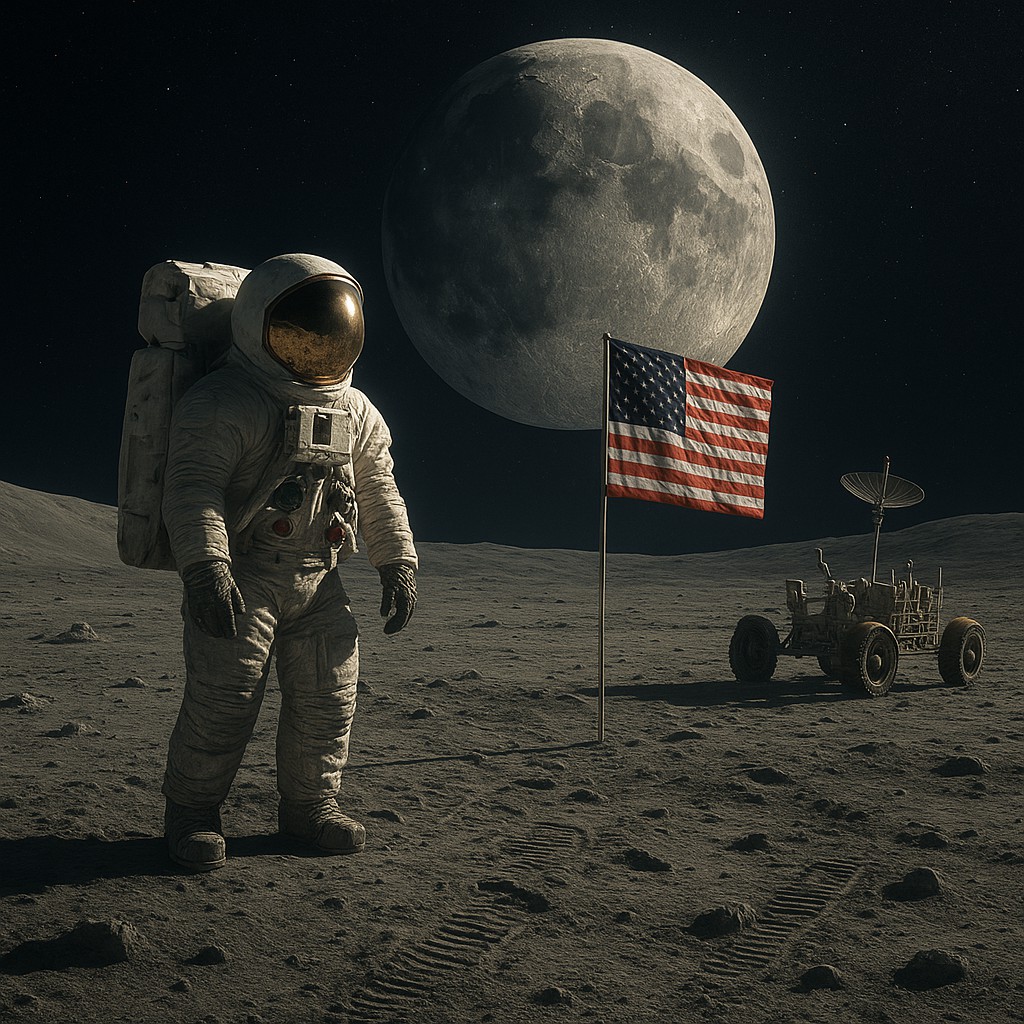
For a few breathtaking years, the Moon stopped being just a distant symbol in the night sky. It was a place with footprints, a flag, and rover tracks that remain today because there is no wind or rain to erase them. Then, almost as suddenly as it began, humans stopped going. No one has walked on the Moon since 1972, even though you can now buy a smartphone that would easily outperform the computers that guided Apollo.
So it’s natural to ask: how many people actually went, when did it happen, why did it stop, and could it have been faked? Those are useful questions because they force you to look beyond rockets and math. Exploration also depends on politics, budgets, risk tolerance, and what a society decides is worth doing.
Below I’ll walk through the facts, the timeline, why we paused, and the common hoax claims. Use the same approach you would for any mystery: follow the evidence, check incentives, and see which explanation needs the fewest miracles.
Who walked on the Moon, and when it happened
A total of 12 people have walked on the Moon, all NASA astronauts from the Apollo program. In all, 24 people traveled to the Moon—meaning they left Earth orbit and reached lunar distance. Half of those landed and walked; the others stayed in lunar orbit in the command module.
All Moon landings happened in a tight window: 1969 to 1972. That is not because the Moon got less interesting in 1973. Apollo was an expensive, deadline-driven sprint with a specific political and technological goal: "land a man on the Moon and return him safely to the Earth" before the decade ended.
Here is the core landing timeline to help you remember who and when.
| Apollo mission |
Landing year |
Moonwalkers (surface astronauts) |
Fun, memorable note |
| Apollo 11 |
1969 |
Neil Armstrong, Buzz Aldrin |
First landing, iconic first steps |
| Apollo 12 |
1969 |
Pete Conrad, Alan Bean |
Pinpoint landing near Surveyor 3 probe |
| Apollo 14 |
1971 |
Alan Shepard, Edgar Mitchell |
Shepard famously hit golf balls (yes, really) |
| Apollo 15 |
1971 |
David Scott, James Irwin |
First mission with the Lunar Roving Vehicle |
| Apollo 16 |
1972 |
John Young, Charles Duke |
Explored lunar highlands |
| Apollo 17 |
1972 |
Gene Cernan, Harrison Schmitt |
Last humans on the Moon, Schmitt was a geologist |
A small detail that helps: Apollo 13 never landed—an oxygen tank explosion turned it into a dramatic survival mission—and Apollo 18, 19, and 20 were canceled. The 12 Moonwalkers come from six successful landing missions, two astronauts each.
How Apollo pulled off something that still feels impossible
Apollo looks like magic until you break it down. NASA did not try to land one huge ship on the Moon. That would have been like trying to park a skyscraper in your driveway. Instead, Apollo kept a main spacecraft in lunar orbit while a smaller lander descended and returned.
Three main vehicles worked together:
- Saturn V rocket: the giant booster that lifted everything out of Earth’s gravity. It remains the most powerful rocket ever flown successfully.
- Command and Service Module (CSM): the orbiting "mothership" where one astronaut stayed while two went down to the surface.
- Lunar Module (LM): the spidery lander built just for the Moon; it did not need to be aerodynamic because the Moon has no air.
The onboard computers were primitive by today’s standards, but the engineering was brutally practical. The Apollo Guidance Computer had very little memory, yet it was built for reliability and real-time navigation. The missions also relied on checklists, training, procedures, and crews who could stay calm when alarms rang.
Apollo stacked hard problems on top of each other: launch, docking, navigation, landing, life support, ascent, rendezvous, and reentry. Any one of those is a career’s worth of challenge. Apollo did them in sequence, and repeated.
Why we stopped going after 1972 (even though tech is better now)
This is the big emotional puzzle: if we could do it then, why not keep going? The short answer is that Apollo was not a permanent transport system. It was built to win a race. Once the race was won, the political and financial fuel ran out.
The Moon race was powered by geopolitics, not just curiosity
Apollo took place during the Cold War. The Soviet Union had early space wins: Sputnik, the first human in orbit, the first spacewalk. The Moon landing was a clear, dramatic target the US could aim at to show technological strength.
After Apollo 11 in 1969, the central "prove we can" objective was achieved. Public interest moved on, and politicians did what politicians do: fund what voters are excited about now.
Apollo was very expensive, and the budget shrank
NASA’s budget peaked in the mid-1960s at around 4 percent of the US federal budget. Today it is closer to about half a percent. Modern technology may be more capable, but you still need steady funding, industrial capacity, and the political will to accept risk.
Apollo also cost a lot per landing. It required huge teams, specialized factories, custom hardware, and a Saturn V that had no other use after Apollo. Once production lines shut down and experts dispersed, restarting is not the same as taking a dusty rocket off a shelf.
Risk tolerance changed, and priorities shifted
Three astronauts—Gus Grissom, Ed White, and Roger Chaffee—died in the Apollo 1 fire during a ground test, and Apollo 13 nearly became a disaster. Those events showed how unforgiving human spaceflight is. In the decades after, NASA pursued goals seen as more sustainable: robotic exploration, Earth observation, and long-term operations in low Earth orbit (Skylab, the Space Shuttle, then the International Space Station).
The Space Shuttle was sold as a reusable system that would make spaceflight routine. It did important work, but it did not become as cheap or as frequent as hoped. It was designed for low Earth orbit, not lunar landings.
“Better technology” helps, but it does not make Moon trips easy
Yes, modern computing, materials, and simulation tools are far better. But to land humans on the Moon you still need:
- A heavy-lift rocket or equivalent capability
- A lunar lander
- Life support and radiation protection
- Training, mission control, and deep-space communications
- A supply chain that can produce and test everything safely
In short, we did not just lose "the tech." We lost the specific industrial machine and constant practice that made Apollo possible. Skills like precision manufacturing, large-scale cryogenic rocket production, and deep-space crewed operations are not like riding a bike. They are more like running a restaurant: if you close it for years, you cannot reopen overnight and serve a perfect dinner rush.
What changed recently: the Moon is “interesting” again for new reasons
The long gap makes more sense when you see that exploration comes in waves. We are now in a new wave, driven by motives different from the Cold War sprint.
The Moon is a stepping stone, not just a trophy
Modern plans treat the Moon as practice for Mars and as a place to learn how to live and work off Earth for long periods. The Moon is also scientifically valuable, especially the south pole, where permanently shadowed craters may hold water ice.
Water ice is not just for drinking. You can break it down into hydrogen and oxygen, which are rocket propellants. That matters because lifting fuel from Earth is expensive. Using local resources could change the economics of deep space missions.
More players are involved now
In Apollo, NASA was the center of everything. Today, national space agencies and private companies share the scene, with different budgets, timelines, and attitudes toward risk. That is messier, but it can also be more resilient.
NASA’s Artemis program aims to return humans to the Moon this decade. Plans and schedules can shift, but the intent is real, and the focus is on sustainable operations rather than one-off flags-and-footprints missions.
Could it have been faked? How to think like a detective
The Moon-landing hoax idea is one of the most persistent modern myths. It survives because it is dramatic, it flatters the believer, and most people have never checked the evidence themselves.
But evaluated as a real-world claim, it collapses. A hoax of that scale would require a conspiracy of astonishing size, perfect secrecy, and zero physical contradictions. Real conspiracies tend to be small, leaky, and full of paper trails.
Common hoax claims, and what the evidence says
Claim 1: "The flag waves, so it must be wind."
There is no air on the Moon, so no wind. The flag had a horizontal rod to hold it out, and when the astronauts planted the pole the fabric oscillated. In a vacuum there is no air resistance to damp that motion, so the flag can keep fluttering briefly. What looks like waving is just vibration.
Claim 2: "There are no stars in the photos."
The lunar surface and the astronauts are brightly lit by the Sun. Camera exposures were set for that bright scene, so faint stars do not show up. It is the same as taking a daytime photo on Earth; you do not capture stars in those settings.
Claim 3: "The shadows look weird, so there were studio lights."
The Moon’s terrain is uneven, and perspective on a bumpy surface makes shadows appear to diverge or change length. The bright lunar soil also reflects light, filling in shadows in odd ways. You can reproduce such shadow effects on Earth with a single light source and rough ground.
Claim 4: "NASA lost the technology, so it must not have happened."
NASA did lose some original hardware, tooling, and telemetry tapes, which is embarrassing but not proof of fraud. Not being able to rebuild a Saturn V exactly the same way does not mean it never existed. Many industrial feats are hard to recreate without the same supply chains and teams.
The strongest evidence that it was real (and hard to fake)
Focus on evidence that is independent and physical:
- Moon rocks: Apollo crews brought back about 382 kilograms (over 800 pounds) of lunar samples. These rocks show characteristics of an airless body and changes from solar wind exposure that are hard to fake. Scientists worldwide, including non-US researchers, have studied them.
- Retroreflectors on the Moon: Apollo placed mirror arrays on the surface that reflect laser light back to Earth. Scientists still bounce lasers off them to measure the Earth-Moon distance with extreme precision. The reflectors work and are on the Moon.
- Independent tracking: Multiple countries and observatories tracked the missions during the Cold War. If the US had faked it, rivals had every incentive to expose the fraud.
- Orbiter photos of landing sites: Later spacecraft, including NASA’s Lunar Reconnaissance Orbiter, photographed the Apollo sites. You can see equipment, rover tracks, and disturbed soil consistent with landings.
To fake Apollo convincingly you would need movie-quality footage in an era before modern CGI, plus a global network of consistent radio transmissions, radar and tracking data, physical samples that pass international tests, and hardware left on the Moon that later missions can photograph. That is not impossible in a sci-fi sense, but it is wildly less likely than the straightforward explanation: it happened.
The deeper lesson Apollo teaches (besides "rockets are cool")
Apollo shows that big achievements are rarely limited by raw technology alone. They are limited by alignment: funding, urgency, leadership, public attention, and a clear plan. In the 1960s those things lined up, and we landed on the Moon. Then the alignment shifted, and human spaceflight focused closer to home for decades.
The encouraging twist is that the story is not "we stopped because we can’t." It is "we paused because we chose other priorities." Choices can change, and they are changing now with new missions, new tools, and new reasons to go beyond planting a flag.
If you take one idea away, make it this: the Moon landings were not a one-time miracle. They were a human project built from engineering and courage, yes, but also from budgets, politics, and persistence. Understanding that makes the past feel more real and the future feel more possible.