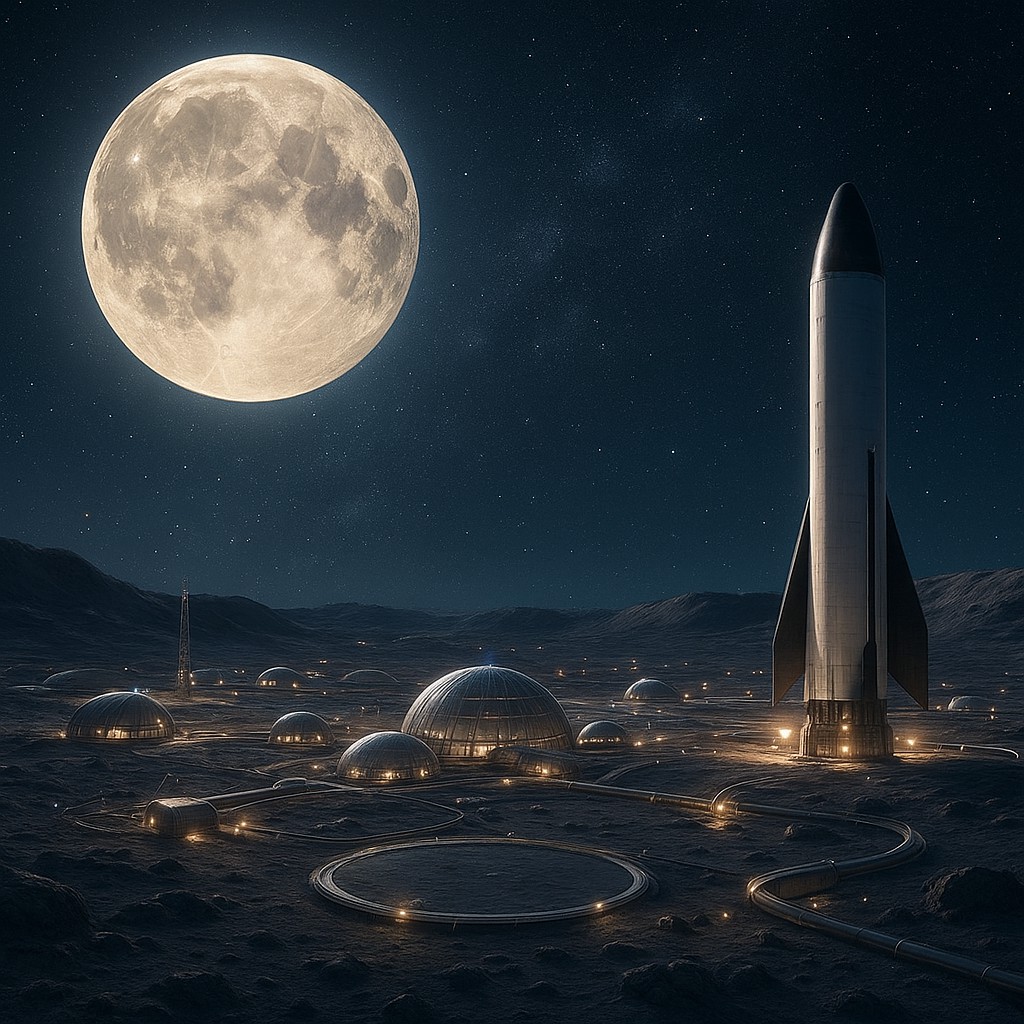
Look up at the night sky on a clear evening, and you will see a giant, glowing pearl that has fascinated humanity since we first learned to walk upright. For decades, the Moon was viewed as a finished chapter in history, a dusty souvenir of the Cold War where we left some footprints and a few golf balls before moving on to dream of the red deserts of Mars. However, the story has changed dramatically in recent years. SpaceX, the company that made landing orbital rockets look like a routine Sunday drive, has set its sights back on our closest neighbor. They aren't just planning a quick visit; they want to build a permanent, self-sustaining "Moon City."
This shift represents more than just a change in travel plans. It is a smart evolution in how we will become a species that lives on multiple planets. While Mars has always been the ultimate "Plan B" for humanity in Elon Musk’s eyes, the Moon has emerged as the most logical and necessary first step. We are no longer talking about a tiny research shack held together by duct tape and hope. We are talking about an industrial hub, a fueling station, and a thriving metropolis that could be built in less than a decade. To understand why SpaceX is moving so aggressively toward the lunar surface, we have to look at the hard physics of space travel. It is a matter of building a backyard practice range before attempting a marathon across the solar system.
The Logistics of a Two-Day Commute
The main reason to love the Moon as a construction site is its location. When planning a trip to Mars, you are at the mercy of how the planets move. Because the orbits of Earth and Mars align only once every 26 months, you have a very narrow "launch window." If you miss that window, or if you land on Mars and realize you forgot to pack enough spare oxygen filters, you are stuck waiting over two years for the next ride home. A trip to Mars takes roughly six to nine months one way, making any supply chain issues potentially fatal and progress painfully slow.
The Moon, by comparison, is right next door. A trip to the lunar surface takes about two days, which is roughly the same time it takes for a standard package to cross the country. More importantly, you can launch to the Moon almost constantly, roughly every ten days. This means that if something breaks, a replacement part can be there within the week. If a crew member gets sick, they can be back in a high-tech Earth hospital before the weekend. This "short leash" allows SpaceX to test, fail, learn, and rebuild at a pace that Mars simply cannot match.
By focusing on a Moon city first, SpaceX can test its life support systems, radiation shielding, and landing tech in an environment that is harsh but forgiving. It is much easier to fix a brand-new civilization when tech support is only 240,000 miles away rather than 140 million. This high-frequency schedule means SpaceX can send dozens of Starships to the Moon in the time it would take to send just one fleet to Mars, speeding up the growth of lunar housing and equipment at a massive rate.
Turning the Moon Into a Cosmic Gas Station
One of the biggest hurdles in space travel is the "rocket equation," which basically says you need fuel just to carry your fuel. To get a massive ship like Starship off Earth, you need a huge amount of propellant to fight our planet's thick atmosphere and strong gravity. By the time a rocket reaches orbit, most of its fuel is gone. If we want to explore the outer solar system, we usually have to launch incredibly heavy loads from Earth, which is expensive and wasteful. This is where the concept of a "self-growing" lunar city changes the entire economy of space.
The Moon is thought to have large deposits of water ice, especially in the dark craters at its poles. Water is not just for drinking; it is essentially rocket fuel in disguise. Through electricity, we can split water (H2O) into hydrogen and oxygen. For SpaceX’s Raptor engines, these components can help create liquid methane and liquid oxygen. If SpaceX can set up a mining colony to harvest lunar ice, the Moon becomes a refueling station in the sky. It is much cheaper to lift a ship off the Moon, which has only one-sixth of Earth’s gravity and no atmosphere, than it is to launch from Earth.
This "gas station" would turn the Moon into a gateway for the rest of the solar system. Instead of Earth being the only starting point, the Moon becomes the staging ground. Ships can launch from Earth relatively light, dock at a lunar station to fill their tanks with locally made fuel, and then head toward Mars or the asteroid belt much more efficiently. This industry would create a "self-growing" loop where the city expands its mining, which fuels more ships, which brings more people, leading to even more growth.
Comparing the Two Worlds
To understand why the shift toward the Moon is so smart, we can compare the environment and logistics SpaceX must manage. While Mars is the ultimate goal for long-term survival, the Moon offers several immediate perks for a new civilization.
| Feature |
The Moon (Lunar City) |
Mars (Martian Colony) |
| Travel Time |
~2 days |
6 to 9 months |
| Launch Frequency |
Every ~10 days |
Every 26 months |
| Communication Delay |
~1.3 seconds (Near instant) |
3 to 22 minutes (Wait for it...) |
| Gravity |
16% of Earth's (Very Low) |
38% of Earth's (Low) |
| Atmosphere |
None (Vacuum) |
Very Thin (Carbon Dioxide) |
| Resources |
Ice in craters |
Ice and minerals in soil |
| Emergency Return |
Possible in days |
Usually impossible for 2+ years |
As the table shows, the Moon is a much more practical place to test experimental homes. The communication delay is an especially big deal. On the Moon, an operator on Earth could drive a robotic rover with almost no lag, making building and mining much faster. On Mars, if a rover gets stuck in a ditch, it might take twenty minutes for the signal to reach Earth and another twenty minutes for the "back up" command to get back. Developing the automation we need for Mars will be much easier if we perfect it on the Moon first.
Building the Shield and Growing the Habitat
Living on the Moon is not exactly a picnic. Without an atmosphere or a magnetic field, the surface is hit by solar radiation and tiny space rocks called micrometeorites. This is why SpaceX’s vision involves "self-growing" infrastructure that uses lunar soil, also known as regolith. Engineers are looking for ways to use 3D printing to turn this dust into solid building materials. By covering homes in several meters of soil, colonists can stay protected from radiation and the extreme temperature swings of the lunar day and night.
The term "self-growing" is the key. SpaceX does not want to ship every single brick from Earth. The goal is to send the "seeds" of a city, such as robots, 3D printers, and chemical processors, that can use local materials to expand the base. This works like a living organism that uses the energy and materials around it to grow. Once the power plants and air systems are running, the city can expand into large underground or shielded domes where humans can live, work, and grow food in water-based gardens.
This lunar city also serves as a massive lab for the human body. We still do not fully understand the long-term effects of very low gravity. Will our bones get brittle? Will our hearts change shape? By having a city on the Moon, we can study these effects for years while staying close to medical help. This research is vital because if humans move to Mars, we need to know how to keep them healthy. The Moon is essentially the world’s most important medical trial for the future of our species.
Fact-Checking the Mars vs. Moon Debate
Some space fans worry that focusing on the Moon means SpaceX is giving up on Mars. This is not true. Musk and his team have explained that the Moon city is a "booster" for Mars, not a replacement. The Mars city is still on the schedule, perhaps only a few years behind the Moon. The lessons learned on the Moon will make Mars missions much safer. Think of it like a video game where you need to clear Level 1 (the Moon) to get the gear you need for the Boss Fight on Level 2 (Mars).
Another common myth is that the Moon is useless because it has no air. While Mars is more "Earth-like," the Moon's vacuum is actually a plus for some industries. Making high-quality fiber optics, special metal blends, and medicines is often easier in a vacuum or low gravity. A lunar city could become a factory hub, exporting "Made on the Moon" tech back to Earth to fund itself.
By aiming for a lunar city in less than ten years, SpaceX is forcing itself to innovate quickly. This urgency is vital in the space industry, where projects often get stuck in the planning phase for decades. By moving to the Moon, SpaceX creates a series of "wins" that keep people excited and prove that living in space is actually possible. It turns the dream of a spacefaring civilization into a reality we might see on the news while we drink our morning coffee.
A New Frontier for the Human Spirit
The drive to build a city on the Moon is about more than just fuel or radiation; it is about the basic human desire to explore. For the first time in history, we have the technology, the money, and the will to move beyond our single planet. SpaceX’s move to the Moon is a mature, strategic plan for this great adventure. It recognizes that while we look at the stars, our feet must first find a solid place to stand. This lunar city will be a symbol of our creativity, a lighthouse for future travelers, and a community that proves we are no longer trapped by the gravity of our home world.
As we watch Starship test flights continue to push boundaries, the idea of a city on the Moon feels less like science fiction and more like a scheduled event. Building there will be difficult, dangerous, and expensive, but the reward is the survival of humanity. We are standing at the edge of a new era where the "man on the moon" won't just be a face in the craters, but a neighbor, a scientist, and a pioneer. The Moon is no longer just a destination; it is the foundation of our future in the stars.