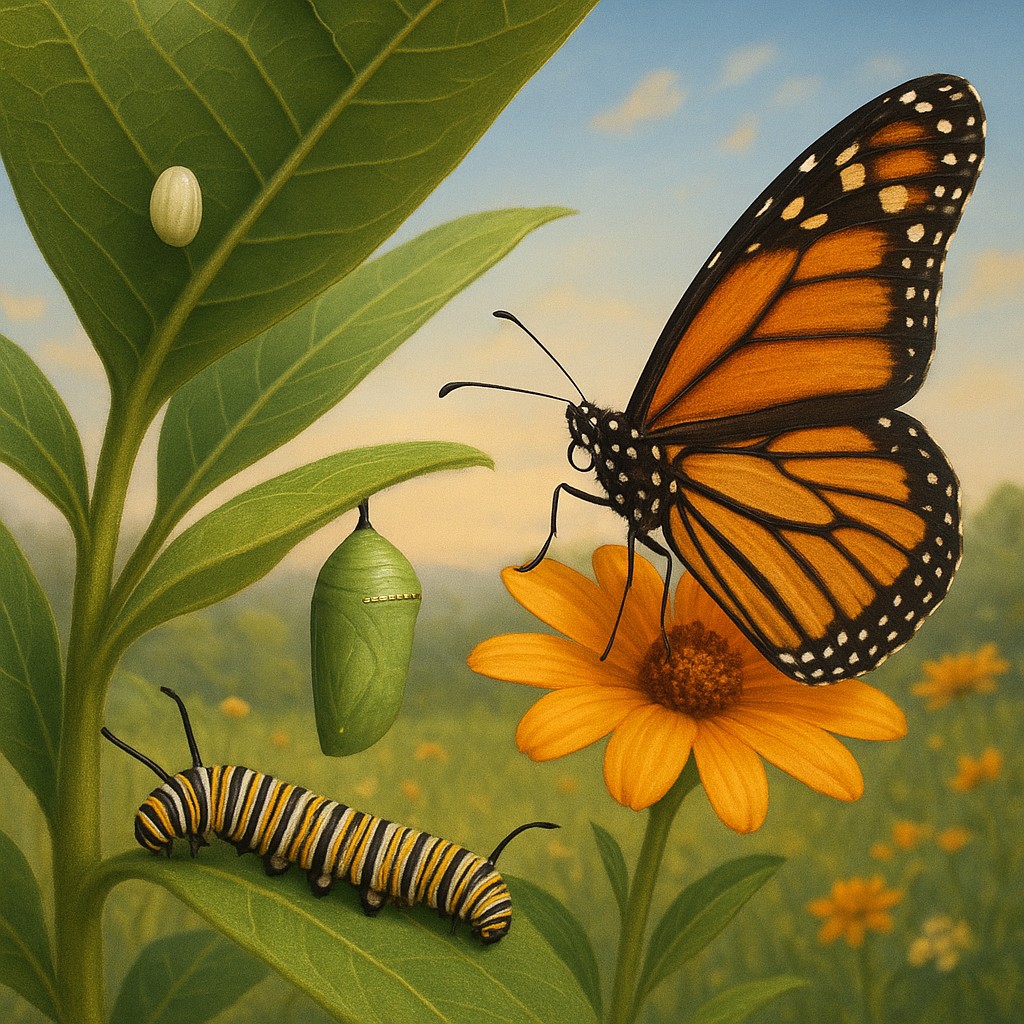
The monarch butterfly begins life looking nothing like the orange-and-black postcard you might imagine. It starts as a tiny egg no bigger than a pinhead, stuck to the underside of a leaf like a secret someone forgot to tell you. A few weeks later, that same creature may be gliding over gardens, tasting flowers with its feet, and dodging hungry birds with the confidence of a tiny acrobat.
Even more impressive, some monarchs pull off a travel feat that would make most road-trippers complain. They migrate thousands of kilometers, navigating with a brain the size of a grain of rice and wings that seem too fragile for the job. If you have ever wondered how something so small can do something so huge, you are about to meet one of nature’s most elegant overachievers.
Learning the life of a monarch is like reading a good adventure: there is transformation, danger, clever adaptations, and a bit of mystery. Along the way, you will also sharpen your eye for the natural world, because once you understand monarchs, you start seeing the quiet dramas on every patch of milkweed and every sunny sidewalk.
Meeting the monarch: a butterfly with a plan (and a passport)
Monarchs (Danaus plexippus) are large butterflies with orange wings edged in black and white spots that look like someone dotted the margins with a paint pen. Their colors are not just decoration. They warn predators, saying, "Eating me is a bad idea." That warning is backed by chemistry. Monarch caterpillars eat milkweed, a plant that contains bitter compounds called cardenolides that can make predators sick.
You can tell males and females apart if you know where to look. Males usually have a small black spot on each hind wing, a scent gland used in courtship, and slightly thinner black wing veins. Females lack those spots and often have thicker veins. Light and wing wear can make this trickier than it sounds. If you are thinking, "So the difference is basically perfume pockets," that is a fair summary.
Monarchs live across North America and beyond, but not all follow the same lifestyle. Some populations migrate long distances, while others stay relatively local, depending on climate and milkweed availability. The famous migration in North America sends eastern monarchs to overwintering sites in central Mexico and western monarchs to the California coast. Think of it as a seasonal move to a monarch-sized vacation rental, except the rental is a forest and the vacation is survival.
The egg stage: tiny, fragile, and placed with care
A monarch’s life begins when a female lays eggs, usually one at a time, on milkweed leaves or sometimes on stems and flower buds. The eggs are small, pale, and ribbed, like microscopic footballs. Laying single eggs rather than a cluster is not absent-mindedness, it is strategy. Spreading eggs reduces the chance that one hungry predator or parasite wipes out the whole next generation in a single snack.
Females do not choose milkweed randomly. Milkweed is essential because monarch caterpillars are literal specialists: without milkweed, they cannot develop normally. The plant is both food and chemical defense. When the egg hatches, the caterpillar often eats its own eggshell first, which is a tidy little starter meal full of nutrients. If you ever needed proof nature hates wasting resources, there it is.
This stage is short, usually only a few days depending on temperature. Warm weather speeds development, while cool weather slows it. The egg is vulnerable to drying out, being knocked off by rain or wind, or being eaten by tiny predators. If the egg makes it to hatching, the monarch has cleared its first hurdle, and the story becomes dramatically more snack-based.
Caterpillar life: a hungry tube with excellent fashion sense
Monarch caterpillars are famous for bold stripes: black, white, and yellow bands that look like a miniature sports jersey. Those stripes are not just cute. They also signal toxicity to predators, especially after the caterpillar has eaten enough milkweed to store defensive chemicals in its body. At first, a newly hatched caterpillar is small and not well defended, which is why it tends to feed discreetly on leaf tissue.
Caterpillars grow fast, and their skin does not stretch. Instead, they molt, shedding their outer skin multiple times. Each stage between molts is called an instar, and monarchs typically go through five instars. During this phase they are basically eating machines, turning milkweed into monarch mass. If you watch one closely, you can see it chew in steady, efficient bites, sometimes leaving leaf veins behind like lace.
They also have body features that confuse people. Those long black "antennae" at the front and rear are not antennae. They are soft, tentacle-like filaments. They are not stingers, and they are not horns for fighting. They probably help sense the environment and make the caterpillar look harder to swallow. Monarch caterpillars do not bite people, and they are not dangerous if handled gently, although it is wise to wash your hands after touching any wild insect.
Caterpillars face many threats. Birds, spiders, ants, and wasps may all see them as lunch, especially early in life. Parasitoid wasps and flies can lay eggs on or in caterpillars, and their larvae consume the caterpillar from the inside. This is as gruesome as it sounds. This is one reason monarchs lay many eggs: in the wild, only a small fraction survive to become butterflies.
The chrysalis: not a nap, but a rebuild-from-scratch project
When the caterpillar is fully grown, it stops eating and wanders away from its feeding spot. This is not teenage rebellion, it is preparation for metamorphosis. It finds a safe place, often under a leaf or on a sheltered stem, and forms a silk pad. Then it hangs upside down in a "J" shape, looking like a living comma.
Next comes one of nature’s best plot twists: the caterpillar’s skin splits, and underneath is a jade-green chrysalis with tiny gold dots that look like jewelry. Inside, the caterpillar is not simply rearranging parts. Many larval tissues break down and adult structures form. Special groups of cells called imaginal discs, present since the caterpillar was tiny, develop into adult features like wings, legs, and antennae.
A common myth is that the caterpillar "rests" in the chrysalis like it is sleeping through winter break. In reality, it is an intense biological renovation site. The developing butterfly has to build muscles, reshape its digestive system, and assemble wings that will later lift it into the air. If the chrysalis is disturbed or exposed to extreme heat or cold, development can fail. When conditions are right, after about 1-2 weeks, the chrysalis darkens and you can see orange-and-black wing patterns through the casing. That is your cue that the final reveal is near.
Emerging as an adult: wings, timing, and the first flight
When the adult monarch emerges, it is called eclosion. At first it looks awkward, like it arrived at a party in wrinkled clothes. Its wings are soft and crumpled, and it must pump fluid into the wing veins to expand them. Then it hangs and waits while the wings dry and harden. This is a vulnerable period, because the butterfly cannot fly well yet and is an easy target for predators.
Once ready, the monarch takes its first flight and begins the adult phase, focused on feeding, avoiding danger, and reproducing. Adult monarchs drink nectar from flowers using a long, straw-like tongue called a proboscis. They are not sipping for fun, they are fueling a flying lifestyle. Nectar provides sugars for energy, while other nutrients support overall health.
Adults use multiple senses to navigate. They see colors and ultraviolet patterns, which helps them find flowers. They also detect chemical cues that help with finding mates and locating host plants. If you see a monarch fluttering around milkweed, it might be a female inspecting leaves for egg-laying spots, tapping with her feet to "taste" the plant. Yes, monarchs taste with their feet, which makes every leaf a potential menu item.
One life cycle, two very different lifestyles: summer breeders and "super generation" travelers
Most monarch generations live fast. In warm months, a monarch may go from egg to adult in roughly a month, and the adult might live only a few weeks. These monarchs focus on breeding, laying eggs, and keeping the population moving through the season.
But the generation that migrates is different. As days get shorter and temperatures cool, monarchs enter reproductive diapause, which means their bodies pause reproduction so they can invest energy in surviving and traveling. This migratory generation can live much longer, sometimes up to 8 or 9 months, which is remarkable for a butterfly. They are the marathon runners of the species, built for endurance rather than quick reproduction.
Here is the key twist: the monarchs that fly south in the fall are usually not the same individuals that return north in spring, at least for the eastern North American migration. The journey is often completed across multiple generations. So when people say "the monarchs return home," what they really mean is "their descendants return to the same regions," guided by instinct and environmental cues. It is more like a relay race than a round-trip ticket.
A quick snapshot of monarch life stages
| Life stage |
What it looks like |
Main job |
Typical duration (varies with temperature) |
Biggest risks |
| Egg |
Tiny, pale, ribbed oval on milkweed |
Survive until hatching |
~3-5 days |
Predators, drying out, weather |
| Caterpillar (larva) |
Striped, growing fast, molts 5 times |
Eat milkweed, grow |
~10-14 days |
Predators, parasites, lack of milkweed |
| Chrysalis (pupa) |
Green "jewel" with gold dots |
Metamorphosis into adult |
~8-15 days |
Weather extremes, disturbance, disease |
| Adult butterfly |
Orange-black wings, nectar feeder |
Reproduce, migrate (some) |
~2-6 weeks (summer), up to ~8-9 months (migratory) |
Predators, habitat loss, toxins, storms |
Survival tricks: toxins, mimicry, and smart behavior
Monarchs are famous for being toxic to many predators, but it is not automatic. Caterpillars must eat milkweed to get those defensive chemicals, and toxicity varies depending on milkweed species and how much the caterpillar eats. Birds like orioles and grosbeaks sometimes learn to avoid the most toxic parts, or they may sample and then reject monarchs. Nature is full of such negotiations.
Monarchs also have a celebrity copycat: the viceroy butterfly, which looks similar. For a long time, people said the viceroy was a harmless mimic of the toxic monarch. The truth is more interesting: viceroys can also be distasteful, and the relationship is often mutual mimicry. In other words, both species may benefit because predators learn, "Orange and black with that pattern is a bad dining choice."
Behavior matters too. Caterpillars sometimes cut grooves in milkweed leaves to reduce the flow of sticky latex sap, which can trap or gum up small larvae. Adults choose roosting spots that reduce wind exposure and conserve warmth. Migrating monarchs cluster together in large groups at night, which can help with protection and temperature regulation. They are not just pretty, they are practical.
Clearing up common myths (because butterflies deserve accurate PR)
One persistent myth is that monarchs "hibernate" during migration. They do not hibernate in the strict sense. Overwintering monarchs are less active and conserve energy, but on warm days they may fly, drink water, or shift position within a cluster. They are in a survival mode, not a deep sleep.
Another misconception is that monarchs only lay eggs on "the" milkweed, as if there is one official plant. There are many milkweed species, and monarchs use different ones depending on region. Some are better hosts than others, and local ecology matters. Planting native milkweed species is generally best because it supports monarchs without disrupting local plant communities.
Finally, people sometimes assume monarchs are thriving because they are common in photos and gardens. Sadly, population numbers have fallen in many years due to habitat loss, reduced milkweed availability, pesticide exposure, and climate change. Seeing monarchs is wonderful, but it is not a guarantee the bigger story is healthy.
How to observe monarchs like a mini scientist (without bothering them)
Watching monarchs is one of the most satisfying ways to learn biology in real time, because you can see nearly every stage if you have milkweed nearby. The trick is to be curious and gentle. If you find eggs or caterpillars, avoid moving them unless you truly need to protect them from immediate harm. Monarchs have enough challenges without us turning their nursery into a renovation project.
If you want a simple approach, try this:
- Look under milkweed leaves for eggs and tiny caterpillars, especially in warm months.
- Notice feeding patterns; older caterpillars often leave "skeletonized" leaf remains.
- Watch for the wandering behavior that signals a caterpillar is ready to pupate.
- Observe adult nectar feeding and how they move from flower to flower, often preferring sunny, wind-sheltered spots.
Keep notes if you like. Record dates, weather, and what you saw. You will start noticing patterns, like how development speeds up during warm spells and slows down when it cools. That is not just butterfly trivia, it is ecology, climate, and life history all rolled into one fluttering lesson.
A final thought: small wings, big meaning
The life of a monarch butterfly is a masterclass in transformation and persistence. It shows how an animal can be both delicate and tough, both local and global, both ordinary - an egg on a leaf - and astonishing - a migration that spans a continent. Once you know the steps, you can look at a patch of milkweed and see not just a plant, but a whole storyline: beginnings, risks, clever adaptations, and the possibility of flight.
If you want to keep learning, go outside and look closely. Find the milkweed, watch the flowers, and let your curiosity do what monarchs do best: move steadily forward, guided by simple cues toward something extraordinary.