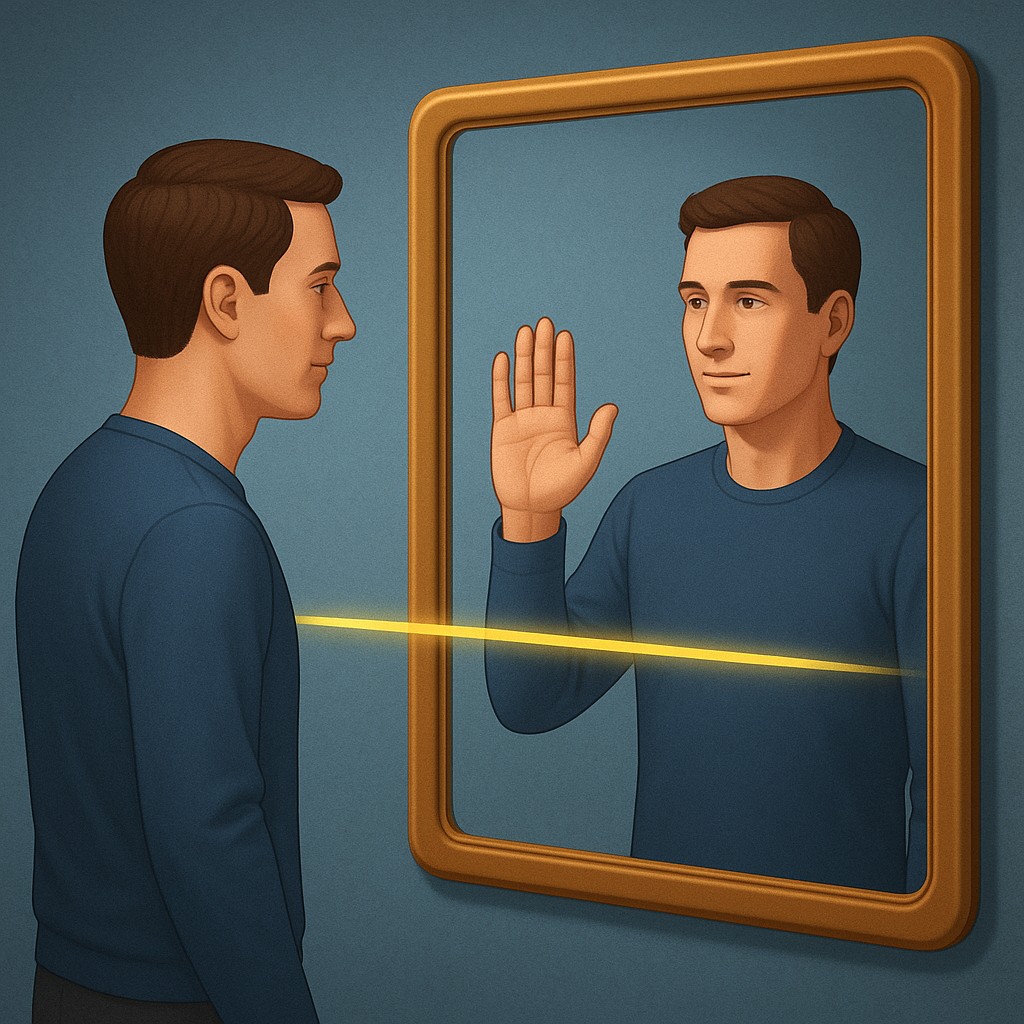
If you stand in front of a mirror and raise your right hand, your reflection appears to raise its left. This seems like a simple, undeniable fact of life, as reliable as gravity or the smell of rain. We have been told since childhood that mirrors "flip" things as if by magic, reversing the world along a horizontal line. We look at ourselves and see a backwards version of our own face, or we try to read a book in the reflection only to find the text dancing in unreadable, inverted squiggles. This happens so often that we rarely stop to ask the most logical question: why would a mirror decide to flip things sideways but stubbornly refuse to flip them upside down?
If mirrors truly had the power to reverse an axis, your reflection should rightfully be standing on its head. After all, if "left" becomes "right," why shouldn't "up" become "down"? Physics does not play favorites with directions, yet we never look into the glass to see our feet dangling near the ceiling. This gap in logic reveals a fascinating secret about the way our brains work. The "flip" we see is not actually a physical property of the mirror at all. Instead, it is a psychological shortcut, a mental trick our brains perform to make sense of a geometry that is fundamentally alien to our everyday experience. To understand what is actually happening, we have to stop thinking about ourselves and start thinking like a photon, a single particle of light.
The Straight Path of the Photon
To debunk the myth of the left-right flip, we first need to look at how light moves. When light hits a mirror, it behaves with absolute, predictable logic. Imagine you are standing three feet away from a flat mirror. When a photon bounces off your nose and hits the glass, it reflects straight back toward you. It does not take a detour to the left or the right. It travels a straight line, hits the surface, and returns. If you point your right hand to the north, the hand in the reflection also points to the north. If you point your left hand to the south, the reflection points south. There is no side-to-side shifting occurring in the mirror's physical world.
The mirror is essentially a giant "Return to Sender" machine. It takes every point of light it receives and bounces it back at the exact same angle it arrived. Because the mirror is a flat surface, it acts as a perfect map of the light hitting it. If you were to trace the path of the light from your right hand to the mirror and back, you would see that the right side of the mirror is interacting only with the right side of your body. The mirror is not crossing any wires. It is simply acting as a transparent wall that pushes the image back toward you. The confusion begins because we try to interpret that light using social logic rather than the logic of shapes and lines.
The Depth Mystery and the Z-Axis
The only real transformation a mirror performs is a reversal along the "Z-axis," or the axis of depth. Think of your world as having three dimensions: height (up and down), width (left and right), and depth (front and back). When you stand before a mirror, the mirror leaves your height and your width completely untouched. Your head stays at the top, and your right hand stays on the right side of the room. However, it takes the "front" of you, such as your face, and projects it into the distance. It reverses the direction you are facing.
This is often called a front-to-back inversion. Imagine you are wearing a rubber mask of your own face. If you were to grab the mask and pull it through the back of your head so that it was inside out, you would have a more accurate representation of what a mirror does. The part of you that was closest to the mirror (your nose) is shown as the part of the reflection closest to the mirror. The part of you furthest away (the back of your head) is shown as the furthest part of the reflection. The mirror is essentially a depth-reverser. It turns you inside out along your line of sight, which is a physical change we rarely encounter in the natural world.
Why the Brain Insists on a Sideways Flip
If the mirror is only flipping us front-to-back, why is our inner monologue so convinced that the flip is left-to-right? The answer lies in our social evolution. Humans are incredibly good at seeing things from another person's perspective. When we see a human shape facing us, our brains find it nearly impossible to treat it as just a collection of light rays. Instead, we treat it as a person. To understand a person facing us, we mentally project ourselves into their position. We imagine walking around to the other side of the glass, turning 180 degrees, and standing where the reflection is.
When you perform that mental 180-degree turn, you are effectively rotating your body around your vertical axis. In that physical rotation, your right hand moves to the left side of the room. Therefore, when you look at your reflection, your brain says, "If I were over there facing me, that would be my left hand." We perceive a left-right flip because we are addicted to the idea that the reflection is a person who has turned around to greet us. We project our own physical limitations, the fact that we can only face someone by turning our bodies, onto the mirror. The mirror isn't flipping anything; you are flipping yourself in your mind.
| Type of Orientation |
What Happens to the Image? |
Mental Perception |
| Up-Down Axis |
No change. Your head stays up. |
Correctly perceived as stable. |
| Left-Right Axis |
No change. Your right hand stays right. |
Falsely perceived as "flipped." |
| Front-Back Axis |
Complete reversal. Your front becomes the reflection's front. |
The only real physical inversion. |
| 180-Degree Rotation |
You physically turn around. |
How we "think" the mirror works. |
Testing the Illusion with Transparency
A great way to break this mental habit is to use a transparent object. Imagine you have a clear piece of plastic with the word "HELLO" written on it in black marker. If you hold that sign up in front of you and look at it, you see the word normally. Now, if you hold it up to a mirror, the word "HELLO" in the reflection will look backwards. Most people would say, "See? The mirror flipped the text!" But look closer at what you did. To show the sign to the mirror, you had to turn the plastic around. You performed the horizontal flip yourself before the mirror ever saw the letters.
If you were to write "HELLO" on a transparent sheet and hold it so that you could read it while looking through it at the mirror, the reflection would also show "HELLO" perfectly clearly and in the correct order. The mirror simply reflects exactly what is facing it. When we use solid objects, like a book or a shirt with a logo, we are forced to turn them around to face the mirror. We are the ones introducing the reversal through our own movements. The mirror is just a faithful reporter of the position we have provided. It is a passive participant in our own physical rotations.
The Logic of the Pointing Experiment
If you still find it hard to believe that mirrors don't flip left and right, try the "pointing experiment." Stand in front of your bathroom mirror and point a finger to your right. Notice where your reflection's finger is pointing. It is pointing in the exact same direction, toward the same wall or towel rack. There is no horizontal reversal. Now, point your finger straight up toward the ceiling. The reflection points to the ceiling. No vertical reversal. Finally, point your finger straight forward, directly at the mirror.
Now, something different happens. Your finger is pointing toward the mirror, but the reflection's finger is pointing directly back at you. Your finger is pointing North, but the reflection is pointing South. This is the Z-axis in action. This is the only dimension where the mirror actually changes the direction of the path. Your finger and the reflection's finger are like two cars meeting in a head-on collision. They are on the same line, but they are pointing in opposite directions. This is the front-to-back inversion that defines all mirrors. However, because we don't have eyes on the back of our heads, we find it difficult to visualize this depth-flip without translating it into a more familiar left-right swap.
Lessons from the Silvered Glass
Understanding how mirrors truly function is more than just a fun physics trivia point; it is a lesson in how human intuition can be fundamentally at odds with the physical world. We live in a world of social shortcuts, where our brains are constantly processing raw data to make it fit into our narrative of how people and objects behave. The mirror doesn't lie, but our brains certainly do, translating a complex depth-reversal into a simple, comfortable story about left and right.
The next time you look in the mirror to brush your hair or check your outfit, try to see the image for what it really is: a direct, un-flipped map of light. Instead of imagining a twin who has turned around to face you, try to see the front-to-back inversion for what it is. You are looking at a version of yourself that has been pushed through a mathematical sieve, reversed in depth but perfect in every other way. This shift in perspective reminds us that the world is often much simpler than our brains make it out to be, and that sometimes, the most obvious "facts" of our lives are just clever illusions waiting to be unmasked by a little bit of curiosity.