Epic / High Fantasy
Midnight at Viva Mall: Names, Music Boxes, and a Compass’s Promise
September 20, 2025
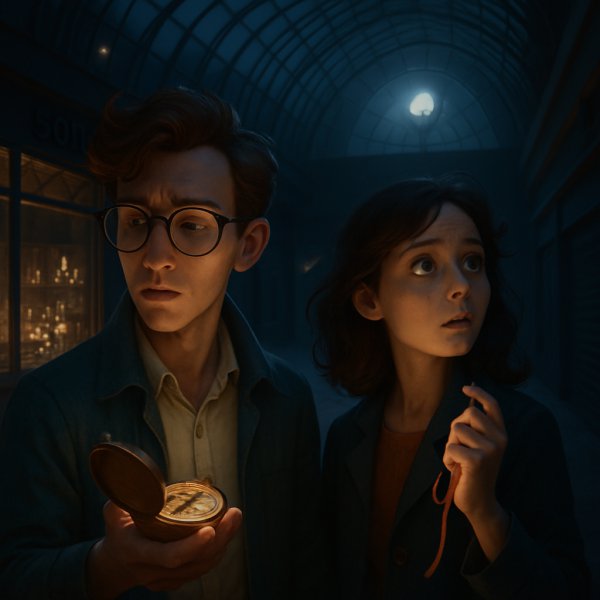
The lights at Viva Mall died like a hesitant sigh. Hubert felt the change in his teeth first - a tiny chill, as if someone had opened a cold window in his chest. The great glass atrium pooled moonlight into a pale coin, and every souvenir shop became a dark theater of glittering things. Dayna, her ribbon wound twice around one finger, kept glancing up at the skylight as if it might open and spill the last tram into the sky. The security gates slammed with a sound like shutters closing on a ship, and somewhere a child's laugh, thin and distant, answered the echo.
"Of course tonight," Dayna said. She rubbed the silk ribbon between thumb and forefinger, a nervous ritual that smoothed her voice. "Three stops. Get the compass fixed, find the music box, then home before the suppliers lock the east wing."
Hubert closed his palm over his own small object, a brass compass with a cracked glass face. He had flicked the lid open and shut all afternoon; habit, or superstition - like turning a coin before you bet. The compass needle wavered, then pointed not to true north but to the nearest stall of old things, a stubborn quarter-inches past the directions on the map. Hubert wanted, simply, to be useful. He wanted to hand someone something that mattered. He feared being the sort of man people thanked politely and then forgot. He tucked the compass against his palm as if it might answer him.
They crossed an empty corridor of lights that still hummed with the scent of roasted chestnuts and lemon cleaner. A display of wind-up soldiers stood in a neat square inside The Antique Emporium; each had faded paint, a brass spring at its back, a chip of enamel for a smile. One soldier blinked. The blink was an insult to silence, a small, impossibly precise movement, and then the soldier saluted. A spring unwound somewhere, like a throat clearing in the dark, and the soldiers stepped down from their plinth with soft, clean clicks.
Hubert and Dayna froze beneath the glow of emergency lamps. The soldier looked at them with a face that remembered parades. Its eyes were tiny, black beads, but in that glassy sphere there was a pulse - a memory of hands and hands-that-loved-things. The soldier did not advance. It tilted its head, as if counting them. Then it marched away in neat, obedient steps.
What did that mean? Which memory had it answered, and to what end? They could not leave - every door they tried found itself chained by something unseen - and the mall felt suddenly much larger, as if the night had added corridors. The brass compass dug into Hubert's palm, heavy and warm. Dayna's ribbon loosened and flitted free, as though excited.
The rising web tightened like a net. Toys moved in the shadow between stores: plush dragons that uncoiled velvet wings, marionettes that swung themselves from their strings, an old carousel horse that paced the food court and left hoofprints on polished tile. They came without malice at first, curious as children with new eyes. Then the rules of the night showed themselves. A wind-up dragon hissed steam that smelled like burnt caramel and hot oil. A plush bear pressed forward and its stitches separated with a wet, threadlike sound. Not everything that had been made for play wished to be played with again. Some remembered control, others the ache of being forgotten.
"You see that?" Dayna whispered. She kept her voice low as if loudness might snap the magic. "They wake to the music. The music in the atrium—this way, Hubert."
She led him past a shuttered jeweler with a bell that tinkled without anyone touching it. They passed a pop-up stall whose mannequins turned their heads with a synchronized grace that made Hubert's neck prickle. The compass needle swung, now pointing to the center dome where the old fountain had once played tunes carved into its bronze lip. At its base was a shop filled with boxes: music boxes, glass-eyed dolls, a battered gramophone with a vinyl the color of dried leaves.
Hubert wanted to pry open the safe exit, to find the security office or the manager, to make a phone work. Every pragmatic path they tried folded into more strangeness. The mall's maps were wrong; arrows curved. Hallways lengthened like looms. Window displays reassembled themselves into fortresses. With each wrong turn the toys grew bolder, the toy knights forming ranks in the shadow of a neon sign. Every step narrowed choices, and the narrowest choice pressed at the heart of them both.
"Why would toys need to wake?" Hubert said. His voice shook. He was trying to point, too, at the simple logic of it, at the ordinary world where things did not step down from shelves. "What's the game?"
Dayna's jaw worked. "Memory," she said finally. "A toy is a place for people to leave pieces of themselves, and when those pieces are lost over years the toy aches. They wake to find what was taken."
She pulled a small wooden music box from a shelf, its paint flaked into a map of old stories. It had belonged to her grandmother, she had always said, and the tune inside was one she kept humming when she had to be brave. Night made the melody sharp as a blade. She wound it with a slow, careful motion, fingers steady. The first notes climbed into the dome and the toys stilled like a tide hearing the moon's name. They gathered by sound, drawn as moths are to the shape of light.
The melody did not quiet them. It sharpened them. Faces that had once been painted with smiles resolved into intent. The tin general at the center of the ring - a larger soldier with a scarred jaw - stepped forward and spoke in a voice that was tin and memory.
"We marched for memory before," it said, "and for command. The Playwright taught us to move when the song called. We were given a task: guard the mall until it is remembered. We will not sleep until we are taken somewhere children will see us again."
Its goal was simple: carry the toys back into the world of hands. Hidden fear coiled below its words - the fear of being shelved, of being abandoned to dust. Motion crept like rust up their legs as the toys formed a procession, their march a problem for the two humans caught inside.
Hubert and Dayna found themselves bargaining with puppets. Dayna offered the music box, promised to hum the tune in daylight, to speak of the toys so someone might care. The tin general smiled a hinge of teeth that were small and merciless. "We do not trust promises from mouths that forget," it said.
The reversal came not with violence but with recognition. Hubert's compass, which had seemed only an artisan's trinket, vibrated against his palm and warmed until the cursor of its needle sang with a faint silver hum. Dayna's ribbon pulsed at her wrist like a heart. Each object was not merely a habit but a key: the compass had been made by a cartographer who mapped the border between stories and things, and the ribbon had been cut from a flag that once hung in a child's window to name each toy by a color.
"Names," Dayna said aloud. "They need names back."
Hubert understood, as if a lock clicked. Toys that are remembered by name do not forget who they were. They anchor to the sound of being loved. The tin general advanced, a brassy gesture of claim, and the plush bear swelled with an old sorrow like a drum.
How could they give names without promises of safety? If they sounded the box's tune again, might the toys swell to a fever and spill out into the city, bewildered and hungry for belonging? The heavier fear leaned forward in Hubert - he might be the one who unleashed something he could not fix. Dayna feared that if she let the music bind them, the toys might use her, and she would be left with nothing but the echo of her grandmother’s song.
They had, it turned out, a third choice that neither had seen: to change the melody rather than stop it. Not with force, but with story - the thing the old cartographer had taught Hubert's grandfather, when he was small and wanted a world better than the one he could see. A story is a map as sure as a compass, and to name a toy in truth is to set a new course.
At the dome they stood back to back. Dayna set the music box between them and wound it. Hubert opened the compass and let the needle spin, then catch. He wanted to be useful. He wanted to be brave. He spoke first, small and honest.
"This is Hubert," he said, because that is what her ribbon had taught them to do - to make a line from object to person. "Not General Hubert. Not Soldier Hubert. Just Hubert." He kept his voice steady because a tool listens for steadiness.
Dayna's eyes shined. Her ribbon twined like a conductor's baton. "And this," she said, "is Dayna's Box." She named the music box as if in making it belong she was offering sanctuary. Then she did something that felt like walking across ice: she told the toys a story, not the old one that had bound them to obedience, but one of children discovering soldiers in the attic and making them into heroes for tea, of a dragon who guarded lighthouses and a bear who always fell asleep keeping watch. She wove smaller truths into the melody: that being seen matters more than being carried, that to be remembered is to have threads back to living hands.
The toys listened. The tin general's jaw loosened first, then the marionettes flexed their wooden fingers. Names hung in the air. The plush dragon, called Ruf, blinked and remembered a boy who had sewn a tiny scar onto its wing. The carousel horse, who had been known only as "The Bright One," found a child's name - Mara - affixed in ribbon to its bridle like a banner.
But the Playwright's old spell had a cost. Rewriting memory takes more than sound; it asked for a trade. The toys would regain choice only if someone in the mall took on a fragment of their old guard - a duty of watching so that the toys could sleep knowing they might be found. No one in the city would sign such a thing; life moved too quick. Hubert felt the pull first, a tug at his ribs like a cold string, as if being remembered now meant something else entirely. He thought of being the man who was thanked and forgotten. He thought of Dayna's shoulders, steady and small.
Hubert made the decision before there was time to doubt. He would take the fragment of guard for one night a month, a stitch of time in which the mall would be watched by a living man. He would be the seam that kept toys from falling into oblivion and in return the toys would be free. He could not explain why it felt right; he only knew that fear had led him to want to hold everything at arm's length, and this was the opposite of that - a choice to be bound.
"Take my watch," he said - an old silver pocket-watch his mother had given him, cracked and kept for reasons that were sentimental rather than sensible. "Keep it on your mantle if you must. When the hands meet at midnight I will be at the dome. I'll tell the story again."
Dayna would not listen at first, and then she nodded, because she knew the pattern of his hands when he made promises. She touched his cheek with a thumb, a gesture both private and royal, like crowning him. "Promise me you won't become a shelf yourself," she said.
"I won't," he answered. He wasn't sure if it was a vow or a pact. The toys, taught now by honest names, lined the marble like a guard relieved of parade duty. The tin general bowed in a manner that was tin and old and then, with a sound like a thousand small winds, removed its painted cap and set it down.
The climax was neither a battle of swords nor a shout of victory but a small, sacrificial act: Hubert stepping into the line of duty. He stood beneath the dome as the mall shifted back toward morning. He placed the pocket-watch in the hands of the tin general - a heavy, warm object in a hand that had not been meant to hold more than a show. He offered his own voice as the mall's new memory, and the toys consented. They bowed, not to command but in gratitude, and for a moment it looked like they might cry - a rain of little gears and threads.
The sun found its way through a sliver of skylight, gold and then honest. Dawn gave the mall its shape, and the toys retreated to shelves and cabinets, but not as before. Where they returned they left something of themselves: a small ribbon tied to a mannequin's wrist, the smell of salt on a plush bear's fur, a soldier's tiny scratch on the floor that might become a story.
Outside, Dayna and Hubert stepped into a street that smelled of bread and wet stone. The city was waking as if it had been unmade and made anew. Dayna held her ribbon like a talisman. Hubert's hands were lighter for having put the watch away - not lighter in possession, but in responsibility. He had chosen a thing that made him larger than his fear.
A week later, Dayna left for a market in the outer districts and returned with a small tin soldier balanced on her knuckles. She had tied it with a ribbon to Hubert's pocket, right over his compass. "For when you must remind the mall of how we loved," she said.
Hubert felt the compass under the column of ribbon. It pointed him not to north but to the life around him - to the cadence of people naming things again. He realized the lesson was not about keeping toys as trophies; it was about setting them free with names and stories so that they might choose who they were.
At night he would return to the dome, a single figure beneath glass and stars, speaking in a low voice about the children who needed to know their toys still remembered them. He did it not because it was grand, nor because he was compelled, but because he had learned the value of being the one who remembers.
Sometimes, when rain came and the mall had that particular wet smell like old wood warmed by storm, a shadow would cross the doorway and a child's laugh would answer, not thin but fuller, caught and held like a bell. Dayna would wind the music box and hum a thread of the old melody, but twist it a little, as if adding new lines to an old map. The toys slept then, content, stitched with names and stories.
The last image stayed with them both: the small tin soldier on Hubert's sill at home, its painted face turned toward the window, one tiny hand lifted in the old salute. Sunlight would catch the glass of its eye. Hubert would touch it each morning, feel the compass at his belt, and smile, because he had learned that to give someone a name is to give them a way back. The soldier would salute at dawn, and the mall would remember.
Epic / High Fantasy