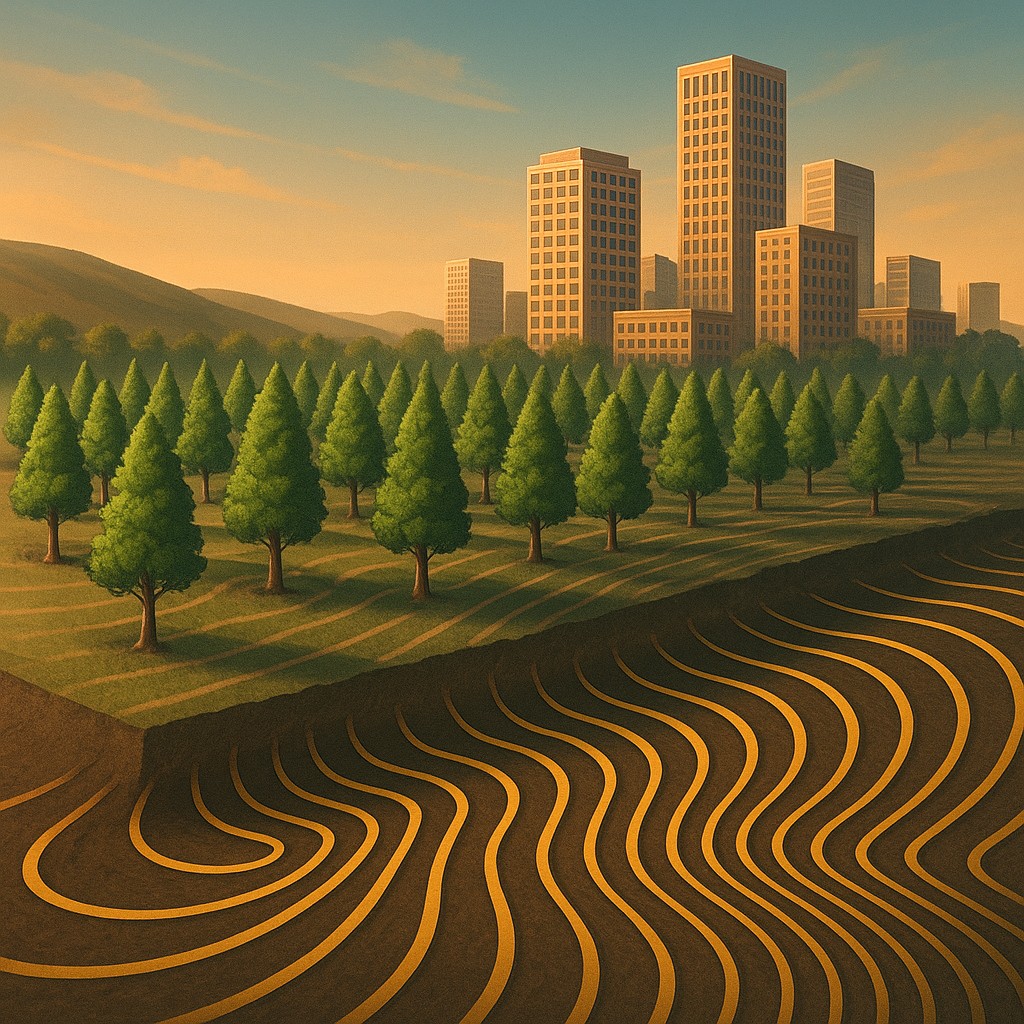
Imagine for a moment that the Earth is not a solid, motionless block of rock, but rather a massive, vibrating bell. When a tectonic plate snaps or a fault line slips, it is as if a giant hammer has struck that bell, sending ripples of energy screaming through the crust. For centuries, our response to this violent music has been defensive. We build thick concrete walls, install heavy rubber pads under skyscrapers, and hope our engineering is tough enough to take the punch. We focus entirely on the building itself while ignoring the ground it sits on.
But what if we could stop the music before it reached the listener? Modern earthquake engineering is undergoing a radical shift. Instead of just protecting individual buildings, scientists are looking at "tuning" the entire landscape. They have discovered that by planting trees in specific, mathematical patterns, we can create a biological filter that captures earthquake energy and reflects it back deep into the Earth. These "metamaterial forests" do not just sit there looking pretty; they act as a high-tech sound barrier that treats the soil like a giant circuit board. By understanding how vibrations work, we are learning how to turn a quiet grove of pines or poplars into a silent guardian for the city.
The Secret Language of Seismic Waves
To understand how a tree can stop an earthquake, we first have to look at how a disaster moves. When the ground shakes, it releases several types of energy. The most destructive are surface waves, specifically Rayleigh waves. Unlike waves that travel deep through the center of the planet, Rayleigh waves roll along the surface like a carpet being shaken. They move in an oval motion, creating literal ripples in the soil that lift and drop foundations. This is what causes the dramatic building failures we see on the news. Because these waves stay trapped at the surface, they carry a high concentration of energy directly into our glass, steel, and brick buildings.
In the past, engineers treated the soil as a passive victim of these waves. However, the new field of seismic metamaterials treats the soil as something we can adjust. A metamaterial is simply a substance structured at a very small scale to behave in ways that do not happen in nature. Usually, these are made of plastics or metals in a lab to control light or sound. On a geological scale, however, the "parts" of the metamaterial are the trees, and the "background" is the dirt. By carefully spacing the trees, we can change how a wave moves through the ground, much like how the holes in a flute change the way air vibrates to create different notes.
The primary goal is to create a "band gap." In physics, a band gap is a range of frequencies that cannot pass through a specific structure. If we can calculate the frequency of a typical earthquake in a certain region, we can design a forest where trees are spaced at the exact distances needed to block those frequencies. As the earthquake wave enters the forest, it hits a rhythmic barrier of trunks and roots that vibrate along with the tremor. Instead of passing through, the energy is "shouted" away by the trees or simply bounced backward, leaving the soil on the other side of the grove remarkably still.
How a Trunk Becomes an Acoustic Filter
A common mistake is thinking these trees act like a physical wall, like a dam holding back water. In reality, the process is much more elegant and uses a concept called "local resonance." Every object has a natural frequency at which it likes to vibrate-think of how a wine glass rings when you tap it. Trees, with their heavy trunks and springy roots, have their own natural resonance. When an earthquake wave hits a tree at that specific frequency, the tree begins to swing. If you have a thousand trees all swinging together in a specific pattern, they act as tiny secondary sources of energy.
As the earthquake moves through the soil, it meets the new waves created by the vibrating trees. If the pattern is right, these waves go through "destructive interference." This is the same trick used in noise-canceling headphones. The headphones listen to the background hum of a jet engine and produce an opposite sound wave that cancels it out. In a metamaterial forest, the physical movement of the trees creates a "counter-vibration" in the soil. The earthquake tries to push the ground left, but the resonance of the trees pushes the ground right at that exact microsecond. The result is a neutral zone where the earthquake energy has been scrubbed away.
The success of this system depends on how "stiff" the trees are and how dense the soil is. This is where the biology gets technical. A willow tree and an oak tree have very different physical traits. An oak is stiff and heavy, meaning it vibrates at a different frequency than a flexible, light willow. Engineers must choose the right species based on the local ground. If the soil is soft and sandy, the trees need to be anchored so their roots act as connectors for this massive acoustic circuit. It is not just a forest; it is a living machine tuned to the frequency of the Earth’s shifting plates.
The Geometry of Geological Defense
The magic of the metamaterial forest lies in its layout. You cannot simply scatter seeds in a field and expect a shield to grow. The trees must be arranged in a "periodic" structure, meaning a grid where the distance between each tree relates mathematically to the length of the earthquake wave. If an earthquake has a wave 50 meters long, placing trees every 10 meters might create a specific kind of interference. However, earthquake waves are not clean, single notes; they are messy, chaotic bursts of many different frequencies.
To handle this, engineers are testing "graded" forests. Instead of a perfect grid where every tree is the same distance apart, a graded forest features trees that gradually change in size or spacing. Imagine a forest where the trees on the edge are small and close together, but toward the center, they become massive and farther apart. This creates a "wedge" effect. As the earthquake wave enters the forest, it hits different filters that catch different frequencies. This allows the forest to soak up a much wider range of earthquake types, from sharp, high-pitched jolts to the long, low-frequency rolls that topple buildings.
| Feature |
Construction Reinforcement |
Metamaterial Forest |
| Main Method |
Strengthening the building to resist force |
Redirecting or canceling waves in the soil |
| Location |
Inside or under a specific building |
In the landscape surrounding a city |
| Maintenance |
Inspections and part replacement |
Gardening, soil checks, and pruning |
| Scale |
One building or a small complex |
Entire neighborhoods or utility zones |
| Extra Benefits |
None (purely structural) |
Cleaner air, cooling, and park space |
| Main Weakness |
Can fail under extreme, unexpected loads |
Needs exact soil and root conditions |
By treating the forest as a wedge, we can even "bend" the earthquake waves. This is like refraction, the same process that makes a straw look broken in a glass of water because light bends as it moves from air to liquid. A graded forest can act as a lens for earthquakes, bending them away from a city and directing them toward empty areas or deeper into the Earth where they can fade away harmlessly. This moves us away from a "shield" mindset and into a "cloaking" mindset, where we essentially make our cities invisible to the earthquake's energy.
Root Systems as the Ultimate Anchors
While the trunk handles the vibration above ground, the real work happens below. A tree’s root system is a complex network that binds the soil together, changing the ground's "bulk modulus," which is a measure of how much the dirt resists being squeezed. In these forests, the roots act as the bridge between the vibrating tree and the earth. If the roots are too loose, the tree will just wiggle in the dirt without affecting the wave. If they are perfectly knitted into the ground, the tree and the soil move as one, moving the most energy possible.
This creates a unique challenge for "living" engineering. Modern construction uses materials like steel that stay the same over time. Trees, however, grow. They change density as they age, grow deeper roots, and their stiffness shifts with the seasons or rainfall. An effective metamaterial forest needs constant soil health checks. If the soil gets too soggy, it loses its stiffness, which can "de-tune" the shield. Engineers are looking into using sensors buried in the roots to track these changes, ensuring the forest stays tuned to the right "note."
Furthermore, the tangled roots of neighboring trees create an underground web that can trap energy. In a wild forest, roots are chaotic. In a seismic grove, the roots might be guided during early growth to form specific patterns that mirror the grid of trunks above. This underground architecture ensures that even energy passing between the trunks is caught by the dense, mathematical root structures below. It is a 3D defense system that protects the city from the surface down to the bedrock.
Overcoming the Obstacles of Living Infrastructure
Despite the potential of these forests, we are still in the early stages. One of the biggest hurdles is space. To cancel out a low-frequency earthquake, which has a very long wave, you need a forest that is several kilometers deep. This is hard to do in crowded cities like Tokyo or San Francisco. However, we don't necessarily need a forest in the city center. We can place these filters on the outskirts, near fault lines, to act as a buffer that softens the blow before it hits the urban core.
Another challenge is the life cycle of the system. Building parts might last fifty years, but a tree could live for centuries-or it could die from a disease next week. Keeping the mathematical precision of the grove means that if one tree dies, it must be replaced by another of the exact same size and stiffness. This creates a need for a new profession: the seismic arborist. This job combines geology, physics, and forestry to maintain a living machine that must stay perfectly calibrated for decades.
There is also the question of cost. While planting trees is cheaper than rebuilding every skyscraper, the land required is expensive. To make this work, planners are looking at "multi-use" landscapes. A city park, a golf course, or a hiking trail could all be designed as seismic shields. By hiding the engineering inside a public park, the cost of the land is justified by the fun and environmental perks it provides, giving the city a "free" earthquake shield as a side effect of creating more green space.
The Future of Resonant Landscapes
Looking ahead, the idea of the metamaterial forest might expand. We are beginning to realize that the entire "built environment" can be tuned. Imagine a group of skyscrapers designed with specific heights and spacing so they vibrate in harmony, protecting each other from tremors. We might even see "land-forming," where the hills and valleys around a city are sculpted into shapes that trap seismic energy. We are moving toward a future where we don't just build on the Earth; we learn to play the Earth like an instrument.
The shift from fighting nature to working with it is a major step in our evolution. By using the patterns found in nature to defend ourselves, we are admitting that we cannot beat the Earth into submission with concrete and steel. Instead, we can use the laws of physics-geometry and resonance-to create a safer world. It is a reminder that the best technology isn't always made of wires; sometimes, it’s made of wood, soil, and a deep understanding of the planet's rhythms.
The next time you walk through a quiet grove of trees, look closely at their spacing. Notice the way the light hits the leaves and how the trunks stand like guards in the dirt. You may be standing in the middle of a masterpiece of engineering, a silent, living machine waiting for a song it was designed to never let you hear. The metamaterial forest is more than just a group of plants; it is proof that by understanding the deep pulse of our planet, we can turn a force of destruction into a harmless reflection, ensuring that even when the Earth shakes, our cities remain still.