You are currently swimming in a sea of forgotten data. Think back to exactly seven days ago. You likely remember waking up, the weather, and a few tasks you finished at work or school. But can you recall the specific pattern of the clouds during your commute? Do you remember the exact words your barista said before handing you your coffee, or the color of the third car you passed on the highway? Probably not. Your brain is a masterpiece of intentional forgetting. It acts as a biological filter designed to make sure the boring clutter of daily life does not overwhelm the precious storage space reserved for the things that actually change your life.
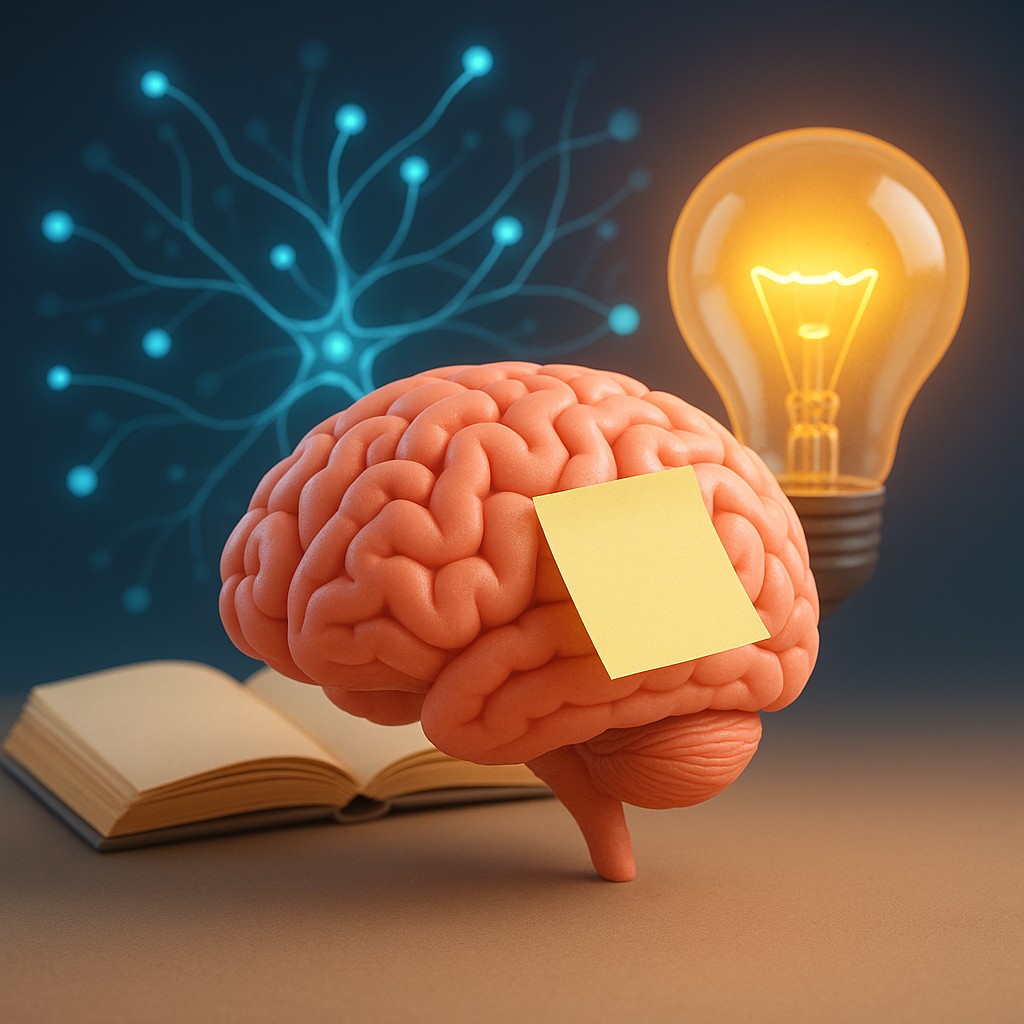
If our brains recorded every single sensory input with perfect, permanent detail, we would be paralyzed by the sheer volume of useless information. We would remember every itch, every blink, and every dull spreadsheet cell with the same intensity as our wedding day or a terrifying car accident. To prevent a "Hard Drive Full" notification from screaming in our minds, the brain uses a clever, two-step vetting process. It does not decide what is important the moment it happens. Instead, it places a temporary "sticky note" on certain nerve connections and waits to see if anything interesting happens later in the day to justify making that note permanent.
The Sticky Note Strategy of the Mind
At the heart of this process is a concept called synaptic tagging. To understand this, we have to look at the synapse, which is the tiny gap where two brain cells (neurons) communicate. When you experience something, neurons fire signals across these gaps. If the experience is unremarkable, like eating a ham sandwich while staring at a wall, the connection between those neurons is "weakly" stimulated. The brain recognizes that this might be important but is not sure yet. So, instead of immediately building the heavy-duty protein structures needed for a long-term memory, it simply places a chemical "tag" on that specific synapse.
This tag is essentially a biological bookmark. It does not contain the memory itself, but it marks the location where a memory could be built. These tags are short-lived; they usually last only a few hours. If nothing else happens to prove the importance of that ham sandwich, the tag dissolves. The synapse returns to its normal state, and the memory of that lunch vanishes into the void of forgotten afternoons. This is why you can remember what you ate today, but finding the memory of a specific Tuesday lunch from three weeks ago feels like trying to grab smoke with your bare hands.
When the Brain Calls for a Permanent Record
The magic happens when something significant occurs shortly after those tags have been placed. Imagine you finish that ham sandwich, and twenty minutes later, you get a phone call saying you have won the lottery, or you witness a dramatic car crash outside your window. This "strong" event triggers a massive wave of activity in the brain. Specifically, it releases "plasticity-related proteins" (PRPs). These proteins are like a construction crew sent out from the center of the brain cell with orders to strengthen any synapse that is currently wearing a "tag."
In a fascinating twist of biological opportunism, the proteins do not really care what the tag was for. They simply find the tagged synapses and begin the work of Long-Term Potentiation (LTP), a process that strengthens the connection to make the memory permanent. Because your "boring" lunch happened close in time to the "exciting" lottery win, the lunch synapse is still tagged when the protein construction crew arrives. The brain assumes that everything leading up to the big event must be relevant. As a result, you end up with a crystal-clear, permanent memory of a sandwich that your brain would normally have tossed out like yesterday's news.
The Time Window of Significance
This window of opportunity does not stay open forever. Scientists have found that for this "tagging and capture" to work, the two events usually need to happen within a few hours of each other. This is a survival tool developed over millions of years of evolution. If an ancestor ate a specific berry and then felt violently ill two hours later, it was vital to remember exactly what that berry looked like, even if eating it felt ordinary at the time. The "strong" event (the illness) captures the "tagged" event (the berry's appearance) and fuses them into a permanent lesson: "Don't eat the blue ones."
| Feature |
Synaptic Tagging (Weak Event) |
Memory Capture (Strong Event) |
| Duration |
Temporary (1 to 4 hours) |
Permanent (Days to Years) |
| Mechanism |
Chemical markers on the synapse |
Protein building and structural change |
| Trigger |
Routine, dull, or low-emotion input |
High emotion, novelty, or excitement |
| Result |
Likely forgotten unless reinforced |
Becomes a stable long-term memory |
| Biological Goal |
Efficiency and clutter reduction |
Survival and future planning |
This framework explains "Flashbulb Memories." When a major historical event occurs, people often remember exactly where they were and what they were doing, down to the most trivial details. You are not remembering those details because the details themselves were important; you remember them because your brain was flooded with "Save" signals (proteins) that latched onto every temporary tag currently active in your head. Your brain essentially hits "Save All Open Tabs" when it experiences a shock.
The Glitch in the Memory Matrix
While this system is incredibly efficient for survival, it is not perfect. Because the "capture" process is somewhat random, it can lead to distorted or "false" associations. If you have a stressful argument with a partner, your brain might accidentally "capture" the song playing on the radio or the specific smell of the room, forever linking those things with the feeling of distress. This can lead to unexplained triggers where a certain brand of laundry detergent suddenly makes you feel anxious because it was "tagged" during a moment of high-emotional protein building years ago.
Furthermore, this mechanism explains why studying for an exam is often more effective when followed by something stimulating rather than a nap or mindless scrolling. If you study (weakly tagging those synapses) and then go for a run, engage in a heated debate, or even watch a deeply moving film, the resulting chemical surge can help "capture" the information you just reviewed. Conversely, if your day is a flat line of boredom from start to finish, the tags simply expire. Your brain assumes nothing noteworthy happened, and it clears its history to make room for tomorrow.
The Architecture of an Intentional Life
Understanding synaptic tagging allows us to stop being passive observers of our memories and start being the architects of our minds. We often complain about our "bad memories," but in reality, our brains are doing exactly what they were designed to do: protecting us from the burden of infinite, useless data. If you want to remember something, you have to signal to your brain that it matters. You have to provide the "capture" signal that turns a fading tag into a permanent monument.
This is why "novelty" is such a powerful tool for mental clarity. When we break our routines and seek out new experiences, we provide the sparks of dopamine and other chemicals that act as the glue for our daily tags. A life lived entirely in a predictable loop is a life that the brain will eventually prune away. This leaves you with the sensation that years have passed in the blink of an eye with nothing to show for them. By injecting surprise, emotion, and challenge into our days, we give our brain cells the "construction materials" they need to build a rich, detailed, and lasting record of our journey through the world. Every moment is a potential tag; it is up to the world, and how we engage with it, to decide which ones we get to keep.