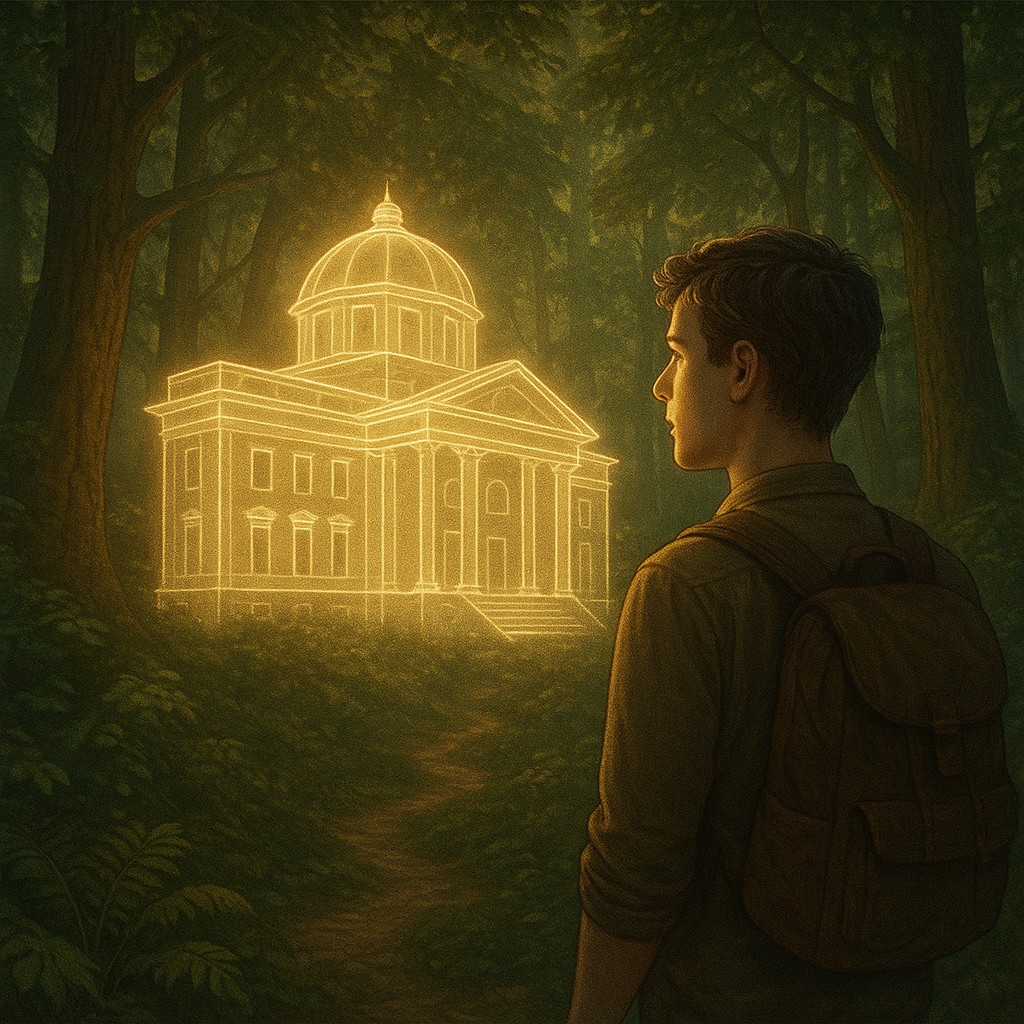
Imagine standing in a thick, ancient forest ten thousand years ago. Your survival doesn't depend on reciting poems or memorizing strings of random numbers. Instead, your life depends on knowing exactly which river bend leads to the sweet berry bushes and which hollow log is home to a grumpy bear. Over millions of years, evolution has fine-tuned your brain to be a world-class GPS. We are biologically wired to remember places, paths, and 3D layouts because, for our ancestors, getting lost meant more than just being late for dinner; it meant becoming dinner.
In today's world, we rarely need to track migrating herds, yet we are constantly flooded with abstract data, passwords, and grocery lists. This creates a basic mismatch between what our brains were built to do and what we ask of them every day. We struggle to remember a ten-digit phone number, yet we can easily recall the floor plan of our childhood home, even if we haven't stepped foot in it for decades. The Method of Loci, also known as the Memory Palace technique, is the ultimate "brain hack" to bridge this gap. It allows us to take dry information and trick the brain into treating it like a physical location, turning abstract data into something our biology can actually handle.
The Architectural Blueprint of Your Mind
The magic of the Memory Palace happens in a tiny, seahorse-shaped part of the brain called the hippocampus. This area is the main hub for both memory and navigation. Because these two functions live in the same neighborhood, they are deeply linked. When you move through a physical space, your brain fires off "place cells" that create a mental map of your surroundings. By using the Method of Loci, you are essentially hijacking these cells to carry "cargo" in the form of information. Instead of trying to memorize historical dates in a vacuum, you are literally placing them on your coffee table or hanging them on your coat rack.
To build your first mental structure, you don't need to be an architect. In fact, the most effective Memory Palaces are places you already know by heart. This could be your current apartment, your old high school, or even a level from a favorite video game. The key is familiarity. When you don't have to struggle to remember the environment, your brain can give 100 percent of its energy to the items you are placing inside it. You move through this space in a logical order, creating a "journey" that you can repeat in your mind whenever you need to pull that data back out.
This technique isn't a new discovery; it dates back to ancient Greece. Legend says the poet Simonides of Ceos was at a banquet when the roof collapsed, crushing the guests so badly they couldn't be identified. As the sole survivor, Simonides found he could name every victim simply by picturing where they had been sitting around the table. He realized that our memory for "where" is much stronger than our memory for "who" or "what." By linking information to locations, he found a way to make passing thoughts permanent.
Turning Data into Visual Anchors
The biggest hurdle for beginners is realizing you can't just put a word in a room and expect it to stick. If you need to buy milk, don't just imagine a carton on your sofa. Your brain is designed to filter out the boring, so a plain carton of milk will likely be ignored. To make information "sticky," you have to use "elaborative encoding," a fancy term for making things memorable. You need to turn that boring milk into something bizarre or hilarious. Perhaps you imagine a six-foot-tall cow sitting on your sofa, lazily pouring a gallon of milk over its own head.
This works because our brains are hardwired to pay attention to things that are unusual or emotional. A giant cow on a sofa triggers an "alert" in the brain because it's so out of place. When you pair this vivid, weird image with a specific spot, the hippocampus binds the two together. Later, when you mentally "walk" into your living room, the image of the cow pops up almost automatically. You don't have to strain to remember the milk; the room itself acts as a visual prompt that does the hard work for you.
The more senses you use, the better. Don't just see the cow; hear it moo and smell the milk. If you are studying for an exam on the laws of heat and energy, you might imagine a roaring fireplace in your hallway or a steaming engine in your bathtub. By turning abstract ideas into physical objects with weight, texture, and sound, you are translating "data" into "experience," which is the language your brain speaks best.
Avoiding Mental Clutter
As you get better at building Memory Palaces, you might be tempted to cram everything you know into one house. This leads to a common problem called "interference." Just as a real room is hard to walk through when it’s full of junk, a mental room gets confusing when it’s overloaded. If you balance ten different items on one bedside table, your brain will likely blur them into a single, unrecognizable mess. This "crowded path" makes your mental anchors lose their spark.
To keep your mental maps clean, it's better to use different Memory Palaces for different subjects. You might use your house for chores, your office for work, and your grandmother's house for learning a new language. This separation prevents "proactive interference," which is when old memories get in the way of new ones. By giving each set of info its own "real estate," you let the brain create clear, distinct paths for each journey.
| Memory Component |
Traditional Rote Learning |
Method of Loci (Memory Palace) |
| Main Brain Region |
Prefrontal Cortex (High effort) |
Hippocampus (Spatial/Automatic) |
| Duration |
Short-term (needs repetition) |
Long-term (high retention) |
| Effort Level |
High (boring and repetitive) |
Moderate (creative and fun) |
| Organization |
Random or in a list |
Spatial and structured |
| Error Rate |
High (easy to skip items) |
Low (the path guides the memory) |
To avoid confusion, make sure your "mental walk" always follows the same direction. If you usually walk through your house clockwise, stick to that. Changing the route halfway through is like trying to drive while someone swaps the gas and brake pedals. Consistency builds a strong framework, allowing you to fly through your memory palace without getting lost in your own thoughts.
Expanding from Studios to Cathedrals
Once you master the basics with a small apartment, you can scale up. Memory athletes, who can memorize ten decks of cards in minutes, don't rely on a single house. They build "Memory Cities." They might use an entire neighborhood, a park, or a series of museums. Some even use "virtual" palaces from movies or games, as long as they know the layout well enough to walk through it without thinking.
The beauty of this method is how flexible it is. It isn't just for lists; it works for public speaking, languages, or professional skills. If you have an hour-long presentation, you can "place" each main point in a different room. When you stand up to speak, you don't need notes. You simply take a walk through your palace. If you forget what comes after the intro, you mentally look at the front door, and the visual anchor you put there will trigger the next topic. This removes the "blanking out" fear because the path is already paved.
For learning languages, you can use rooms to group types of words. You might put "action" verbs in the kitchen, where things are being chopped and fried. You could put "emotions" in the bedroom and "tools" in the garage. This adds a level of organization that flashcards can't touch. You aren't just learning a word; you are giving it a home.
The Myth of "Photographic Memory"
One of the biggest myths in school is that some people are born with a "photographic memory" while the rest of us are doomed to lose our keys. In reality, true photographic memory is incredibly rare and has almost never been proven in adults. What people mistake for it is usually just a skilled use of techniques like the Memory Palace. Most "memory geniuses" started with average memories and simply trained themselves to think spatially.
The Method of Loci proves that memory is a skill, not something you're stuck with. It’s like exercise for the mind. At first, it might feel slow to turn grocery items into cartoons and put them in your bathroom. You might think it would be faster just to write them down. That might be true for a quick trip to the store, but the goal here is long-term memory and mental sharpess. By practicing, you are changing how your brain handles information and linking your imagination to your logic.
This method also shows that learning doesn't have to be a boring grind. If you’re struggling to remember something, it’s usually not because your brain is "full." It’s because you’re trying to force-feed it in a language it doesn't like. When you move from boring repetition to spatial palaces, you stop fighting your biology and start working with it. You aren't just a student anymore; you are an interior designer for your mind, turning empty halls into a vibrant, organized library of your life.
Building Your Mental Estate
You now hold the keys to a kingdom inside your own head. The Method of Loci is more than a party trick; it’s a testament to how flexible the human brain can be. We are the children of explorers and navigators. Every time we use a Memory Palace, we honor that history. We are taking the cold, digital noise of the 21st century and translating it into the warm, physical language of our ancestors.
Next time you feel buried under a mountain of facts, don't reach for a highlighter. Instead, close your eyes and go home. Walk through your front door and start placing your ideas on the shelves and tables of your mind. Turn the dull into the dramatic and the abstract into the real. Your brain is ready to map out your success, one room at a time. There really is no place like home for the things you want to remember.