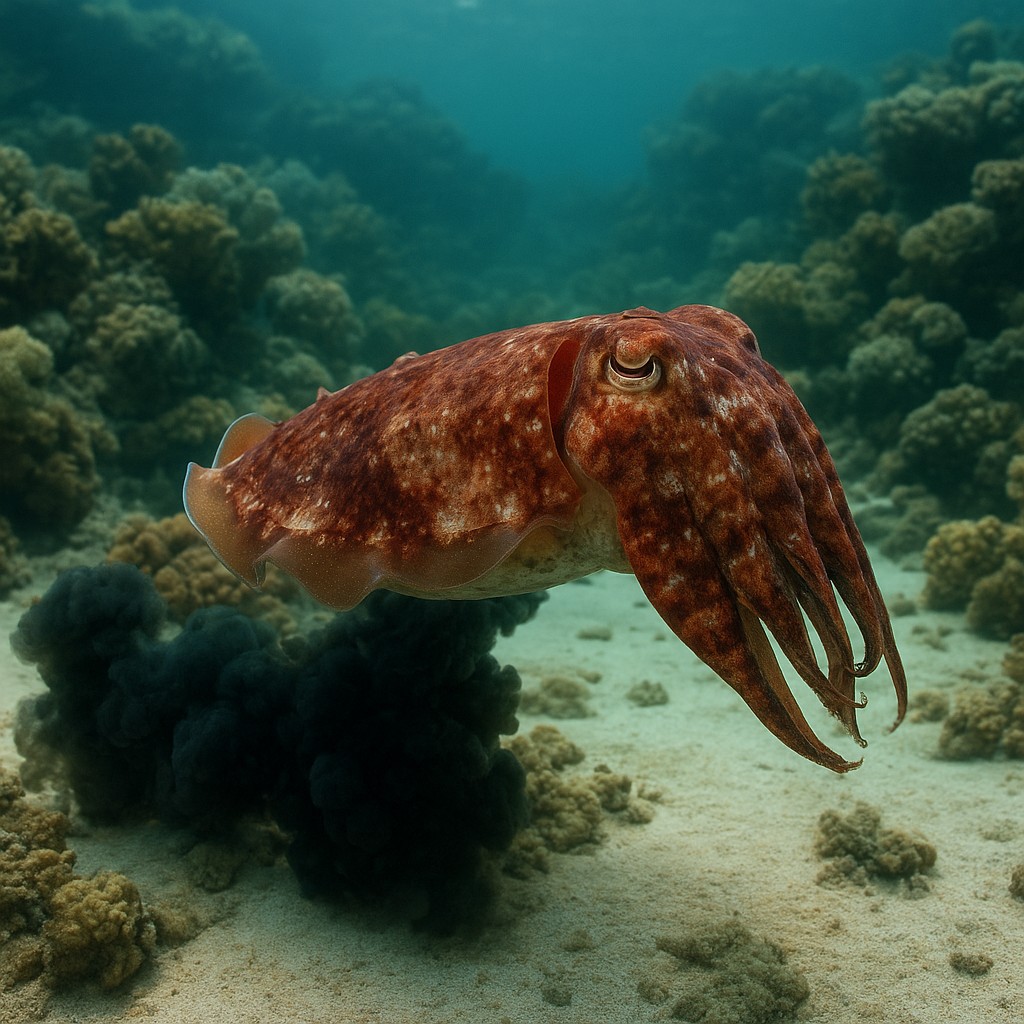
Imagine strolling across the ocean floor, passing through intricate coral reefs and over stretches of dull, beige sand. Suddenly, a rock in front of you seems to "open up" and darts away in a cloud of ink. You have just met one of nature's greatest magicians: a cephalopod. Whether it is a mischievous octopus or an elegant cuttlefish, these creatures possess a superpower that would be the envy of any movie spy. In less time than it takes to blink, they can alter their appearance to become practically invisible, turning themselves into a perfect extension of their surroundings.
What makes this feat even more incredible is the high-tech complexity hidden beneath their skin. Unlike a chameleon, which takes several minutes to change color based on hormones or temperature, an octopus reacts through direct nerve impulses. It is a living, high-definition biological interface. Let's dive into the depths of marine biology to see how these animals manipulate light, texture, and perception to master the art of illusion, and how their secrets are inspiring the engineers of tomorrow.
The Invisible Orchestra of Chromatophores
At the heart of this metamorphosis are tiny, remarkably sophisticated organs called chromatophores. Think of them as millions of microscopic living pixels spread across the animal's entire body. Each chromatophore is a small, elastic sac filled with colored pigment, usually black, brown, orange, or yellow. A ring of tiny muscles, controlled directly by the brain, surrounds each sac. When the muscles contract, they stretch the sac out, spreading the color over a larger area to make it visible. When the muscles relax, the sac shrinks back into a nearly invisible dot, revealing the deeper layers of the skin.
This direct muscular control is the secret to the lightning-fast speed of cephalopods. Because the nervous system drives the expansion of every pixel, an octopus can create complex patterns, such as stripes or spots, in a fraction of a second. But the show does not end there. Beneath this first layer of "paint" lie other cells called iridophores and leucophores. Iridophores act like biological mirrors, reflecting light to produce shimmering shades of blue, green, or silver. Meanwhile, leucophores scatter the surrounding white light, allowing the animal to match the brightness of its environment perfectly. The combination of these three layers allows for such precise visual mimicry.
A Living Sculpture Built for Illusion
While changing color is impressive, it would not be enough to fool a sharp-eyed predator if the cephalopod’s silhouette remained smooth against a jagged coral reef. This is where the second secret of camouflage comes in: changing skin texture. Octopuses and cuttlefish have bundles of muscles called papillae located just under the skin’s surface. By contracting these muscles in a coordinated way, they can sprout bumps, spikes, or filaments. This transforms perfectly smooth skin into a jagged surface that mimics the rough texture of seaweed or the graininess of a rock.
This physical transformation is a masterpiece of biological engineering. Instead of just "looking" like the background, the animal adopts its three-dimensional structure. When a cuttlefish rests on a bed of broken shells, it raises its papillae to break up its body's outline, making it almost impossible for a predator to spot. This ability to manipulate physical shape in real time is what truly sets cephalopods apart from the rest of the animal kingdom. They do not just wear a camouflage suit; they become the environment itself.
The Paradox of the Colorblind Genius
Perhaps the most confusing and ironic part of this story is that most cephalopods are, by our scientific standards, completely colorblind. Physiological tests show that their eyes have only one type of light receptor, meaning they should only see the world in shades of gray. Yet, they manage to match the colors of their surroundings with an accuracy that fools even the most trained human eyes. How can they do this without being able to see the green of a leaf or the red of a coral?
Scientists are exploring several fascinating theories to solve this mystery. One suggests that cephalopods use "chromatic blurring." By quickly shifting the focus of their strangely shaped eyes (often U or W-shaped), they might perceive different wavelengths of light by watching how they split across the retina, much like a prism. Another theory suggests their skin itself might "see." Light-sensitive proteins identical to those found in eyes have been discovered in octopus skin cells. This suggests they might detect light and contrast directly through their body surface, bypassing the eyes to fine-tune their camouflage.
| Mechanism |
Cell or Muscle Type |
Main Function |
Visual Effect |
| Chromatophores |
Elastic pigment sacs |
Rapid color change |
Warm color pixels (yellow, red, brown) |
| Iridophores |
Crystalline plates |
Light reflection |
Iridescent effects, metallic blues and greens |
| Leucophores |
White reflective cells |
Light scattering |
Intense whiteness and brightness matching |
| Papillae |
Skin muscle bundles |
Texture modification |
Shifting from smooth to rough or spiky skin |
A Direct Link Between Eye and Muscle
The cephalopod nervous system is a marvel of decentralization. It is often said that an octopus has nine brains: one central brain and a cluster of neurons in each arm. This structure allows for unparalleled reaction speeds. For camouflage, this means visual information picked up by the eye (or the skin itself) is instantly turned into a motor signal and sent to millions of chromatophores. There is no complex conscious thought process involved; it is a nearly reflexive reaction, yet it is performed with artistic precision.
This ability to process information in real time is of great interest to researchers in robotics and materials science. Imagine clothing that changes color to regulate your body temperature, or ultra-low-power screens made of physical pigments rather than light-emitting diodes. The field of "smart materials" is drawing direct inspiration from the layers of cuttlefish skin to create coatings that can change their appearance or shape when triggered by an electrical signal. We are learning how to build technology that "lives" and "reacts" the way these animals have for millions of years.
The Art of Deception and Communication
Camouflage is not just for hiding. For cephalopods, it is also a complex language. Cuttlefish, for example, use moving patterns on their skin to talk to one another or to hypnotize their prey. During a mating display, a male might show an aggressive striped pattern on one side of his body to ward off a rival, while displaying a softer, more attractive pattern on the other side to woo a female. This is directional, dynamic communication that few other species can match.
Evolution gave these creatures a biological "invisibility cloak" to make up for their lack of a protective shell. By losing their shells over millions of years, the ancestors of the octopus became faster and more agile, but they also became vulnerable prey. Camouflage became their primary line of defense, a strategy based not on brute strength, but on intelligence and illusion. This shift from physical armor to mental trickery is a fascinating testament to the ingenuity of natural selection.
Watching an octopus vanish into the background, it is hard not to feel a deep sense of wonder at the complexity of marine life. These animals remind us that perception is often an illusion and that nature solved complex engineering problems long before humans arrived. Whether they are escaping a shark or blending into the sand to wait for a meal, cephalopods turn biology into a form of living art. The next time you look at a photo of the ocean floor, look a little closer: what you think is an old rock covered in seaweed might just be watching you back, hidden behind the most advanced camouflage system on Earth.