You already encounter the periodic table every time you cook, charge your phone, or breathe. It is more than an arrangement of boxes with letters and numbers - it is a powerful organizing principle that turns a messy zoo of elements into a map of how matter behaves. Once you learn to read it, the table becomes a cheat sheet for predicting reactivity, bonding, and even the colors and melting points of substances you see every day.
Think of the periodic table as a language of chemistry. Each square is a word that tells you about the number of protons in an atom, how many electrons live on its outer shell, and what kinds of chemical friendships it prefers. This guide will walk you through that language step by step, demystify common myths, and give practical tricks so the table feels less like rote memorization and more like a reliable companion.
A living map of elements and why it matters
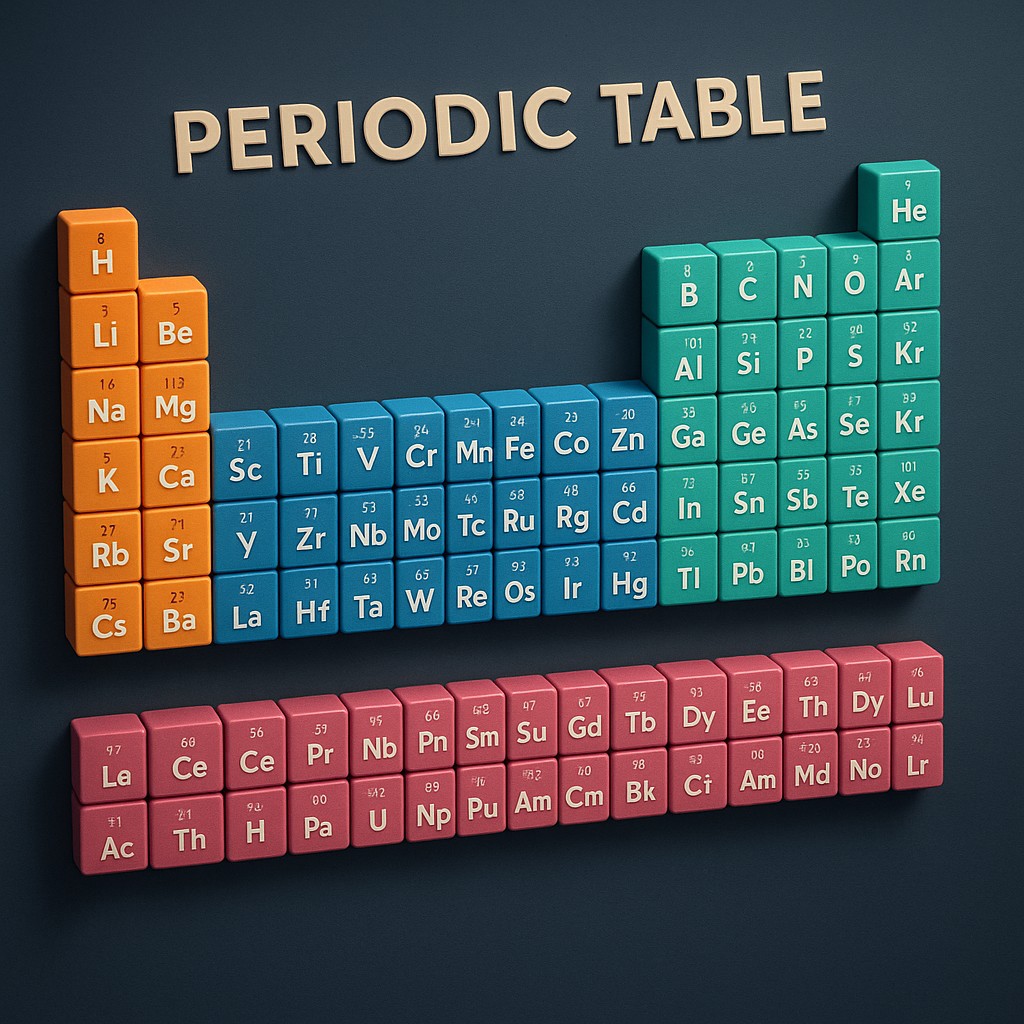
The periodic table is a visual chart that organizes all known chemical elements in a way that reveals repeating patterns of properties. At its heart is a simple rule: if you line up elements by increasing atomic number - the number of protons in the nucleus - patterns in chemical behavior emerge. Those repeating patterns are called periodic trends, and they let chemists predict how an unknown or synthetic element will behave before it has been physically studied.
This predictive power is what made the periodic table revolutionary. In the 19th century, Dmitri Mendeleev arranged elements by atomic mass and left gaps where he suspected undiscovered elements should sit. He even predicted the properties of those missing elements, and when elements matching his predictions were discovered, confidence in the system exploded. Today we use atomic number rather than mass, and the table continues to grow as scientists create new, heavy elements in particle accelerators.
The layout: rows, columns, and the story they tell
Reading the table is like reading a grid of habits and tendencies. Rows are called periods. Each period corresponds to an electron shell being filled - as you move left to right across a period, electrons are added one by one to the same shell. Columns are called groups or families, and elements in the same group tend to have similar chemical behaviors because they share the same number of valence electrons - the electrons in the outermost shell that do most of the chemical work.
The left side of the table is dominated by metals, which are typically shiny, malleable, and good conductors of heat and electricity. The right side contains nonmetals, many of which are gasses or brittle solids and tend to gain electrons during chemical reactions. A jagged line of metalloids runs between the two, acting as a gradual transition zone with mixed properties. This visual division tells you, at a glance, whether an element is likely to behave like metal or nonmetal.
Why electrons rule the chemistry world
The arrangement of electrons around an atom is what determines chemistry. Valence electrons are the ones that participate in bonds and reactions. Atoms with nearly empty valence shells, like the alkali metals on the far left, tend to lose electrons easily and act as strong reducing agents. Atoms with nearly full valence shells, like the halogens on the right, tend to gain electrons and act as oxidizing agents. Then there are the noble gases, with full valence shells, which are famously unreactive because they have little incentive to change their electron configuration.
Understanding electron shells also explains periods. Think of each period as a new apartment floor where electrons move in. Each new period starts when a new shell begins to accept electrons, and ends when that shell is full. This shell model is an excellent mental image: the periodic table is an apartment building where an element’s floor tells you how many electron shells it has, and their group tells you how happy the outer room is being full or empty.
Blocks, families, and the meaning of "s", "p", "d", and "f"
Chemists often talk about the s, p, d, and f blocks of the table. These labels come from the type of atomic orbital that is being filled with electrons. The s-block on the left contains the highly reactive alkali metals and alkaline earth metals. The p-block on the right holds the nonmetals, metalloids, and some metals. The d-block in the middle houses the transition metals, notable for forming colorful compounds and multiple oxidation states. The f-block, usually shown as two rows at the bottom, contains the lanthanides and actinides with elements that have electrons entering f-orbitals.
Knowing the block gives powerful clues. For example, d-block transition metals can easily adopt a variety of oxidation states because d electrons are only moderately bound. That versatility makes them catalysts, pigments, and the backbone of many modern technologies. The f-block elements are important for magnetic materials, nuclear reactions, and specialty electronics. So when you see an element’s block, you already know a bit about how it behaves and where it might be useful.
Periodic trends you can rely on
Several trends run predictably across the table and are worth committing to memory. Atomic radius generally decreases across a period-left to right-because added protons pull electrons closer, strengthening the attraction. Atomic radius increases down a group because new orbitals orbit farther from the nucleus. Ionization energy, the energy required to remove an electron, tends to increase across a period and decrease down a group. Electronegativity, the tendency of an atom to attract electrons in a bond, usually increases across a period and decreases down a group.
These trends are not just textbook trivia, they explain real chemistry. For instance, the high electronegativity of oxygen explains why water molecules are polar and why oxygen forms strong bonds with many elements. The low ionization energy of sodium explains why it reacts explosively with water. With these trends in mind, you can often predict whether two elements will form an ionic bond, a covalent bond, or not bond readily at all.
The periodic table as a predictive toolkit
The table is not a static museum piece, it is a working tool for prediction and design. Material scientists use it to search for new alloys and superconductors. Pharmacologists look for elements with specific ionic sizes and charges for drug design. Environmental scientists monitor periodic trends to understand how pollutants behave and move through ecosystems. Even planetary scientists use the table to infer conditions on other worlds by considering which elements might be abundant or volatile.
One of the most dramatic examples of prediction was Mendeleev identifying a gap and forecasting the properties of an element he called eka-silicon. When germanium was discovered and matched Mendeleev’s forecast, it validated the table’s predictive strength. Modern chemists extend the same logic, using trends and quantum mechanics to forecast properties of elements that are too unstable to study in bulk.
Clearing up common misconceptions
There are a few myths that slow learning down. First, the table is not a definitive list of "good" or "bad" elements - toxicity, usefulness, and scarcity are context dependent. For example, arsenic is infamous as a poison but also plays roles in semiconductors and microbial metabolism. Second, elements are not fixed personalities; their behavior changes with context, such as pressure, temperature, and chemical environment. Under extreme conditions, even noble gases can form compounds. Third, while Mendeleev deserves credit, he was not the only contributor - several scientists noticed patterns and the table evolved through collaboration.
Another common mistaken belief is that periodic trends are exact rules. They are general patterns with exceptions due to electron-electron interactions, relativistic effects in heavy elements, and quantum quirks. Transition metal chemistry, for instance, frequently violates simple rules about valence and bonding, which is why transition metal complexes are a rich and diverse field of chemistry.
Practical ways to read and remember the table
You do not need to memorize every box to be fluent. Focus on patterns and families, and learn useful anchors. Here are a few practical steps that help:
- Learn the first 20 elements well; most introductory chemistry revolves around them.
- Memorize group traits: alkali metals (group 1) are highly reactive metals, halogens (group 17) are reactive nonmetals, noble gases (group 18) are inert under normal conditions.
- Use the table to predict outcomes of simple reactions, then check with experiments or online resources.
- Group-based mnemonics help: for example, “Happy Henry Likes Beer But Could Not Obtain Food Now” as a playful way to remember the first ten elements.
Practice by asking questions: given two elements, which will likely donate electrons, which will accept, and what type of bond will they form? Over time, reading the table becomes intuitive, like seeing familiar neighborhoods when you look at a city map.
A quick comparative cheat-sheet for major groups
| Group name |
Group number |
Valence electrons (typical) |
Typical oxidation state(s) |
Reactivity and traits |
Example elements |
| Alkali metals |
1 |
1 |
+1 |
Extremely reactive with water, soft metals, strong reducing agents |
Lithium, Sodium |
| Alkaline earth metals |
2 |
2 |
+2 |
Less reactive than alkali metals, form basic oxides |
Magnesium, Calcium |
| Transition metals |
3-12 |
variable (1-2+ d electrons) |
Multiple, variable |
Good conductors, form colored compounds, catalysts |
Iron, Copper |
| Halogens |
17 |
7 |
-1 commonly, others possible |
Very reactive nonmetals, form salts with metals |
Fluorine, Chlorine |
| Noble gases |
18 |
8 (except helium with 2) |
0 usually |
Very low reactivity, stable electron configurations |
Neon, Argon |
Stories that make the table human and memorable
Science is more fun when it comes with stories. Consider sodium and chlorine. Alone, sodium is a soft, dangerously reactive metal and chlorine is a poisonous green gas. Together, they form sodium chloride, table salt, essential to life and utterly benign at normal doses. Chemistry often hides surprises like that, where combining two volatile things leads to stability.
Or think of carbon. Its position in the p-block with four valence electrons lets it form chains and rings, which is why carbon chemistry underpins organic molecules and life itself. The periodic table helps you see why carbon is uniquely suited to build complexity, while silicon, directly below it, is similar but not identical, explaining why silicon-based life is a staple of science fiction but chemically improbable here.
How to keep learning after this guide
Start with the first 20 elements, then expand to the transition metals and p-block elements that show up in everyday materials. Perform simple experiments safely: dissolve table salt, burn magnesium ribbon in a controlled lab or classroom setting, observe the color changes of copper compounds. Use interactive apps or wall posters that allow you to click an element and see its properties. Read short biographies of chemists like Mendeleev, Marie Curie, and Glenn Seaborg to see how human curiosity and clever thinking shaped the modern table.
Join a club or online forum where people ask and answer chemistry questions. Teaching someone else what you have learned is a brilliant way to lock it in. When you can predict the products of a reaction or explain why lithium batteries work by referencing electron behavior and periodic trends, you will feel the table click from abstract chart to practical tool.
Keep in mind that the periodic table is both elegant and pragmatic: it reduces complexity without losing nuance. It is a map you will return to again and again, each time discovering new routes and destinations.
You are now ready to see the periodic table not as a list to be memorized, but as a living map that tells you how atoms prefer to behave. Let curiosity guide you - look up an element that interests you today, trace its family traits, and ask how those traits show up in your world. With a little practice, the table will stop being a mystery and become one of your smartest allies in understanding the material universe.