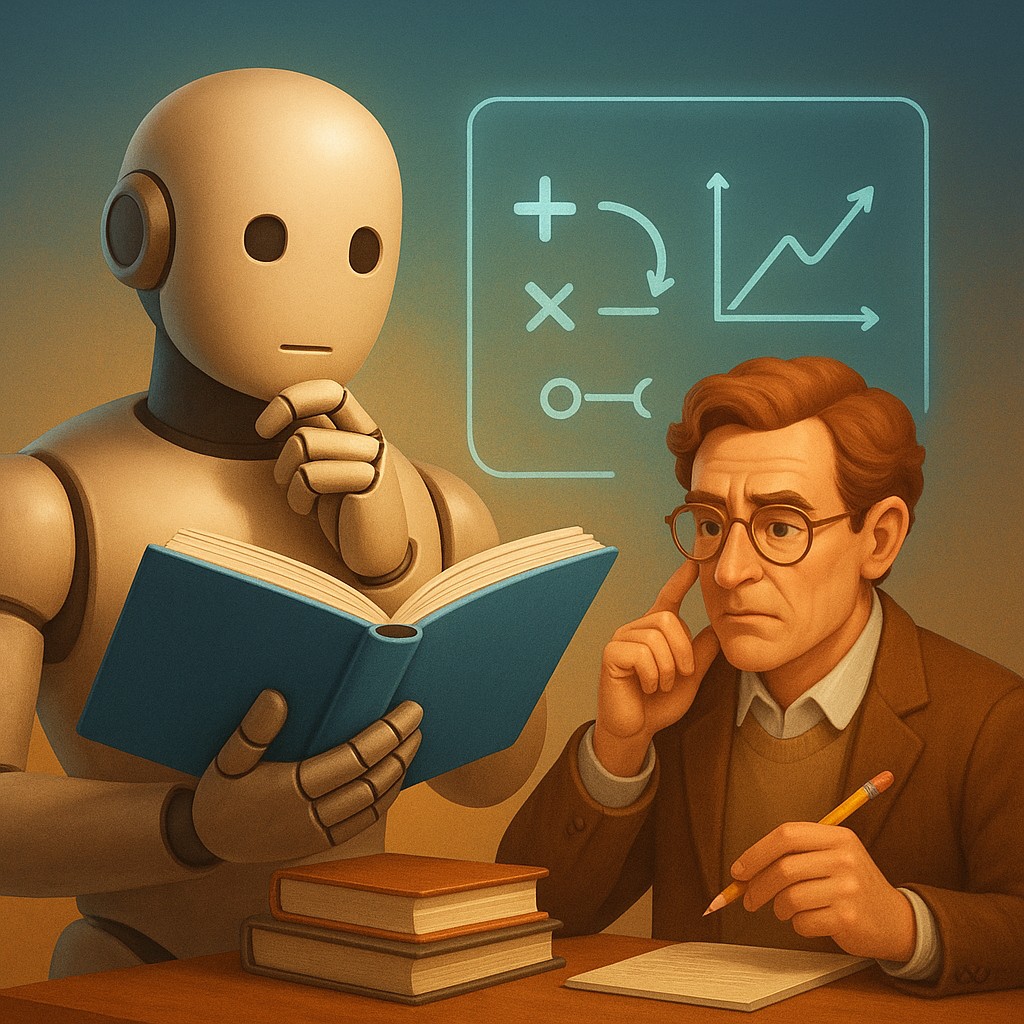
Imagine you have a friend who is a total genius. This friend has read every book in the Library of Congress, memorized every medical textbook, and can explain quantum physics in three languages. However, they are having a bit of an identity crisis. Because they know everything, they do not quite know who they should be at any given moment.
If you ask them for a recipe, they might give it to you in the style of a legal contract. If you ask for a bedtime story, they might accidentally pivot into a lecture on thermodynamics. Traditionally, to fix this, you would have to put your friend through years of specialized therapy or retraining to turn them into a permanent chef or a full-time lawyer.
In the world of Artificial Intelligence, we face this exact dilemma. We have built massive Large Language Models (LLMs) like GPT-4 or Llama that contain billions of "parameters," which are essentially the digital neurons that store knowledge. But traditionally, redirecting these giants to perform a specific task, like acting as a charming travel agent or a rigorous doctor, required a process called fine-tuning. This meant opening up the hood and tweaking those billions of neurons, which is incredibly expensive, slow, and exhausting for a computer. It is the equivalent of rewiring a skyscraper's entire electrical system just because you want to change the color of the lightbulbs. Fortunately, a new technique called "soft prompting" is changing the game. It allows us to steer these digital behemoths with a gentle mathematical nudge rather than a total overhaul.
The Ghost in the Machine and the Limits of Words
To understand soft prompting, we first have to look at how we normally talk to AI. When you type a message into a chatbot, you are using "hard prompts." These are made of actual words, like "Write a poem about a toaster." The AI takes these words, converts them into numbers (called tokens), and processes them through its entire network to generate a response.
For a long time, the only way to get better results was "prompt engineering," which is basically the art of begging the AI to behave by adding more and more words. You might say, "You are a world-class poet. You are feeling melancholy. Please write a sonnet about a toaster, but do not use the word 'bread.'"
While effective, hard prompting has its limits. Words are imprecise. The way I define "melancholy" might be slightly different from how the AI learned that word during its training. Furthermore, every word you add to a hard prompt takes up valuable space in the model's short-term memory, known as the "context window." If you have to spend a thousand words just describing the persona you want the AI to adopt, you have much less room for the actual data you want it to process. It is a clunky way of steering a complex mathematical system. We have been trying to drive a Ferrari using only basic voice commands, when what we really need is a way to tap directly into the steering column.
The Architecture of a Mathematical Whisper
Soft prompting abandons the idea that our instructions need to be readable by humans at all. Instead of using words like "medical expert" or "pirate," soft prompting creates a "prefix" of specialized data fragments. These are called "virtual tokens." They exist in the same mathematical space where the AI does its thinking, but they do not correspond to any specific word in the English language.
If you were to look at a soft prompt, it wouldn't look like a sentence; it would look like a long string of seemingly random numbers. It is mathematical noise that, to the AI, carries a very specific "vibe" or instruction set.
This prefix is tacked onto the front of your actual input. When the AI processes your request, it hits these virtual tokens first. Think of them as a specialized filter or a pair of tinted glasses. The underlying model, the "frozen" base of the AI, doesn't change a single one of its billions of settings. Instead, the soft prompt "nudges" the patterns of the neural network. By the time the AI gets to your actual question, its internal state has already shifted into the right persona. It is as if you didn't have to retrain your genius friend to be a chef; you just gave them a specific aromatic salt to smell that instantly triggered their "chef memories."
How Soft Prompting Differs from Traditional Methods
The beauty of this approach lies in its efficiency. In traditional fine-tuning, you have to save a completely new version of the entire model for every task. If you want a model that specializes in law, another in medicine, and another in coding, you would need to store three massive, multi-gigabyte files. With soft prompting, you keep one single copy of the enormous base model and simply swap out tiny files containing the soft prompts. These prompts are incredibly small, often taking up only a few kilobytes of memory.
| Feature |
Hard Prompting (Words) |
Fine-Tuning (Retraining) |
Soft Prompting (Virtual Tokens) |
| Human Readable? |
Yes, it is just text. |
No, it changes the "brain." |
No, it is mathematical noise. |
| Memory Usage |
High (uses up conversation space). |
Massive (requires full model copies). |
Minimal (tiny prefix file). |
| Ease of Setup |
Instant (just type). |
Slow (days of training). |
Medium (short training period). |
| Precision |
Low (words are vague). |
Very High (permanent changes). |
High (targeted steering). |
| Hardware Needs |
Low. |
Extremely High (expensive GPUs). |
Low to Medium. |
As you can see, soft prompting bridges the gap between the ease of typing a prompt and the surgical precision of retraining a model. It allows developers to "program" the AI's behavior without needing the power grid of a small city. It also means a single AI server can switch from being a French tutor to a coding debugger in a millisecond just by swapping the mathematical prefix at the start of the request.
Training a Non-Verbal Instruction
You might wonder: if humans can't write these soft prompts because they are just noise, how are they created? The answer involves a clever bit of "meta-learning." We actually use the AI to train its own filters. Engineers provide the model with a set of examples, such as a thousand pairs of medical questions and their ideal answers. They then run a training loop that doesn't change the model's core but instead "optimizes" those virtual tokens at the beginning.
The computer tries out millions of different combinations of numbers in that small prefix until it finds the exact mathematical signature that makes the frozen model produce the right answers most consistently. It is a bit like tuning a radio. You turn the dial, listening through the static, until the voice of the announcer becomes crystal clear. Once that perfect "tuning" is found, it is saved as a soft prompt. The AI hasn't "learned" medicine in the sense that it has new neurons; it has simply discovered a way to access its existing medical knowledge more effectively.
Overcoming the Black Box Problem
One of the most fascinating aspects of soft prompting is that we don't always know why a specific string of numbers works. Because these virtual tokens don't map to human language, we can't "read" the instructions we've created. Researchers have tried to translate these soft prompts back into English, and the results are often bizarre. A soft prompt that makes an AI excellent at summarizing technical papers might translate into a nonsensical string of words like "blue apple gravity sideways nevertheless."
This highlights a fundamental shift in how we interact with technology. We are moving away from the era of "coding," where we give a machine a list of explicit instructions (If X, then Y), and into an era of "steering," where we influence the statistical probabilities of a massive system. We are acting less like programmers and more like lion tamers or orchestral conductors. We are learning how to press the right "buttons" in the AI's subconscious to pull out the hidden talents it already possesses.
The Future of Task-Specific AI
As AI models continue to grow, the importance of soft prompting will only increase. We are reaching a point where even the world's largest companies cannot afford to constantly retrain their flagship models. Soft prompting provides a sustainable path forward. It allows for the "democratization" of AI, where a small startup with a single laptop could potentially train a world-class medical advisor by creating a specialized soft prompt for a massive, open-source model.
This technique also opens the door for hyper-personalized AI. Imagine an AI that doesn't just know how to write in a "professional" style, but has a soft prompt specifically tuned to your writing style, your vocabulary, and your sense of humor. Your personal "style prefix" could be a tiny file you carry with you, allowing any AI you interact with to instantly recognize your preferences. We are moving toward a modular future where the "brain" is a universal utility and the "personality" is a lightweight, interchangeable filter.
The transition from rigid programming to fluid steering represents a massive shift in history. By embracing mathematical complexity rather than forcing machines to speak our language perfectly, we have unlocked a way to make AI more versatile and efficient than ever before. Behind the scenes, it might not be a new brain doing the work, but rather a very clever, invisible, mathematical nudge. In the world of modern AI, that "noise" is where the real magic happens.