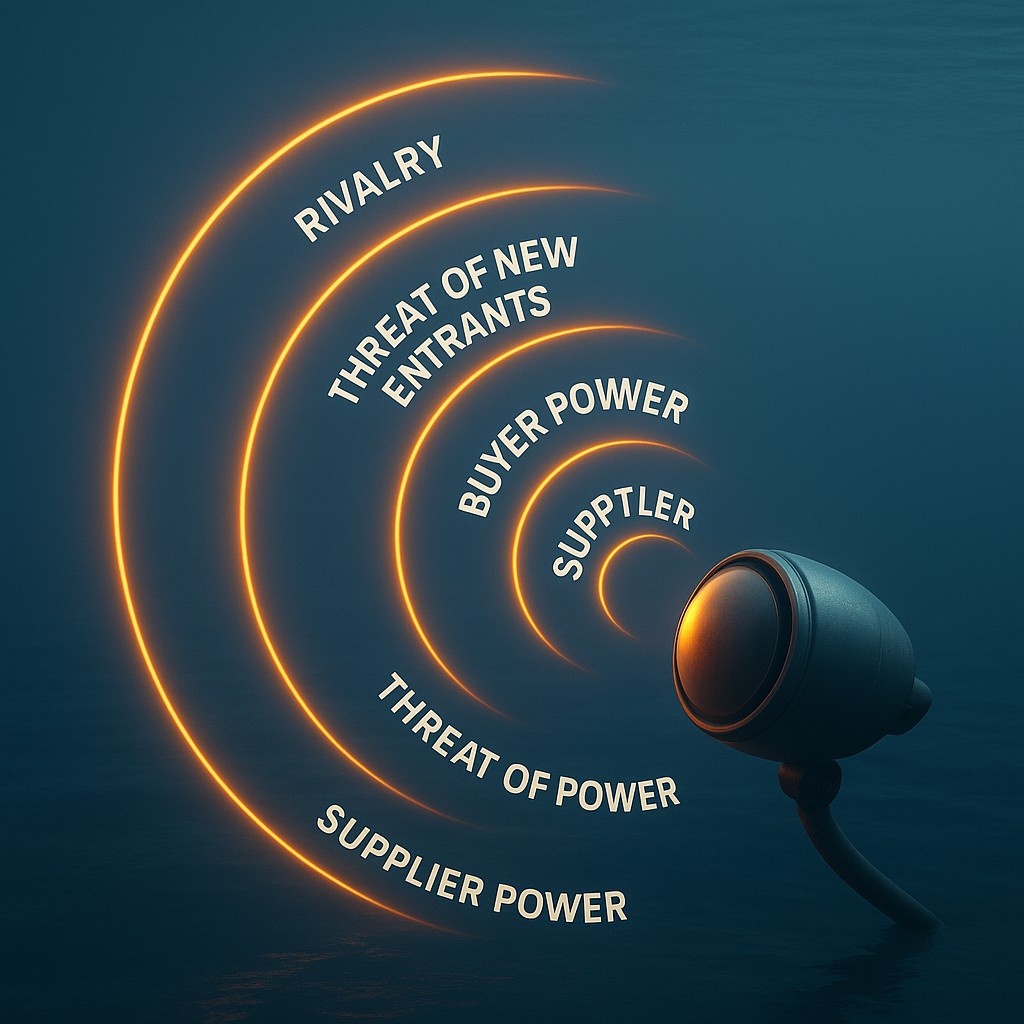
Imagine you’re the captain of a sleek sailing ship, eyes locked on a distant horizon where a chest of gold gleams. You’ve got a strong vessel, a loyal crew, and a map pointing straight to the prize. But as you set sail, you realize the ocean isn’t just open water - it’s a chaotic swirl of rival captains, sudden storms, and merchants who charge top dollar for a single barrel of fresh water. Success doesn’t just depend on how fast your ship sails. It’s about reading the hidden currents that decide whether you’ll strike it rich or vanish beneath the waves.
In the business world, these hidden currents were first charted in 1979 by a sharp strategist named Michael Porter. He saw that most leaders only looked at their immediate rivals, like ships eyeing each other in the fog. But Porter knew the real “weather” of an industry comes from five powerful forces that constantly push and pull on a company’s profits. Understanding them is like installing a high-end sonar system - suddenly, you can spot dangers before they hit, and find the calm zones where others founder.
Seeing the Whole Battlefield
To master your market, stop thinking of competition as a simple face-off between two companies selling the same thing. Porter’s Five Forces model asks you to look at the entire battlefield - the full ecosystem that shapes every business. Profitability isn’t down to luck or just “working harder.” It’s built into the structure of the industry itself. If you were opening a coffee shop, you wouldn’t only worry about the café across the street. You’d also consider the cost of coffee beans, the rise of energy drinks, and how easy it is for someone else to pop up next door tomorrow.
Each of these forces eats into your profits. When they’re strong, no one makes much money. Think of the airline industry - sky-high fuel costs, tight rules, and passengers who’ll switch carriers for $5. Margins get razor-thin, and nobody wins. But when the forces are weaker, many players can thrive at once. By spotting which forces are strongest, a business can build defenses or even change the rules to its advantage.
The Heat of Direct Competition
The most visible force is the daily grind with rivals. This shows up as price wars, flashy ads, and a rush to roll out new features. When competition gets fierce, it becomes a race to the bottom: companies slash prices until no one profits. This usually happens when lots of similar-sized companies battle for a shrinking market - fighting over a fixed pie instead of growing it.
Another thing that heats up rivalry? High exit costs. Picture this: shutting down a factory costs more than running it at a loss, due to specialized equipment or long-term contracts. So even if a company is losing money, it stays in the game. That keeps the market packed and prices low. But in markets where products stand out - like luxury watches or designer perfumes - rivalry is more polite. Brands don’t just compete on price, so everyone keeps healthier profit margins.
The Quiet Threat of New Competitors
While you’re busy watching current rivals, be alert for newcomers crashing the scene. This is the “threat of entry,” and it hinges on how high the walls are around your industry. If it’s cheap and easy to start up - no special skills, little cash - any profitable market will soon overflow with new players driving profits back down. Think of the app world: a teenager with a laptop can go up against a billion-dollar company in weeks.
To keep outsiders out, established businesses rely on “barriers to entry.” These include economies of scale - big companies can produce so cheaply that new rivals can’t compete on price. Others include high startup costs (like the billions needed to build a chip factory), strong brand loyalty, or legal protections like patents. If you hold the patent on a life-saving drug, you don’t have to fear a new competitor showing up overnight.
When Customers Call the Shots
We often see customers as allies, but in Porter’s framework, their “bargaining power” can drain your profits. If you have only a few buyers, or they buy in bulk, they can dictate terms. Imagine a small parts supplier sending 80% of its output to Walmart. If Walmart demands a 10% price cut, the supplier has no real choice - refuse, and it might lose its main customer.
Buyer power also grows when products are all pretty much the same. If a customer thinks “a gallon of gas is a gallon of gas,” they’ll pick the cheapest, forcing sellers into a price war. And in today’s digital world, customers have more power than ever. They can check prices from fifty stores in a few seconds. That transparency gives them the upper hand, making it tough to charge more unless you offer something truly special.
Pressure from the Supply Chain
On the flip side, there’s the “bargaining power of suppliers.” Just as strong customers can push prices down, strong suppliers can push your costs up. A supplier has power if their product has no real replacement, or if your business isn’t crucial to their sales. Take a small PC maker: you depend on Microsoft and Intel. Their operating systems and chips are industry standards, so they can set prices - and you’ll pay, because people won’t buy your computers without them.
Suppliers also gain leverage when switching is painful. If your office runs on a certain software platform, switching providers could mean months of retraining and data headaches. Knowing this, suppliers can slowly raise prices without fear of losing you. Smart companies fight back by finding alternative suppliers - or even buying their own, a move called “backward integration.”
The Silent Rise of Substitutes
Perhaps the trickiest force is the “threat of substitutes.” This isn’t about a rival selling the same thing. It’s about a different product solving the same problem. For a movie theater, the real threat might not be the theater down the block - it could be Netflix, video games, or even a nice evening at the park. If a substitute offers better value, customers will switch.
Plumbers may only see other plumbers as rivals, but if an easy-to-use DIY pipe sealant hits the market, that’s a substitute that could steal their work. The danger? These threats often come from outside the industry. The postal service didn’t see email as a rival until it was too late. Landline companies lost ground to mobile phones, which are now being edged out by messaging apps. To stay ahead, businesses must offer something a substitute can’t copy - like a unique experience, top-tier service, or a brand that makes customers feel like insiders.
Profits: Why Some Industries Win and Others Struggle
To see how these forces play out, compare two very different industries - one where profits run high, and one where everyone scrapes by.
| Force |
Favorable Industry (e.g., Soft Drinks) |
Unfavorable Industry (e.g., Trucking) |
| Rivalry |
Moderate; brands compete on image and taste. |
Intense; mostly focused on cutting prices. |
| Threat of Entry |
High; bottling and distribution require huge investment. |
Low; almost anyone with a truck and license can start. |
| Buyer Power |
Low; individual consumers have little influence. |
High; big clients dictate shipping rates. |
| Supplier Power |
Low; ingredients like sugar and water are cheap. |
High; fuel and truck costs are fixed and steep. |
| Substitutes |
Moderate; people still love their favorite soda. |
High; rail, air freight, or future self-driving fleets. |
Clearing Up the Confusion
A common error is to treat Porter’s Five Forces as a one-time exercise. People analyze their industry once, file the report, and forget it. But industries evolve. A new technology can suddenly empower a supplier - or make it easy for anyone to enter your market. This tool isn’t a static checklist. It’s a live radar. If you’re not checking it every year or two, you’re driving blind.
Another myth? “Bigger is always better.” Size helps against some forces, but it also makes you a target. A giant might dominate suppliers, but it can’t pivot quickly when a substitute emerges. Smaller, nimble companies often find “sweet spots” where the five forces are weaker. A craft coffee roaster doesn’t fight Starbucks on price - they compete through quality, story, and community, where buyers stay loyal and don’t bargain hard.
Finding Your Strategic Edge
Now that you’ve seen how the Five Forces work, what’s next? The goal isn’t just to map the landscape - it’s to find a spot where your business can stand strong or even reshape the game. That’s called “positioning.” If buyer power is your main threat, you might build loyalty programs or features that make switching costly. If new rivals can jump in easily, invest in branding to create a moat they can’t cross.
Smart strategy means choosing your battles. No company can dominate all five forces. Trying to do everything just burns resources. Instead, focus on the one or two forces causing the most damage. This might mean stepping back from markets where the pressure is too great. Sometimes, the best move is to change the game - like innovating a new production method that removes a powerful supplier from the equation.
Rewriting the Rules
In rare cases, a visionary doesn’t just adapt to the Five Forces - they redraw them. Think of Amazon. By building a massive delivery network, they created an entry barrier almost no one can match. With Amazon Prime, they turned buyers into loyal members, reducing their bargaining power. And by launching their own brands, they gained major control over suppliers.
This kind of thinking shifts the question from “How do I sell more?” to “How do I make selling easier?” It’s like playing chess while others play checkers. When you understand the structure behind your profits, every decision gets clearer. You see why a merger could backfire by increasing rivalry, or why a new tech is a gift because it weakens supplier power. You stop just reacting - and start sailing by the stars.
Your Turn to Strategize
Now you hold a powerful lens: Porter’s Five Forces. It reveals the hidden bones of any business, whether you run a lemonade stand, a tech startup, or a global empire. You no longer have to guess why some businesses soar while others fail - often, it’s not about the product, but the underlying forces at work. Strategy isn’t magic. It’s the practical skill of spotting patterns in market chaos.
As you move through the world, look at businesses with fresh eyes. Ask: Who really holds the power? Why is this company so expensive - or so cheap? What stops a rival from opening across the street? When you start asking these questions, you’re no longer just watching the economy. You’re navigating it - with a map in hand. Respect the forces. Work with them. Let them guide you. The horizon is wide, and with your new clarity, the treasure is within reach.