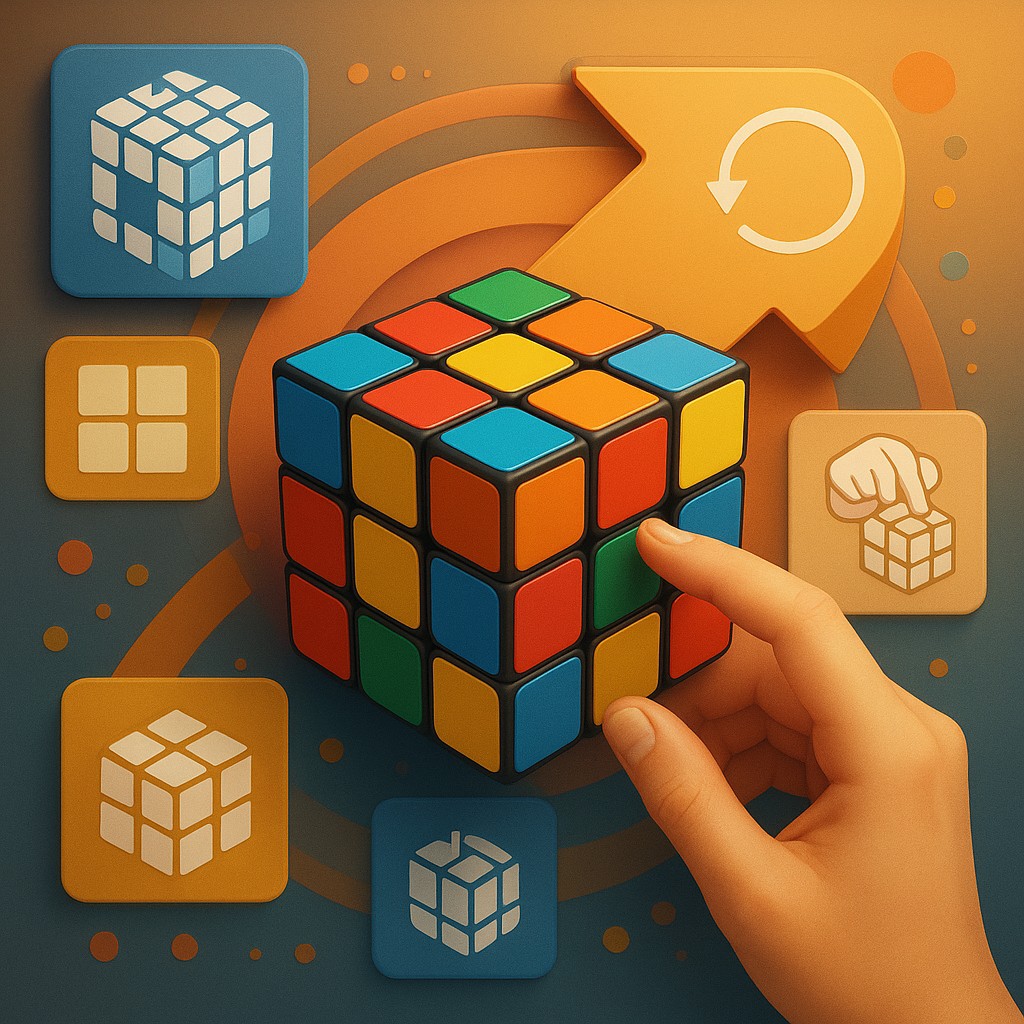
A Rubik’s Cube looks like a toy that wandered out of a math department and set out to ruin your confidence. You twist it once, and a colorful problem appears that seems to multiply every time you try to “fix” it. The secret is that fast solving is not about genius-level spatial power or supernatural finger speed. It comes from a steady method, training your hands to repeat the same moves, and learning to see the cube as patterns instead of a panic attack.
Speedcubers — people who solve quickly — are not inventing a new solution each time. They follow a plan, like a good chef: prep first, then a predictable sequence, then a clean finish. That plan turns the cube’s chaos into stages you can practice until your hands do them automatically. Once you see that, “fast” stops being a mystery and becomes a skill.
What follows is a practical guide to the technique most people use to learn speed solving: the CFOP method (also called the Fridrich method, though many people helped shape it). You will not need advanced math, only a willingness to practice and to be a little confused for a week or two, which is a normal part of learning.
The big idea: speed comes from a method, not luck
Fast Rubik’s Cube solving is basically three things working together: an efficient method, pattern recognition, and smooth turning. Beginners often try to solve by “making a side” and then forcing the rest into place. That is like building a bookshelf by randomly tightening screws until it looks straight. You might get there eventually, but it will take forever and leave you with a grudge against hex keys.
A good speed method breaks the solve into phases where each move has a purpose. CFOP does this by building a cross, pairing corner and edge pieces (F2L), orienting the last layer (OLL), and then permuting the last layer (PLL). Each phase sets up the next, so you are not undoing your own work. In speedcubing terms, you want fewer moves and fewer pauses.
The most common myth is that speedcubers memorize the entire cube. They do not. They memorize a toolkit: a bunch of short algorithms (move sequences) and the patterns that tell them which one to use. It is more like learning guitar chords than memorizing every possible song.
Meet the cube like a mechanic, not a magician
Before you try to go fast, understand what you are moving. A Rubik’s Cube has:
- Centers (one per face): they never change position relative to each other, so they set the color scheme.
- Edges (two colors): 12 pieces.
- Corners (three colors): 8 pieces.
If your cube has a white center, white will always be opposite yellow on standard cubes, and the centers decide everything. That fixes a common beginner myth: you do not “put colors where they belong,” you place pieces where the centers say they belong.
You also need basic notation so you can learn techniques precisely. The standard notation uses letters for faces: R (right), L (left), U (up), D (down), F (front), B (back). A move like R means turn the right face clockwise. R' means counterclockwise. R2 means a 180 degree turn. If you learn to read notation fluently, learning becomes much faster because you can follow written guides and practice consistently.
One more practical note that affects speed a lot: cube quality. A stiff, crunchy cube from a gift shop can still be solved fast, but it is like sprinting in hiking boots. A modern speedcube turns smoothly, corner-cuts (keeps moving even if slightly misaligned), and does not fight your fingers. If you are serious about speed, a decent cube and a little lubricant are like proper running shoes - they are not cheating.
CFOP in plain English: the four-phase road map
CFOP is popular because it grows with you. You can learn a beginner version quickly, then add techniques as you improve without changing the whole structure. Here is the roadmap with the “fast technique” focus in each phase.
Building the Cross: speed starts before you start
The cross is the foundation, and it is where speedcubers start planning ahead. The goal is to make a cross on one face (often white) with the edge colors matching the side centers too. Beginners often build the cross by trial and error and then fix the side colors later, which wastes moves and time.
Instead, aim to build the cross efficiently and, eventually, during inspection time — typically 15 seconds in competitions. At first, focus on making it cleanly with correct side alignment. Then start reducing moves by planning two or three edges before you start turning.
A helpful trick: think of cross edges as “keys” that must fit into four “locks.” Each lock is defined by the center colors. Your job is to insert the keys without scrambling the locks you already filled. That mindset keeps your cross from turning into a frantic twist-fest.
Common myth to ditch: the cross does not have to be on white. Many cubers learn white first, but advanced solvers do the cross on any color for efficiency. You can start with white until you are comfortable.
F2L: stop doing layers, start pairing pieces
F2L stands for First Two Layers, but the name hides the key idea: you solve the first two layers at once by pairing a corner with its matching edge and inserting the pair together. Beginners often solve the first layer corners, then the second layer edges separately. That works, but it is slower because it repeats effort and creates pauses.
In F2L, find a corner and its matching edge, pair them in the top layer, then insert the pair into its slot. Speed comes from reducing rotations (turning the whole cube) and building lookahead, which means spotting the next pair while inserting the current one. That is the real speed secret: fewer pauses. Fast solvers are not necessarily turning faster every moment, they are pausing less.
Start F2L with a small set of cases:
- Pairing when corner and edge are both on top.
- Fixing “stuck” pieces when one is in the wrong slot.
- Simple inserts into the front-right slot, then mirror to other slots.
One habit that pays off immediately: solve F2L with minimal cube rotations. Rotations cost time and disrupt your ability to track pieces. Try to keep the cube oriented consistently and use U moves (top turns) to bring pairs where you like to work.
OLL: make the top face one color
OLL is Orient Last Layer. That means you make all the top stickers the same color (usually yellow if white is on the bottom). This step feels like magic the first time because the cube can look wildly scrambled, and then suddenly the top becomes a clean color.
Full OLL is 57 algorithms, which is a lot. The good news is you do not start there. Most people begin with 2-look OLL, which uses a small set of algorithms to do OLL in two steps: first make a yellow cross on top, then orient the corners.
Speed technique here is mostly pattern recognition. You want to glance at the top and instantly think, “Ah, this shape.” The algorithms themselves are short and repeatable, like muscle-memory moves that feel more like choreography than memorization.
A misconception to correct: algorithms are not random. Many are built from common patterns like R U R' U'. The more you practice, the less they feel like memorization and the more they feel like familiar moves.
PLL: put the last layer pieces in the right places
PLL is Permute Last Layer. After OLL, the top face is one color, but the side pieces are still scrambled. PLL swaps pieces around without messing up the top color you just made.
Full PLL has 21 algorithms. Like OLL, you can start smaller with 2-look PLL, which breaks it into two steps: place corners, then place edges. This cuts the initial learning load while still allowing fast solves.
The speed technique in PLL is recognition plus clean execution. Many PLLs are fast, flowing sequences that reward good finger tricks. As you improve, you will aim to recognize PLL cases from the sides quickly without rotating the cube too much.
A realistic learning path (and the one table you’ll actually use)
The fastest way to get faster is not to learn everything at once. Upgrade your method in stages so each new piece of knowledge finds a place to attach in your brain. Here is a practical progression many speedcubers follow.
| Stage |
What you learn |
Algorithms to memorize (approx.) |
Typical milestone times (very rough) |
Main speed focus |
| Beginner layer-by-layer |
Basic solve, simple last layer |
5-10 |
2-5 minutes |
Consistency, clean turns |
| CFOP with 2-look OLL/PLL |
Cross, basic F2L, 2-look last layer |
15-25 |
45-120 seconds |
Reduce pauses, fewer rotations |
| Improved F2L |
More F2L cases, better piece tracking |
25-40 |
25-60 seconds |
Lookahead, efficiency |
| Full PLL |
All PLL cases |
40-60 |
15-35 seconds |
Recognition, finger tricks |
| Full OLL + advanced tricks |
All OLL, cross on any color, advanced F2L |
100+ |
sub-15 and beyond |
Planning, flow, turning speed |
Those time ranges vary widely, so treat them like weather forecasts, not promises. The real value is the focus column: it tells you what to practice at each stage.
The hidden engine: lookahead, finger tricks, and turning control
Most people think speed is about moving their hands faster. That is like thinking good writing is about typing speed. It helps, but it is not the core. Speedcubing’s engine is rhythm: consistent turning with minimal stopping.
Lookahead: solving the next thing while finishing the current thing
Lookahead means your eyes search for the next piece while your hands finish the current algorithm. It feels impossible until it suddenly feels normal. To build it, slow down on purpose during F2L and try to keep turning without pauses. Your goal is not maximum speed, it is minimum hesitation.
One drill: do timed solves where you deliberately turn at 70 percent speed but never stop moving. You may be slower at first, but you are training the skill that creates truly fast solves later.
Finger tricks: small efficient moves, not big dramatic twists
Finger tricks are ways to perform turns with small finger pushes instead of regripping the cube all the time. For example, many solvers do U moves with an index-finger flick. This reduces effort and keeps your hands stable.
You do not need a dictionary of finger tricks. Start with:
- U and U' flicks using your index finger.
- R and R' using wrist plus fingers without regripping.
- Avoid full-hand “claw turns” when a finger flick will do.
If a move forces you to reposition your whole hand each time, it is probably costing you speed.
Turning control: smooth beats fast and sloppy
A counterintuitive truth: turning slightly slower but accurately often makes you faster overall. Lockups, when the cube jams, destroy time and rhythm. Good speedcubers turn smoothly, align layers naturally, and only accelerate when they are confident.
If your cube locks up constantly, either your turning is too rough, your cube needs adjustment, or both. Speed is a marathon of tiny efficiencies, not one heroic burst of twisting.
Fixing the classic mistakes that keep people slow
A few habits act like anchors. Cut these, and you will improve without learning a single new algorithm.
First, too many cube rotations. Rotations are sometimes necessary, but beginners rotate constantly to “find” pieces. Train yourself to use U moves and look from different angles instead. Fewer rotations improve both speed and awareness.
Second, solving without a plan. Even a simple plan helps: during inspection, pick your cross color and locate at least two cross edges. Planning the whole cross comes later, but planning something is a good start.
Third, over-memorizing instead of understanding. If you learn an algorithm without knowing what it does, you will forget it, misapply it, or freeze mid-solve. Always connect an algorithm to a goal and a visual pattern: “this case makes a line,” “this swaps these edges,” and so on.
Fourth, ignoring practice structure. Random solves are fun, but improvement likes targeted practice. If your F2L is slow, do F2L drills. If your cross is messy, do cross-only practice.
Practice that actually works (without becoming a cube hermit)
Effective practice is specific and slightly challenging. You want time in the zone where you fail a bit, notice why, and adjust. That is how your brain upgrades itself.
Try a simple weekly routine:
- Cross drills (10 minutes): scramble, build the cross, reset. Aim for fewer moves and less thinking time.
- F2L drills (15 minutes): solve the cross, then solve only F2L and stop. Focus on no pauses and fewer rotations.
- Last layer practice (10 minutes): repeat 2-look OLL and PLL algorithms until they feel automatic.
- A few full solves (10-15 minutes): apply everything, but stay relaxed and controlled.
Record a handful of solves sometimes. Watching yourself is mildly painful, like hearing your recorded voice, but it reveals issues you cannot feel while solving. You will spot unnecessary rotations, pauses, and awkward grips.
Bringing it all together: the “fast technique” in one sentence
The technique to solve a Rubik’s Cube fast is to use an efficient step-by-step method like CFOP, train F2L pairing and lookahead to reduce pauses, and drill last-layer algorithms until recognition and execution become automatic. That is the whole game: efficiency plus flow plus repetition. Finger speed is the icing, not the cake.
If you are at the beginning, your next best step is 2-look CFOP with basic F2L. If you are already there, improve F2L lookahead and learn full PLL. And if you are deep in the hobby, welcome — you now notice cubes in movies and judge actors for fake turning.
A closing push: your future self solves in one smooth rhythm
The Rubik’s Cube rewards a rare kind of progress: the kind you can feel in your hands. One week you stop pausing after every pair. Another week your cross takes half the moves. Then one day you finish a solve and realize you were calm the whole time, like the cube finally agreed to cooperate. That moment is not luck, it is practice becoming instinct.
Keep it playful. Time yourself, but do not let the timer become your boss. Learn one small improvement at a time, celebrate the clean solves, and trust that speed is a side effect of doing the right things smoothly. The cube is not smarter than you, it is just more colorful about it.