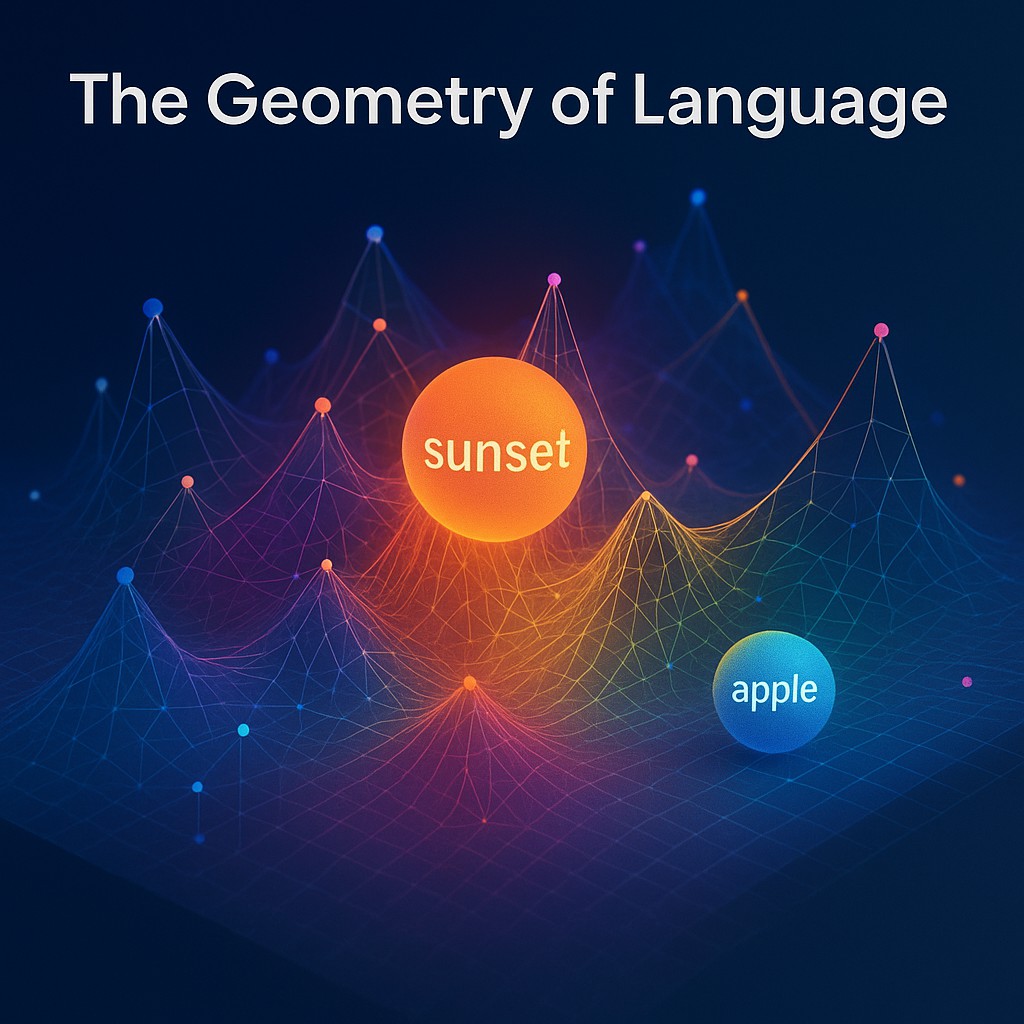
Imagine trying to explain a "sunset" to someone who has spent their entire life in a dark cave. You might describe the warm glow of amber and violet, the way the light softens as it nears the horizon, or the cool shift in the evening air. To a person, these descriptions paint a vivid picture because we have a lifetime of physical senses and cultural context to draw from. However, when you try to explain that same sunset to a computer, you hit a wall. To a machine, the word "sunset" is just a specific string of characters, no different from a random jumble like "snutse" or "xyzzy." It has no eyes to see colors and no skin to feel the temperature drop.
For decades, the biggest hurdle in computer science was bridging this gap between human nuance and machine logic. We tried giving computers dictionaries, but those definitions only led to more words, creating a loop of confusion. If a computer looks up "apple" and finds "a round red fruit," it then has to look up "round," "red," and "fruit." It never actually grasps the essence of what an apple is. The breakthrough came when we changed our perspective. Instead of trying to teach computers what words mean, we started teaching them where words live. By turning language into a massive, multi-dimensional map made of numbers, we found we could teach machines to navigate human thought using the precision of geometry.
Mapping the Galaxy of Human Speech
When we think of a map, we usually think of two dimensions: latitude and longitude. With just those two numbers, you can find any spot on Earth. Word embeddings take this concept and expand it to a level that would make a traditional mapmaker dizzy. In a typical language model, a word is represented by hundreds or even thousands of coordinates instead of just two. Each number tracks a specific slice of meaning, even if those slices are too abstract for a human to name. One number might track "formality," another might track "liquidness," and a third might track "royalty." Together, these numbers form a "vector," which is essentially a point in a huge, digital space.
This layout is not random; it is built through intense observation. Algorithms like Word2vec or GloVe scan billions of pages of text, from Wikipedia entries to classic novels, looking for patterns of behavior. They follow a simple theory: you can define a word by the company it keeps. If the word "bark" often appears near "dog," "leash," and "park," the computer calculates a coordinate that places "bark" near those terms. If "bark" also appears near "tree" and "forest," the model creates a vector that sits in a clever middle ground. The result is a mathematical universe where words with similar meanings are literal neighbors.
The Mathematical Poetry of Vector Relationships
One of the most striking discoveries in word embeddings is that the space between words actually holds meaning. This is not just about putting "cats" and "dogs" in the same area; it is about the "directions" that exist between points. Researchers found that if they took the vector for "King," subtracted the vector for "Man," and added the vector for "Woman," the resulting coordinate was incredibly close to the vector for "Queen." This was a "Eureka" moment for AI. It proved the model had not just memorized words – it had mapped the underlying concepts of gender and power.
This mathematical logic allows AI to solve analogies with surprising accuracy. The distance and direction between "Paris" and "France" is nearly identical to the distance between "Tokyo" and "Japan." By following these invisible geometric rails, the computer can solve problems it was never specifically taught. It understands that "walking" is to "walked" what "swimming" is to "swam" because the "past tense" direction is a consistent jump across the map. We have turned the messy, beautiful chaos of human language into a logical grid where relationships are solved through simple math.
| Concept |
Human Perspective |
Computer Perspective (Embeddings) |
| Word Meaning |
Senses and memory |
A specific point in a space with 300+ dimensions |
| Synonyms |
Words that feel the same |
Points that are mathematically close together |
| Analogies |
Logical comparisons |
Consistent "steps" or directions between points |
| Context |
The situation or "vibe" |
The density of neighboring words on the map |
| Learning |
Education and life |
Analyzing how often words appear together |
Proximity Versus True Understanding
A common mistake when using modern AI is believing the machine truly "knows" what it is talking about. When a chatbot describes a "crunchy, sweet apple," it feels like the machine is remembering a snack. In reality, the machine is just navigating the neighborhood of "apple" and finding that "crunchy" and "sweet" are its closest permanent residents. The computer has no "aha!" moment. It does not know that an apple is food; it only knows that "apple" and "food" are a very short mathematical distance apart. This distinction is vital because it explains why AI can sometimes state things that are impossible in real life but likely in language.
This "proximity logic" also means that if an AI only reads sci-fi novels, its map of the world will be skewed. In its version of the map, "Mars" might be closer to "home" than "Earth" is. Because these maps are built on human writing, they also mirror our own social biases. If historical texts consistently place "doctor" closer to "man" and "nurse" closer to "woman," the AI learns these as "correct" geometric relationships. It does not see prejudice; it only sees a pattern in the numbers it was given. Understanding word embeddings means being aware of the invisible biases baked into the data we give our machines.
The Invisible Architecture of Daily Life
You likely use word embeddings dozens of times a day without knowing it. When you type a search and the engine suggests "Did you mean..?" or shows results that do not even contain your specific keywords, you are seeing embeddings at work. The search engine is not just looking for matching letters; it is looking for "areas of meaning." If you search for "feline physician," the engine knows to show you "cat vet" because those terms live in the same corner of the map. It understands your intent because it understands the neighborhood.
This technology also drives the recommendation lists on streaming services and the translation apps on your phone. When an app translates a sentence from English to Spanish, it does not just swap words like puzzle pieces. It takes the "meaning vector" of the English sentence and finds the closest match in the Spanish map. This allows the translation to keep the spirit and tone of the original, rather than the clunky, word-for-word swaps of the past. We now live in a world where numbers allow us to move past the barriers of individual languages.
A Multi-Dimensional Future
The story of word embeddings shows how humans can solve complex problems with creativity. We took something as personal and subjective as language and found a way to link it to the reliability of math. By focusing on relationships instead of definitions, we opened a door for software to join the human conversation. This does not take away from the magic of poetry; instead, it shows how connected our thoughts really are. The fact that "hope" and "light" sit near each other in a computer’s memory reflects how we have used those words together for centuries.
As we move into an age defined by AI, remember that you are looking at a magnificent, sprawling map. Every time you speak or write, you contribute a tiny data point to the shared geography of human thought. The AI does not "think" like we do, but it is an expert at reading the room on a global scale. By seeing language as a landscape, we can better navigate the digital world and perhaps learn something new about how we connect ideas in our own minds. The next time you use a word, imagine it landing like a glowing pin on a vast map, lighting up its neighbors and showing exactly where you stand.