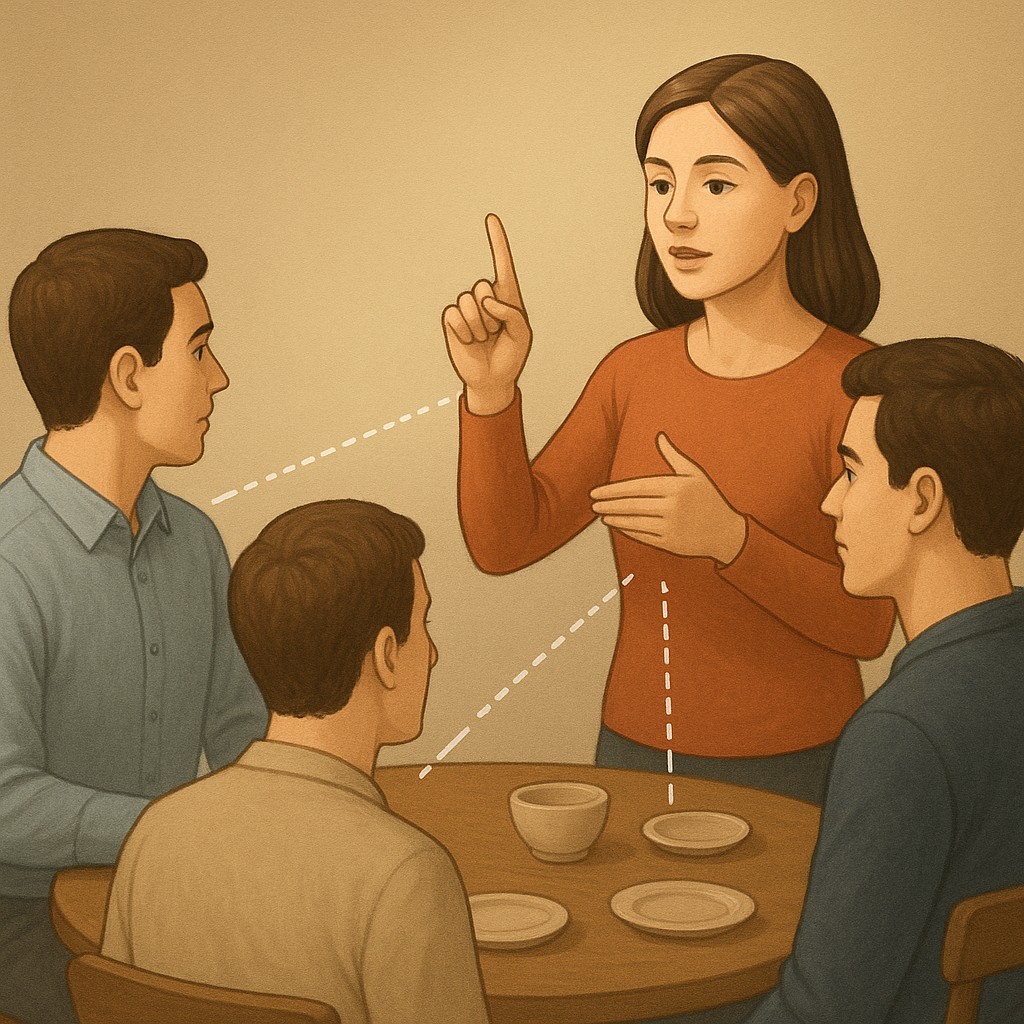
Imagine you are at a dinner party where three different men named Mike are sitting at the table. As the conversation flows, someone says, "He told him that he wasn't happy about what he said to him." In a spoken language like English, this sentence is a grammatical mess. Without constant, clunky interruptions to clarify, the listener has to guess which Mike is upset and who did the offending. We rely on the pitch of our voices, the situation, and frantic pointing to keep the story straight. This happens because sound waves move through time in a straight line. We can only say one word at a time, and once spoken, those words vanish, leaving only a fading memory for the listener to track.
Now, imagine the same scene in a signed language, such as American Sign Language (ASL) or French Sign Language (LSF). Instead of struggling with a pileup of "he" and "him," a signer treats the air in front of them like an invisible, high-definition whiteboard. They "pin" the first Mike to a spot on their left, the second to a spot on their right, and the third slightly further out. For the rest of the talk, those specific coordinates in space represent those specific people. This is the magic of spatial indexing. It is a powerful mental and linguistic tool that allows sign languages to handle complex information with a level of precision that spoken languages often move too slowly to match. By turning the three-dimensional area around the body into a working database, signers create a visual map of logic that stays "active" until the topic shifts.
Mapping the Mind onto Physical Space
At the heart of this system is the "referential locus." In English, a pronoun like "it" is a generic placeholder that the speaker must constantly redefine. A locus, however, is a specific point in the signing space that keeps a permanent meaning for the duration of a story. When a signer introduces a character, they don't just sign the person's name; they physically ground them in the air. For example, if a signer is talking about a heart doctor and a patient, they might gesture toward a point on their right side while introducing the doctor. From that moment on, that specific cubic inch of empty air literally is the doctor.
This process works so well because it uses the human brain's natural talent for remembering locations. From an evolutionary standpoint, we are much better at remembering where something is than we are at memorizing a long list of abstract names. When a signer wants to refer back to the doctor twenty sentences later, they don't need to repeat a title or use a vague pronoun. They simply point their finger, glance over, or even tilt their head toward that spot on the right. This "spatial retrieval" acts as a direct link to the original idea, cutting through the confusion that often ruins spoken pronouns.
The beauty of this system is that it isn't limited to people. Signers use spatial indexing for abstract ideas, timeframes, and even "what if" scenarios. You can place "the past" behind your shoulder, "the future" in front of you, "democracy" on the left, and "dictatorship" on the right. By physically separating these ideas, the signer can show the relationship between them through movement. If democracy is sliding toward dictatorship, the signer moves the sign from one specific point in space toward the other. This isn't just a metaphor; it is a grammatical rule that makes the structure of a thought visible and easy to touch.
The Grammar of Movement and Directional Verbs
Spatial indexing really stands out when you add verbs. In English, verbs like "give," "help," or "tell" are usually static. The word "give" sounds the same whether I am giving you a book or you are giving one to me. We rely on word order (Subject-Verb-Object) to tell the difference. In many sign languages, however, the verb itself travels through the space the signer has already mapped out. This is called verb agreement or directional signing, and it is a masterpiece of efficiency.
If I have placed you on my right and myself in the center, and I want to say "I give to you," I start the sign for "give" at my chest and move my hand toward that spot on the right. If I want to say "You give to me," I start the sign at that right-hand spot and move it toward my chest. The movement itself identifies both the giver and the receiver at the same time. This allows signers to explain complex social interactions with a single, fluid motion that would require a whole sentence in English.
Compare how different languages handle a simple three-way interaction. If a narrator is describing a scene where a teacher helps a student while a principal watches, the spatial clarity of signing is obvious:
| Feature |
Spoken English Approach |
Signed Language (Spatial Indexing) |
| Identification |
Uses names or repetitive titles (The teacher, the student). |
Assigns each person a unique "locus" (Left, Right, Center). |
| Pronoun Use |
Uses "he/she/it," which gets confusing if genders match. |
Points to established spots; no confusion between subjects. |
| Action Direction |
Needs word order (X helped Y) or passive voice. |
The verb physically moves from Locus A to Locus B. |
| Memory Load |
High; listener must track "who is who" through context. |
Low; the "map" is visually present in the air. |
| Abstract Ideas |
Requires long phrases (In regard to, whereas). |
Places concepts in separate zones to show a clear contrast. |
Keeping the Airwaves Clear and Consistent
One might wonder how a signer prevents the air from becoming a cluttered mess of invisible people. The answer lies in "spatial hygiene," a set of strict grammatical rules. When a conversation moves to a brand-new topic, signers use specific markers, such as a sharp blink, a shift in body posture, or a "clean slate" gesture. This signals that the previous map is being erased. It is the linguistic equivalent of clearing a chalkboard. Once the transition is made, those spots in the air are reset and can be given to new characters or ideas.
This system also uses "eye gaze" as a second layer of information. A signer doesn't just point with their hands; they often look at the spot they are talking about. This gaze acts as a powerful clarifies. If a signer is "becoming" a character through a technique called role-shifting, they will turn their body and look toward the spot where the other character was placed. This creates a virtual reality environment where the listener can "see" where everyone is standing, even though the room is empty. It turns a monologue into a theatrical, multi-dimensional experience.
Furthermore, the distance and height of these spots can show social status or physical size. A signer might "place" a child at a lower point and an adult at a higher point. If they are talking about a boss they dislike, they might place that person’s locus further away to show emotional distance. This uses the 3D nature of space to add layers of meaning that would require extra adjectives or adverbs in a spoken tongue. The space itself becomes a tool for expression.
Overcoming Misconceptions about Visual Language
A common mistake is thinking that spatial indexing is just "fancy pointing" or "acting." This is not the case. Brain research shows that when signers use spatial indexing, they aren't just using the parts of the brain that handle vision and movement. Instead, they are using the classic language centers, such as Broca’s and Wernicke’s areas. For a signer, that spot in the air is a grammatical unit, not just a physical location. It is a mental variable, much like "X" or "Y" in math, that holds a value until the problem is solved.
Another myth is that this system is the same in every sign language. While using space is common to most gestural languages, the specific rules for how that space is carved up vary. Just as English and Japanese have different sentence structures, American Sign Language and British Sign Language have different ways of managing their "air-maps." This reveals that spatial indexing isn't just a natural result of being "visual"; it is a highly evolved, cultural technology for managing information.
This system also challenges the old idea that "real" language must be made of sounds. Spatial indexing proves that the human drive to communicate will adapt to whatever physical tools are available. If we have voices, we use pitch and sequence. If we have hands and eyes, we use geometry and depth. The underlying "software" of the human mind, the need to track who is doing what, remains the same. Only the "interface" changes to make the most of our vision and space.
The Mental Power of the Invisible Map
Learning about spatial indexing does more than just teach us about grammar; it reveals the incredible flexibility of the human brain. We are not stuck with only one way of thinking. By "pinning" our ideas to the world around us, we can follow deep, complex stories without getting lost. This system provides a unique form of "distributed thinking," where we offload some of our memory work onto the environment, using the space in front of us as an extension of our own minds.
Next time you find yourself stuck in a confusing conversation where everyone is "he" or "she" and no one knows who did what, take a moment to admire the elegant solution found in the signing community. The air is not just empty space; it is a canvas for logic, a theater for storytelling, and a precise filing system for human experience. This perspective reminds us that communication is not just about the words we choose, but about how we organize our thoughts in the world we live in. You might even find yourself wishing you could reach out and pin a few of your own runaway ideas to the air, creating a map that others can finally see.