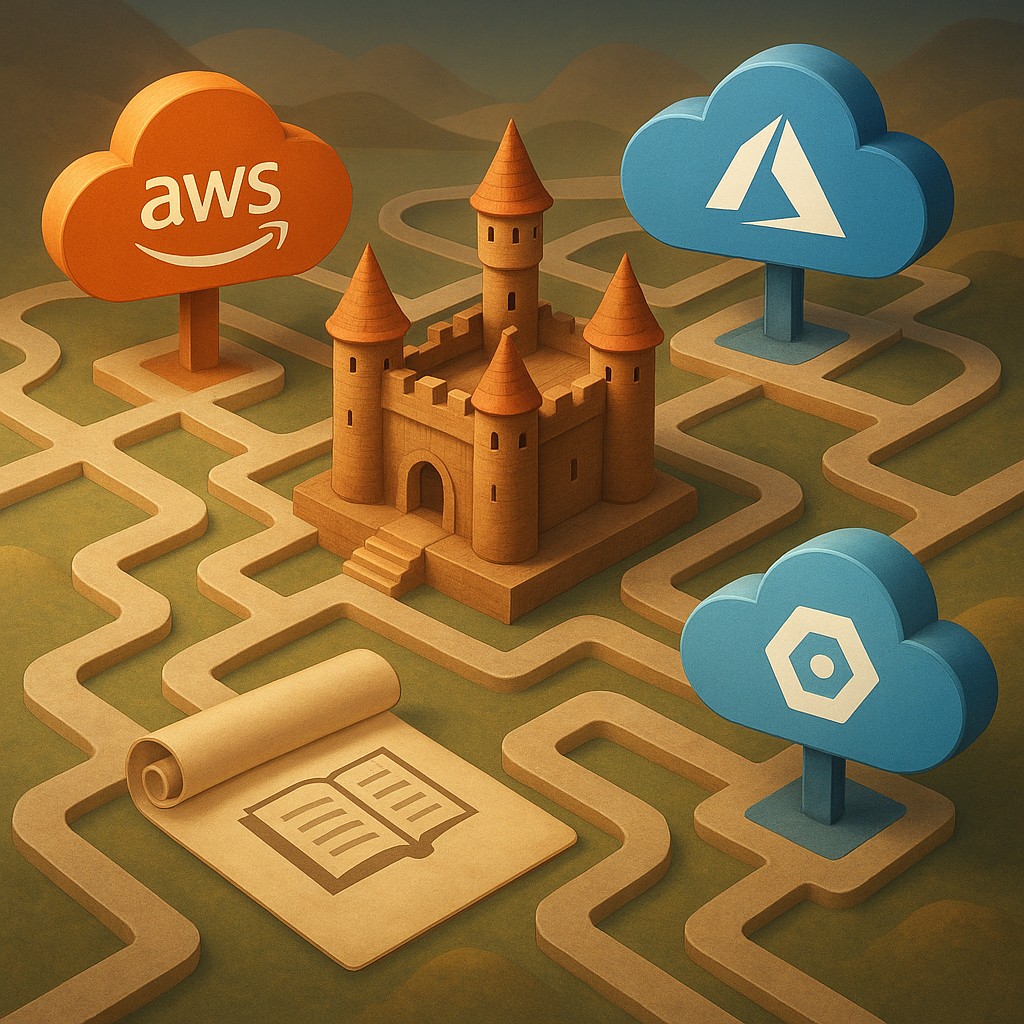
Imagine, for a moment, that you are the architect of a vast, high-tech kingdom. In the early days, you built everything in a single valley. You used local stone and the specific tools of the master masons who lived there. It was fast and efficient. But as your kingdom grew, you realized that relying on one valley was a mistake. A drought, a local earthquake, or even a sudden price hike from those masons could bring your entire civilization to a halt. To protect your legacy, you decide to expand into three different valleys, each run by different guilds with their own languages, tools, and customs.
The problem, of course, is that you now have to manage three different sets of rules. One valley uses metric units, another uses imperial, and the third measures everything in "ox-lengths." If you want to ensure every house in your kingdom is fireproof, you cannot simply send one letter. You have to write three different manuals, hire three sets of inspectors, and hope nothing gets lost in translation.
This is the exact dilemma facing modern digital organizations. They use multiple cloud providers like Amazon Web Services (AWS), Microsoft Azure, and Google Cloud Platform (GCP) to keep their data safe and their costs low. However, they often find themselves trapped in a technical labyrinth where "security" means something slightly different in every language.
Navigating the Maze of Modern Cloud Complexity
In the early 2010s, the goal for most companies was simply to "get into the cloud." It was a single destination, often a committed relationship with one provider. Today, however, most businesses use a multi-cloud strategy. They scatter data and applications across various providers so that if one goes down, the business stays up. This is not just about having a backup; it is about digital sovereignty-the ability to maintain control over your own data. By spreading their digital footprint, companies avoid being held hostage by the pricing or the technical whims of a single vendor, a problem known as "vendor lock-in." If you build your entire company on a foundation that only one provider understands, you are essentially a tenant in a building where the landlord can change the locks at any time.
The challenge of this multi-valley approach is the "management tax." Every time a security team wants to update a privacy rule, they must manually change it within the specific interface of each provider. This is slow and leads to human error. A typo in a security setting in one cloud can cause a massive data leak, even if the other two clouds are set up perfectly. As companies grow, it becomes impossible for people to keep track of all these manual "knobs and dials." We are past the era where a technician could log into a console and click buttons to save the day. We are now in the age of global orchestration. To survive, we must stop thinking about individual servers and start thinking about "intent" - the final result we want to achieve.
The Translator at the Heart of the Machine
The breakthrough in managing international multi-cloud systems is the "abstraction layer." Think of this as a universal translator for digital rules. Instead of writing a rule like "use this specific AWS firewall setting," an organization writes a high-level policy in a standard language, such as: "all databases must be encrypted and hidden from the public internet." This central system takes that "intent" and automatically translates it into the technical dialects of AWS, Azure, and Google Cloud. This marks a shift from manual setup to what experts call Intent-Based Orchestration.
This system relies on "Policy as Code." By treating security and compliance rules like software code, organizations can track versions and history. if a rule needs to change, it is updated in one central location, tested in a safe "sandbox" environment, and then deployed across every cloud simultaneously. This ensures that no matter where data lives, it follows the same rigorous standards. Automation does the heavy lifting, checking every few seconds to ensure no developer has accidentally opened a "back door" or changed a setting that violates the company’s digital constitution. It is the difference between having a police officer on every corner and living in a city where the laws are physically built into the pavement.
Standardizing the Digital Wild West
To understand how these automated policies prevent vendor lock-in, we have to look at how they create a "middle ground" of technical compatibility. When your rules are automated and standardized, the underlying cloud provider becomes a "commodity" - a basic utility like water or power. If Azure raises its prices or Google offers a faster chip for artificial intelligence, the business can move its work because the security and compliance layers are already standardized. They do not have to spend six months rewriting their security protocols; the translator layer simply explains the existing rules to the new "valley."
| Governance Feature |
Manual Management (The Old Way) |
Automated Multi-Cloud Governance (The New Way) |
| Speed of Deployment |
Weeks of manual setup and audits. |
Seconds via automated, software-driven updates. |
| Consistency |
High risk of clouds drifting apart and becoming different. |
Absolute uniformity across all providers. |
| Vendor Freedom |
High lock-in; moving is too expensive and complex. |
High mobility; the system hides vendor-specific details. |
| Compliance Proof |
Sifting through logs for weeks to find evidence. |
Real-time dashboards showing active enforcement. |
| Error Handling |
Humans must step in for every fix. |
Automated repair; the system fixes itself. |
This table shows a fundamental shift in how we view digital infrastructure. In the manual world, the specific tools of the provider are the star of the show. In the automated world, the organization’s intent is the star. The provider is simply a utility, much like the electric company. You do not care if your electricity comes from wind or coal, as long as it powers your toaster. Multi-cloud governance aims to make computing just as interchangeable and reliable.
The Ghost in the Architecture
Despite the benefits of automated governance, there is a catch that prevents a perfect "cloud-neutral" utopia: architectural divergence. Every cloud provider wants to keep you in their ecosystem, so they invent proprietary features - tools they own exclusively - that are incredibly useful but impossible to copy elsewhere. For example, Google might have a specific machine-learning tool that processes data ten times faster than anything else. If you use that tool, you are "locked in" by the sheer power of the feature, even if your security policies are easy to move.
Automated governance can move your data and your safety rules, but it cannot always move the underlying "magic" that makes an app work. This creates a tension. Do you use "lowest common denominator" features so you can switch clouds at the touch of a button, or do you use high-performance, exclusive tools and accept some lock-in? Modern governance models do not fix this gap, but they do make the cost of those decisions clear. By using automated enforcement, a company can see exactly which parts of their kingdom can move and which parts are tied to a specific valley’s magic. This clarity is the foundation of digital sovereignty.
The Rise of Intent-Based Security
The most fascinating shift in this model is the changing role of leadership. In the past, a Chief Information Officer (CIO) was like a lead mechanic, worried about the tension of every belt and the oil level in every engine. Today, they are more like a lawmaker. Their job is to define the "desired state" of the system. They specify the "what" - the data must be private, costs must stay under a certain limit, and the system must be fast. The automated system then figures out the "how" across the various cloud landscapes.
This approach creates "self-healing" infrastructure. If a developer accidentally changes a setting in Azure that makes a database public, the automated engine detects that the "actual state" no longer matches the "desired state." It does not just send an email to a busy admin; it immediately reverses the change or shuts down the connection. This level of proactive enforcement allows international banks and healthcare providers to grow across borders without losing control of their most sensitive data. It turns the cloud from a chaotic frontier into a predictable utility.
As you step into this digital future, remember that the goal of multi-cloud governance is not just to manage technology, but to protect your freedom of movement. By investing in a "universal translator" for your policies, you ensure your kingdom is not defined by the walls of the valley where you started, but by the strength of the rules you carry with you. The cloud is no longer just a place you go; it is a capability you command. By embracing the power of intent and automating your guardrails, you can transform a complex web of global infrastructure into a secure, seamless landscape where your best ideas can flourish.