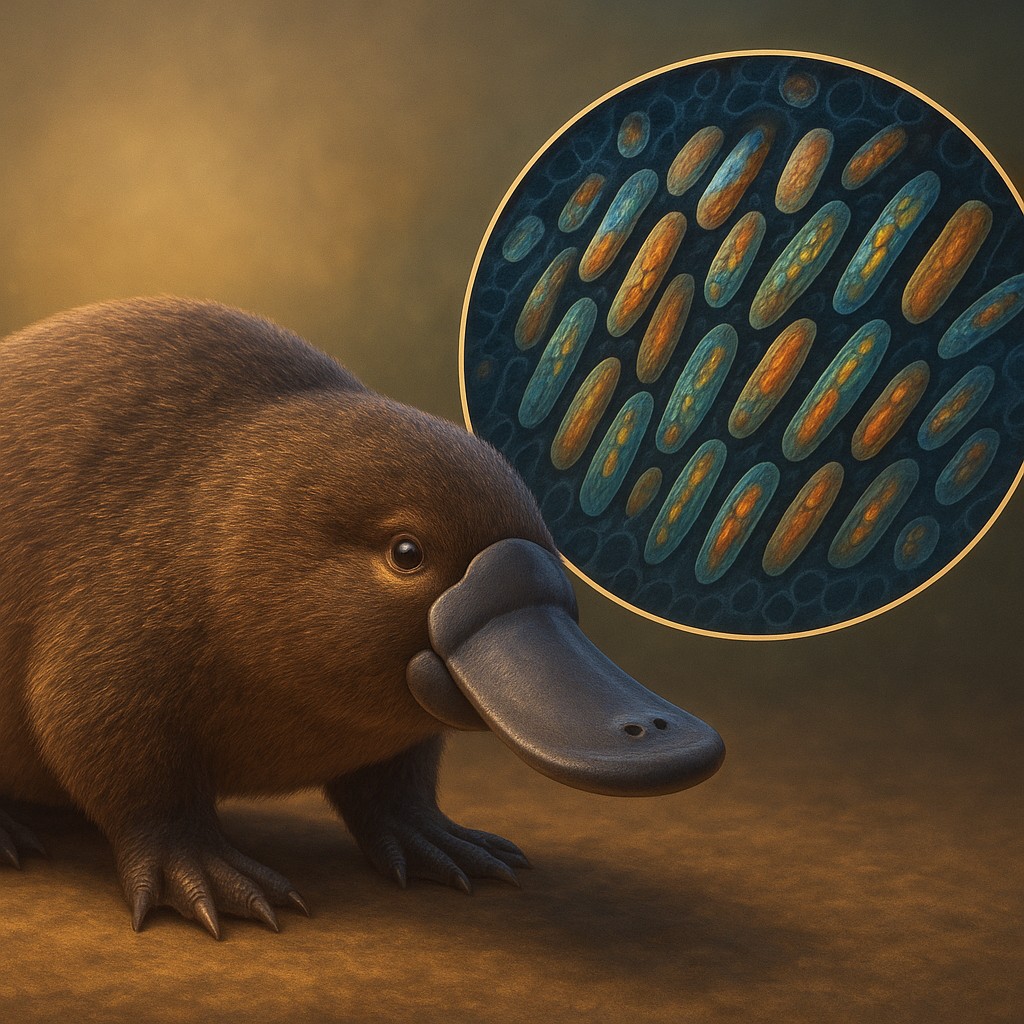
When you first see a platypus, it is easy to imagine that the "evolutionary factory" was simply clearing out its spare parts bin. It has a duck’s bill, a beaver’s tail, an otter’s feet, and the venomous spurs of a reptile. For centuries, biologists have treated this creature as a bit of a joke-a furry mosaic that should not exist, yet somehow thrives in the riverbanks of Australia. It is the only mammal that lays eggs, it hunts by sensing electricity, and it lacks a stomach entirely. The platypus proves that nature is happy to throw out the rulebook whenever it gets bored.
However, a recent study in the journal Biology Letters suggests the platypus is hiding secrets even deeper than its strange exterior. A research team led by Jessica Leigh Dobson looked into the microscopic structure of the animal and found something that should not be there. While we have always known the platypus looks like a bird on the outside, it turns out that at the cellular level, its fur hides a "bird-like" secret that challenges our understanding of mammalian biology. This discovery highlights how little we truly know about the history of the creatures that share our planet.
The Microscopic Building Blocks of Color
To understand why this matters, we first need to talk about melanosomes. These are tiny, specialized structures inside cells that produce and store melanin, the pigment that gives color to skin, hair, and feathers. In almost all mammals, from humans to horses, these melanosomes are solid, shaped like tiny pills or spheres. For decades, scientists believed mammalian melanosomes were always solid, providing a predictable range of browns, blacks, and reds.
Birds, however, took a different path. Certain bird species have hollow melanosomes, which are essentially tiny bubbles filled with air. These hollow structures are the "secret sauce" behind iridescence, the shimmering, metallic effect you see on a pigeon’s neck or a peacock’s tail. Because they are hollow, they interact with light in a much more complex way than solid structures do. They bend and scatter light to create vibrant colors that shift as you move.
Until now, biologists drew a clear line in the sand: birds could have hollow melanosomes, but mammals only had solid ones. In its typical fashion, the platypus has jumped over that line and erased it. After examining platypus fur with high-powered microscopes, the researchers found hollow, spherical melanosomes tucked away inside its dull brown coat. This is the first time such a structure has ever been found in a mammal, proving once again that the platypus is the exception to almost every rule.
The Mystery of the Invisible Shimmer
The most confusing part of this discovery is not just that these structures exist, but what they are doing-or rather, what they are not doing. In birds, hollow melanosomes exist to create eye-catching, iridescent colors. They are the animal kingdom's version of a high-end, metallic paint job on a sports car; they are meant to be seen. The platypus, by contrast, is not flashy at all. Its fur is a muted, muddy brown, which works as excellent camouflage when it searches for worms at the bottom of a river.
Why would an animal evolve a structure designed to manipulate light if it has no interest in being bright? This is the puzzle Dobson’s team is currently trying to solve. When they looked at over 100 other mammal species, including the platypus’s closest living relative, the echidna, they found nothing like it. The echidna, which looks like a walking pincushion, has the standard solid melanosomes you would expect. This makes the platypus a total outlier, even among its own kin.
One possibility is that these hollow structures do something other than create color. In evolution, every trait has a cost, so the platypus likely wouldn't keep such a specific cellular design without a good reason. If it isn't for show, it must be for a practical use. This forces us to look past color and consider the physical benefits of microscopic air bubbles.
Evolutionary Echoes and the Water Hypothesis
Biology often works in strange ways, sometimes keeping old traits around like a pair of comfortable shoes that are too good to throw away. One theory from the researchers is that these hollow melanosomes are a "leftover" from an ancestor shared by the platypus and the echidna. They suggest this ancestor was likely semi-aquatic, meaning it lived part of its life in the water, much like the modern platypus.
In this scenario, hollow melanosomes might have worked as microscopic insulation. Air is a great insulator, which is why we use double-paned windows in houses. For a small mammal diving into cold Australian waters, fur filled with tiny air pockets could have provided a major advantage, helping it keep body heat when the environment was trying to steal it.
| Feature |
Typical Mammals |
Typical Birds |
The Platypus |
| Melanosome Structure |
Solid and dense |
Can be hollow/air-filled |
Hollow and spherical |
| Visual Effect |
Matte or flat colors |
Often shimmering |
Matte brown |
| Main Purpose |
Color and sun protection |
Showy display/Attraction |
Unknown (Maybe insulation) |
| Evolutionary Status |
Standard mammal trait |
Specialized bird trait |
Unique outlier |
As the echidna moved away from the water to live on dry land, it may have lost the need for this specialized insulation. Over time, its melanosomes likely changed back to the solid state seen in most land mammals today. The platypus, staying true to its watery home, kept the trait. If this theory is correct, the platypus isn't just a weird animal; it is a living time capsule holding biological blueprints from ancestors that died out millions of years ago.
Rethinking the History of Hair
This discovery does more than just add to the list of platypus oddities; it forces scientists to rethink the timeline of how fur evolved. For a long time, the story was simple: mammals grew fur for warmth and camouflage, and that fur stayed fairly basic compared to the experimental feathers of birds. Studies on mammals from the age of the dinosaurs suggested that most early species had dull, simple coats.
However, if the platypus has had hollow melanosomes all this time, it suggests that mammalian fur has always had the potential to be more complex than we thought. It implies that evolution was experimenting much earlier than previously believed. We are starting to realize that the "boring" brown fur of ancient mammals might have hidden sophisticated structures that we simply didn't look closely enough to find.
It also raises questions about the origins of shimmering color. While the platypus doesn't use its hollow structures to shine, other research shows some mammals can produce a shimmer through different means, such as the way their hair is shaped. By finding bird-like structures in a monotreme (an egg-laying mammal), we see that the "tools" for creating complex visual effects were present very early in history, before the ancestors of birds and mammals fully split apart.
The Practical Joke That Keeps Giving
When the first platypus specimen arrived in England in 1799, the scientist George Shaw was so sure it was a hoax that he tried to use scissors on the pelt. He wanted to find the stitches where the duck bill had been sewn onto the beaver body. He found nothing. Ever since then, the platypus has taught us that nature does not care about our categories or organized boxes. It reminds us that "common sense" in biology is often just a lack of information.
The discovery of hollow melanosomes shows why basic research is so important. By looking at something as ordinary as brown fur, we have unlocked a new understanding of how cells are built. It reminds us that mysteries are often hidden in plain sight. The platypus remains a rebel, refusing to be normal even down to its smallest molecules.
As we continue to explore the microscopic world, we will likely find more "impossible" traits in animals we take for granted. The lesson of the platypus is simple: never assume you know everything about a species just because you have seen it before. There is always a deeper layer or an evolutionary secret waiting for someone with a microscope and a bit of curiosity. Even the most unusual creatures can hold the keys to the greatest scientific breakthroughs.