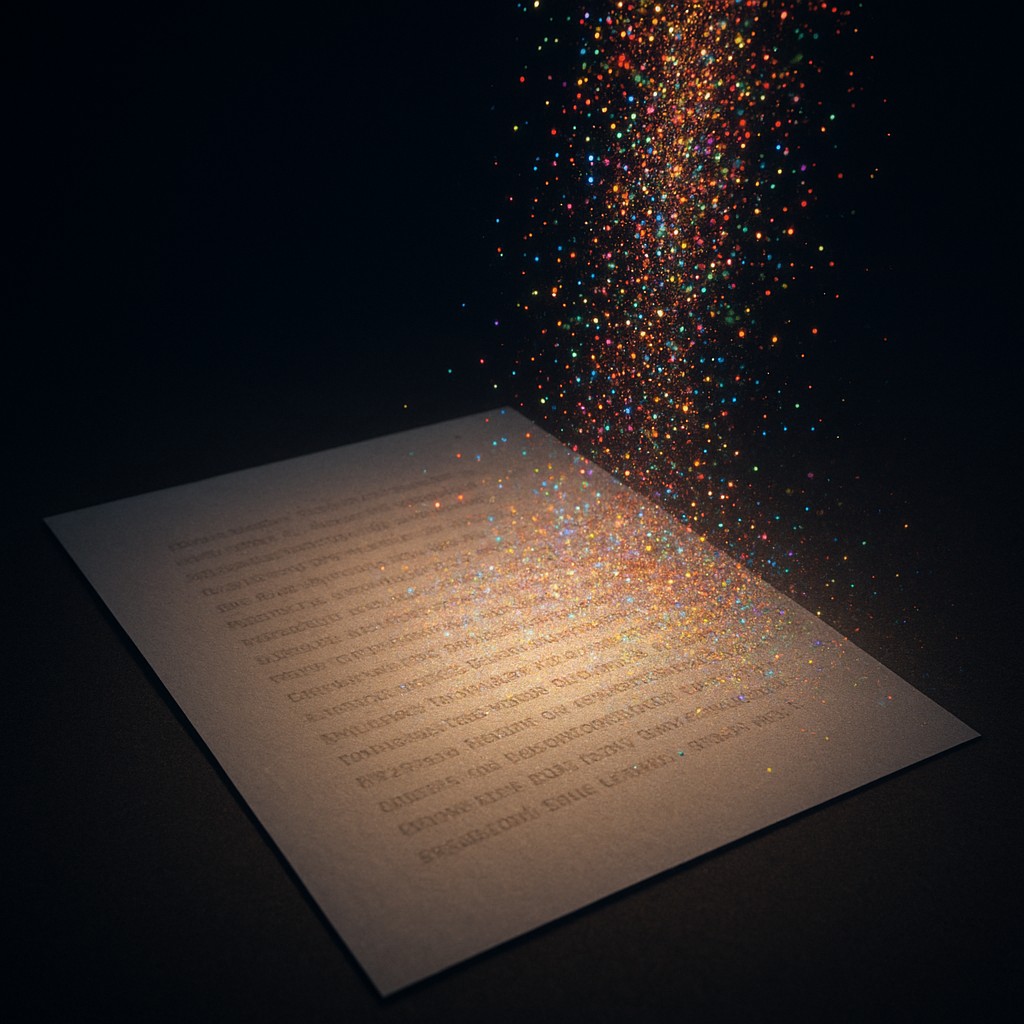
Imagine you are standing in a dark room, trying to read a letter written in incredibly faint gray ink on a slightly less gray piece of paper. No matter how much you squint or how close you hold the page, the signal - the information in the ink - is simply too weak for your eyes to process. Now, imagine someone starts tossing handfuls of fine, multicolored glitter into the air. Logic suggests this would make the letter even harder to read. After all, you are adding random, chaotic interference to an image you are already struggling to see. Yet, in a strange twist of physics, the presence of that glitter suddenly makes the letters pop into focus, allowing you to read every word with perfect clarity.
This counterintuitive phenomenon is known as Stochastic Resonance. In the traditional world of engineering and communication, noise is the ultimate villain. We buy noise-canceling headphones to drown out the hum of an airplane, and we get frustrated when a weak radio signal is swallowed by static. However, nature and high-level physics have a secret: when a signal is too quiet or too subtle to cross a certain "threshold" of detection, a precise amount of random noise can actually act as a bridge. By providing just enough extra energy to push that weak signal over the line, noise transforms from a nuisance into a vital partner in perception.
The Architecture of the Threshold
To understand how noise can be helpful, we first have to understand the concept of a threshold. Almost every system in the universe, from a digital camera sensor to a human nerve cell, has a "minimum height" requirement for entry. Think of it like a high-jump competition. If an athlete can only jump four feet, and the bar is set at five feet, they will fail every single time. In this analogy, the athlete is your signal (the sound you want to hear or the image you want to see), and the bar is the detection threshold. If the signal is "sub-threshold," meaning it falls below that limit, the system records absolutely nothing. To the brain or a computer, the signal simply does not exist.
Stochastic Resonance changes the game by shaking the floor. Imagine that while the athlete is jumping, the ground beneath them is vibrating up and down randomly. Most of the time, the floor might move down when they jump, making their attempt even worse. But occasionally, the floor will jolt upward exactly when the athlete leaps. That extra boost from the "noise" of the floor allows the athlete to clear the five-foot bar. Even though the athlete's own strength hasn't changed, the random interference provided the necessary energy to cross the threshold. This is the fundamental mechanism of the phenomenon: the noise "adds" to the signal to help it reach a level where it can finally be noticed.
This mechanism is not universal, however. It requires a specific set of conditions to occur. First, the signal must be weak, so weak that the system normally ignores it. Second, the system must be non-linear, meaning it doesn't just react the same way to everything it touches, but rather has a specific "trigger" point. Finally, the noise must be just right. If the floor is vibrating too gently, the athlete still won't clear the bar. If the floor is shaking violently like an earthquake, the athlete will be tossed into the ceiling, and the "signal" of their jump will be completely lost in the chaos.
The Goldilocks Zone of Chaos
One of the most fascinating aspects of Stochastic Resonance is that it follows a very specific "U-shaped" or "bell-shaped" efficiency curve. This is often referred to as the Goldilocks principle of noise. If you have zero noise, the weak signal remains invisible. As you slowly increase the amount of random interference, the clarity of the signal actually improves. You reach a peak of performance where the signal-to-noise ratio is at its absolute best. However, if you continue to add noise beyond that point, the quality drops off a cliff. The signal becomes drowned out by the very thing that was previously helping it.
This curve explains why we don't just fill all our devices with static. The goal is to find the "optimal noise level." In biological systems, this often happens naturally. Our sensory organs have evolved to function in an environment that is never truly silent or still. There is always the "noise" of our own blood rushing through our ears or the random firing of neurons in the brain. Researchers have found that these internal biological hums may actually be the reason we can detect such incredibly faint stimuli, like a single photon hitting the eye or a microscopic vibration against the skin.
| Noise Level |
Effect on Signal |
Practical Outcome |
| Too Low (Silent) |
Sub-threshold |
The signal is ignored; the system detects nothing at all. |
| Optimal (The Peak) |
Stochastic Resonance |
Noise boosts the signal over the limit; detection is maximized. |
| Too High (Chaos) |
Overwhelmed |
The signal is buried in interference; the system detects only noise. |
From Crayfish Tails to Human Skin
The first time scientists truly observed this in the wild, they weren't looking at high-tech labs; they were looking at crayfish. These crustaceans have tiny hair-like sensors on their tails that detect the movement of water, which helps them sense approaching predators. In a perfectly still tank, a very faint vibration in the water might go unnoticed. But when researchers added a small amount of turbulent "noise" to the water, the crayfish’s nerves began to fire in response to those same faint vibrations. The noise was making the crayfish more sensitive to the movements of its enemies.
Humans benefit from this quirk of physics just as much as crayfish do. Medical researchers have explored using Stochastic Resonance to help people with sensory impairments. For example, elderly individuals or people with nerve damage often struggle with balance because the sensory signals from the soles of their feet are too weak to reach the brain. By creating specialized "noise-vibrating" insoles that provide a faint, random hum to the bottom of the feet, doctors have successfully improved balance in these patients. The vibrating insoles don't provide a steady rhythm; they provide a stochastic (random) buzz that helps the faint pressure signals from the ground "pop" into the patient's consciousness.
This same principle applies to our hearing. Modern digital hearing aids are being developed to incorporate "dither," a form of low-level noise that helps the wearer interpret soft speech in quiet environments. Instead of just cranking up the volume of everything (which can be painful and distorting), these devices use the logic of Stochastic Resonance to make subtle sounds more detectable without overwhelming the ear with raw power. It turns out that a little bit of static might be exactly what you need to hear a whisper.
Digital Clarity Through Randomness
Beyond the realm of biology, Stochastic Resonance is a heavy hitter in the world of data science and digital imaging. If you have ever taken a photo with a smartphone in a very dark room, you’ve likely noticed "grain" or "noise" in the image. Usually, we think of this as a flaw, but in the context of advanced satellite imaging or deep-space photography, scientists sometimes intentionally use noise-related mathematical techniques to pull information out of the darkness. By understanding how noise interacts with sub-threshold signals, they can reconstruct images of distant stars that are technically too dim for the camera's sensor to "see" on its own.
In the world of audio engineering, this is known as "dithering." When a high-resolution audio file is converted to a lower-resolution format (like from a professional studio master to a standard CD or MP3), "quantization errors" can occur. These errors create a harsh, metallic distortion because the computer is "rounding off" the sound waves at a specific threshold. To fix this, engineers add a tiny amount of random white noise during the conversion. This noise prevents the signal from getting "stuck" at a certain threshold, smoothing out the sound and making it much more natural to the human ear. It is a paradox: you add noise to make the music sound cleaner.
This concept also has massive implications for the future of "Energy Harvesting." Engineers are currently working on microscopic devices that can capture energy from the ambient vibrations of the world around us, such as the hum of traffic, the swaying of a bridge, or the footsteps of people in a hallway. Often, these individual vibrations are too small to be converted into electricity. By applying the principles of Stochastic Resonance, these devices can be designed to use the "noise" of the environment to kick-start the energy conversion process, making them vastly more efficient at powering small sensors or medical implants.
Reclaiming the Value of the "Useless"
The most profound lesson of Stochastic Resonance is the realization that things we label as "useless" or "distracting" often serve a hidden structural purpose. We spend so much energy trying to achieve perfect, sterile environments, believing that if we could just remove all the "clutter" from our lives, our focus and perception would be flawless. But Stochastic Resonance suggests that a perfectly silent environment might actually be a sensory desert where we lose the ability to detect the subtle nuances of the world around us.
This doesn't mean you should go sit at a construction site to improve your concentration, but it does mean that our relationship with "noise" needs a rethink. Whether it is the soft background hum of a coffee shop that helps us get work done or the random fluctuations in our own brain chemistry that allow us to have creative "aha!" moments, there is a specialized power in randomness. When something is hidden just below the surface of your awareness, don't necessarily look for more light; sometimes, you just need a little more vibration to bring the truth into view.
As you move through the world, remember that your brain is not just a passive receiver of information; it is an active participant in a noisy, chaotic dance. The static on the radio, the grain on the screen, and the nervous hum of a crowd are not always barriers to understanding. Often, they are the very catalysts that allow the most delicate signals of life to be heard. By mastering the art of the threshold, we can learn to use chaos to our advantage, turning the static of the universe into a tool for unprecedented clarity and insight.