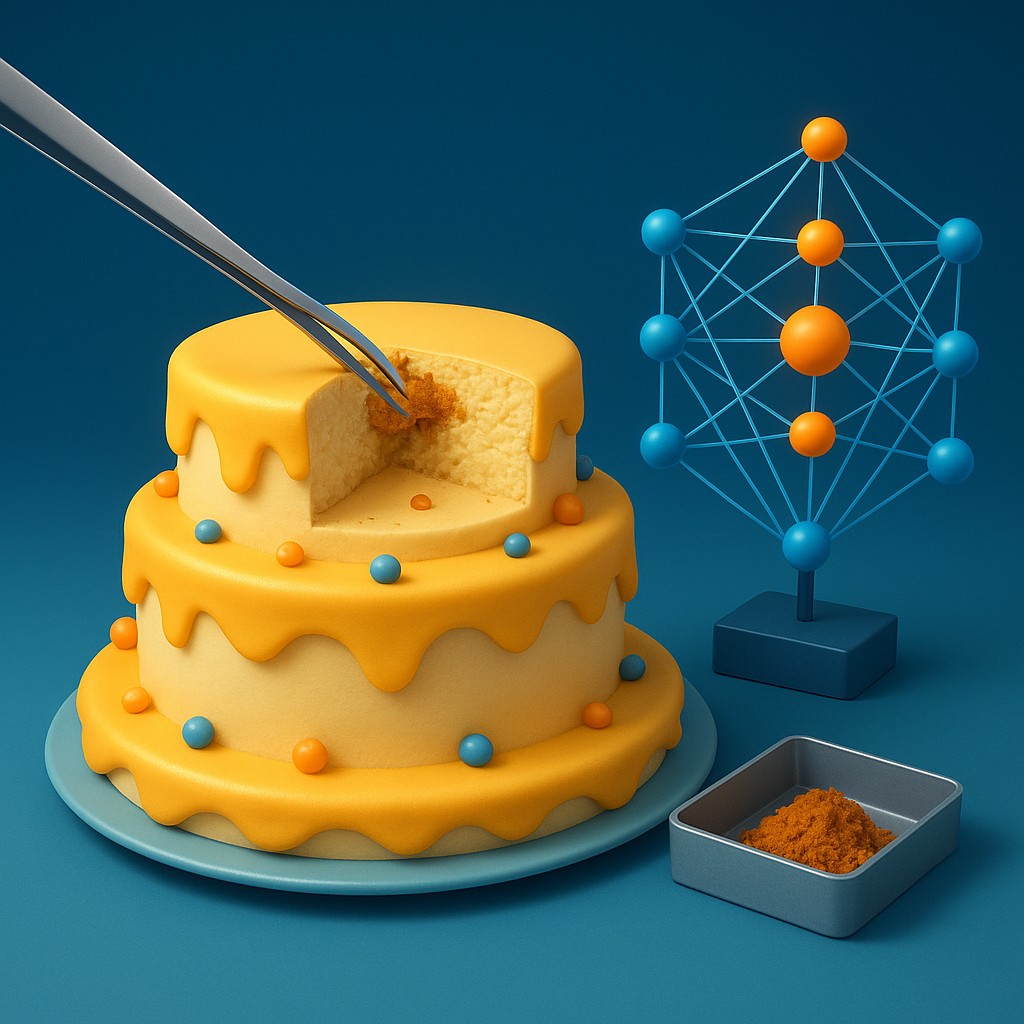
Imagine you are baking a massive, complex wedding cake. You have mixed in hundreds of ingredients: flour, sugar, eggs, and a tiny, specific pinch of high-grade saffron. Later, you realize that saffron was actually a pinch of sawdust. In a traditional database, removing that sawdust is as easy as deleting a row from a spreadsheet. But in a neural network, that sawdust has chemically bonded to every other molecule in the cake through the heat of the oven. You cannot simply reach in with tweezers and pull it out because it has influenced the texture, the rise, and the flavor of every single slice. To get rid of it, your only intuitive option is to throw the whole cake away and start from scratch. This is a time-consuming and expensive disaster if your "cake" is a trillion-parameter AI model that cost forty million dollars to bake.
This is the central crisis facing modern artificial intelligence. We live in an era where the "right to be forgotten" is a legal reality, yet our most advanced digital brains are remarkably stubborn. When you feed private medical records or a copyrighted photograph into a machine learning model, that data is not "stored" in a folder. Instead, it is digested and transformed into billions of tiny numerical adjustments, known as weights, which are scattered across the model’s architecture. Machine unlearning is the emerging, slightly magical science of performing a digital "lobotomy" so precise that the model forgets specific facts or patterns while retaining everything else it learned about the world. It is the art of un-baking the cake without ruining the frosting.
The Ghost in the Mathematical Machine
To understand why unlearning is so difficult, we have to look at how a model actually "knows" something. When an AI learns to recognize a face, it isn't memorizing a JPG file. It is adjusting a vast web of mathematical knobs until the entire system reacts in a specific way to certain pixel patterns. If your personal data was used to tune those knobs, your influence is everywhere. You aren't a single point in the system; you are a subtle hue blended into the entire painting. If a regulator or a user demands that your data be removed, the traditional "delete" button simply doesn't exist. The model doesn't have a designated sector for "John Doe's Address" that can be wiped clean.
This creates a massive friction point between technology and privacy law. Regulations like the GDPR in Europe mandate that individuals should have control over their digital footprint, but AI models are effectively "black boxes" that tend to hold onto their training data with a death grip. If a model accidentally memorized your credit card number because it appeared three times in a giant crawl of web text, that number is now part of the statistical probability of the model's output. Machine unlearning attempts to solve this by identifying which specific "knobs" in the neural network were most affected by your data and twiddling them back to a state where they no longer reflect your information, all while ensuring the model doesn't suddenly forget how to speak English or identify cats.
Reverse Engineering the Gradient Descent
The most direct way to ensure a model has forgotten something is to retrain it from scratch without the offending data. This is called "SISA" (Sharded, Isolated, Sliced, and Aggregated) training, a method that acts as a compromise. By breaking the training data into smaller "shards" and training separate mini-models, engineers only have to retrain a small portion of the system when a deletion request comes in. However, for the largest models, even this is too slow. This is where "approximate unlearning" comes in, which is the truly high-stakes part of the field. Researchers use specialized algorithms to calculate the "influence" of a specific piece of data. They essentially ask the math: "If this specific data point had never existed, which direction would these billions of weights have moved?"
Once they have that answer, they apply a "negative" update to the model. This is like a photo-negative of learning. If learning is the process of moving toward the "truth" of a dataset, unlearning is a calculated retreat away from a specific piece of it. One popular method involves "ascent" steps, where the model is intentionally trained to be more confused or less accurate regarding the specific data point slated for deletion. The trick is to do this with surgical precision. If you push the model too far away from the deleted data, you might unintentionally push it away from other, valid data. This causes a phenomenon known as "catastrophic interference," where the model’s general intelligence begins to crumble.
The Stability-Privacy Tradeoff
The ultimate goal of machine unlearning is to reach a state of "indistinguishability." This means that after the process is complete, the resulting model should look exactly like a model that was never trained on the deleted data in the first place. Achieving this is a balancing act between three competing interests: privacy, utility, and efficiency. You can have perfect privacy by deleting the whole model, but then it becomes useless. You can keep the model perfectly useful by ignoring the deletion request, but then you have zero privacy.
| Unlearning Approach |
Complexity |
Efficiency |
Accuracy Retained |
| Full Retraining |
Extremely High |
Very Low |
Perfect |
| Shard-Based (SISA) |
Moderate |
Medium |
High |
| Influence Functions |
High |
High |
Variable |
| Gradient Scrubbing |
Moderate |
Very High |
Moderate |
As shown in the table above, there is no "free lunch" in the world of unlearning. Methods that are fast and efficient often risk "feature leakage," where traces of the forgotten data still linger in the model's subtle biases. For example, even if a model is told to forget a specific person's medical history, it might still have "learned" enough from that person to make eerily accurate guesses about people with similar genetic markers. This is the "ghost" problem: the data is gone, but the statistical shadow it cast on the rest of the network remains. Researchers are currently developing "membership inference attacks" to test their own work, acting like hackers to see if they can still find remnants of the deleted data after the unlearning process is finished.
Moving from Static Security to Life-Cycle Management
The shift toward machine unlearning marks a fundamental change in how we think about data. In the old days of computing, we thought of data security like a fortress. You put the data in a secure vault, and as long as no one broke in, the data was safe. But in the age of AI, data isn't just stored; it is influential. It shapes the behavior of the tools we use every day, from search engines to medical diagnostic tools. This means we have to stop thinking about data as a static asset and start seeing it as a "digital influence" with its own life cycle.
Machine unlearning allows us to manage that influence over time. It gives us a "right to be forgotten" that is actually meaningful in a world where our information trains the next generation of intelligence. It also opens the door for "machine cleaning," where models could be purged of toxic biases or incorrect facts learned during the initial training phase. If a model learns a conspiracy theory or a harmful stereotype, unlearning techniques could theoretically "patch" the model's brain without having to spend millions of dollars and weeks of electricity building a new one from scratch.
The Future of Selective Memory
We are rapidly approaching a future where AI models will be dynamic, living entities rather than static snapshots of a training set. Machine unlearning is the key to making these systems ethical, legally compliant, and flexible. It transforms the "black box" of AI into something more like a chalkboard, where specific errors or private details can be erased while the core lessons stay visible. This isn't just a technical fix; it's a philosophical shift. It acknowledges that human beings have the right to change their minds about what they share with the world, and that our machines should be capable of respecting that choice.
As you navigate an increasingly AI-driven world, remember that the goal of technology shouldn't just be to remember everything, but to remember the right things. The ability to forget is actually one of the most sophisticated functions of the human brain-it is how we filter out noise to focus on what matters. By teaching our machines how to forget, we aren't making them weaker; we are making them more human, more responsible, and ultimately, more useful. The next time you delete an app or request a data wipe, know that a silent, complex dance of mathematics is happening behind the scenes to ensure your digital ghost truly finds its rest.