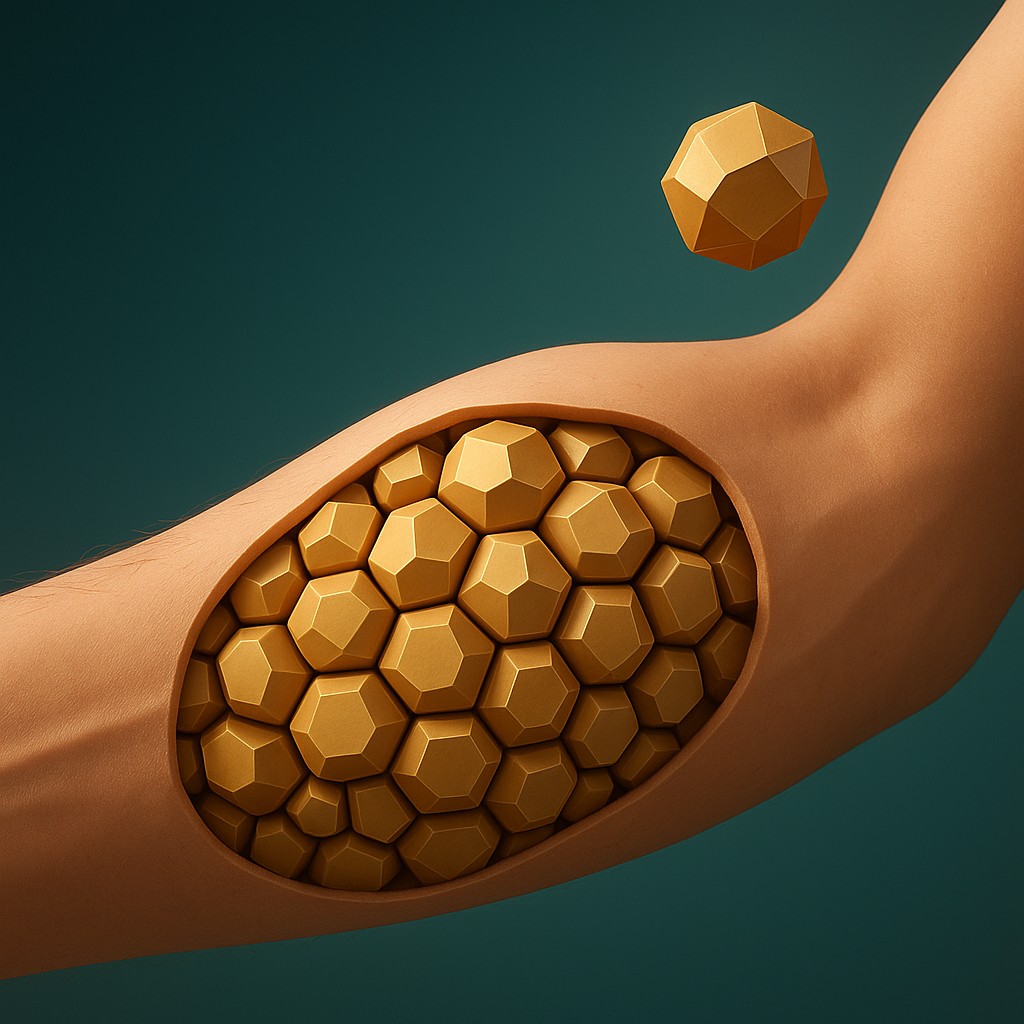
Take a moment to look at your forearm. To the naked eye, your skin looks like smooth, continuous parchment, perhaps broken up by a stray freckle or a hair follicle. It feels soft and flexible, yet it is arguably the most successful waterproof suit ever designed. If you soak in a bathtub for an hour, you do not double in weight from water absorption, nor do your internal fluids leak out onto the floor. This is a feat of biological engineering we often take for granted. We assume skin is just a generic bag that holds our parts together, but in reality, you are wrapped in a sophisticated, self-renewing mosaic. It is a structure that solves a geometric riddle first posed by the physicist Lord Kelvin in the 19th century.
The secret to this waterproof seal lies in a hidden architecture that goes far beyond simple layers. Your skin is constantly shedding, losing millions of cells every day, yet it never springs a leak. If your skin were made of simple cubes, bending your elbow would create gaps at the corners, much like grout cracking between square bathroom tiles. To prevent this, nature uses a much more complex shape as its primary building block. Deep within the outermost layer of your skin (the epidermis), your cells are shaped into fourteen-sided solids known as tetrakaidecahedrons. This specific 3D geometry is the golden ticket to maintaining a perfect seal in a flexible, moving environment.
The Geometry of a Perfect Space Filler
To understand why your skin cells aren't just flat discs or boxes, we have to look at the "Kelvin Problem." In 1887, Lord Kelvin wondered what shape could fill a three-dimensional space most efficiently using the least amount of surface area between the units. While a honeycomb of hexagons works perfectly for flat surfaces, 3D space is much more demanding. You need a shape that can stack infinitely without leaving any bubbles or gaps, while also being able to withstand stretching from many directions. The answer he proposed was the truncated octahedron – a solid with six square faces and eight hexagonal faces.
Your skin cells adopt this exact shape in the "granular layer," the transition zone just before they become the "dead" surface layer. Think of it as a biological puzzle where every piece is designed to lock with its neighbors on every single side. Because of the fourteen different faces, each cell has a massive amount of surface contact with the cells around it. This isn't just for show; it creates a winding, maze-like path for anything trying to get in or out. For a water molecule to escape your body, it can't just move in a straight line. It has to navigate the complex junctions created by these interlocking shapes, making the "leakage" process incredibly slow and difficult.
The Brick and Mortar Architecture
While the fourteen-sided shape provides the structural strength, the waterproofing requires a second component. In dermatology, this is often called the "brick and mortar" model. The cells themselves act as the bricks once they reach the surface. They are tough, scale-like structures filled with a protein called keratin. However, even the most perfectly shaped bricks need something to seal the gaps between them. This is where your body's natural oils, or lipids, come into play.
As cells move toward the surface, they release a cocktail of ceramics (ceramides), cholesterol, and fatty acids. These lipids act as the mortar, filling the narrow spaces between the fourteen-sided cells. Because the cells are so tightly woven due to their geometry, the body only needs a tiny amount of "mortar" to create a continuous, water-repelling barrier. This lipid layer is exactly why your skin resists water. When you see water beading up on your skin after a swim, you are seeing a chemical rejection: the oils in the gaps are literally pushing the water away, refusing to let it soak into your deeper tissues.
Evolution's Solution to Mechanical Stress
If our skin were a rigid shell like a crab’s, the geometry wouldn't matter as much. But humans are masters of movement; we twist, jump, reach, and compress our outer envelope thousands of times a day. A barrier made of simple spheres would be a disaster under this kind of physical stress. In a field of spheres, there is only one point of contact between any two units. If you pull on them, they easily roll away from each other, creating massive holes. Even cubes are risky because their sharp 90-degree corners are "stress concentrators" – places where the material is most likely to rip or wear out.
The fourteen-sided cell is the ultimate compromise between flexibility and stability. Its hexagonal faces allow for a certain degree of sliding without losing contact. When you clench your fist, the skin on your knuckles stretches thin, but those cells simply shift their positions while maintaining their interlocking grip. This geometry ensures that even when the skin is at its thinnest and most stressed, the seal remains intact. You are essentially wearing a suit of armor made of microscopic, self-adjusting polygons that refuse to let go of one another.
Maintaining the Barrier in a Changing Environment
The environment is constantly trying to sabotage your waterproof seal. Dry air tries to suck moisture out through evaporation, while harsh soaps try to dissolve the oil "mortar" holding the bricks together. When you have dry skin, you aren't just lacking water; the geometric and chemical partnership has broken down. If the mortar is stripped away, the edges of the cells begin to lift and curl, leading to the visible flaking we see as irritation.
The following table summarizes the different parts of this microscopic construction project and how they help your skin perform.
| Component |
Biological Term |
Function in the Barrier |
Geometric / Chemical Role |
| The Bricks |
Corneocytes |
Physical shield and structure |
Fourteen-sided shape for interlocking |
| The Mortar |
Lipid Lamellae |
Waterproofing and sealing |
Water-repelling fats that block moisture |
| The Rivets |
Corneodesmosomes |
Holding cells together |
Protein bridges that prevent peeling |
| The Filler |
Natural Moisturizing Factor |
Retaining internal hydration |
Attracts water to keep the "brick" plump |
Life in the Dead Zone
It is a great irony of biology that the layer of your body that keeps you alive is technically dead. The cells in the outermost layer have lost their nuclei and internal machinery; they are essentially protein-filled husks. However, this "death" is a deliberate sacrifice. By removing the active parts of the cell, the body can pack the keratin and the fourteen-sided structures much more tightly. A living cell is "squishy" and filled with fluid, making it a poor candidate for a rigid, waterproof brick. A dead, dried-out cell is much tougher and more predictable in its shape.
This transition from living cell to dead structural unit is a highly choreographed process. As cells rise through the skin, they flatten out and click precisely into their fourteen-sided configuration. If this process goes wrong, as it does in conditions like psoriasis, the cells reach the surface too quickly. They don't have time to form the correct shape or arrange their lipid mortar properly. This results in a barrier that is leaky and fragile, proving that the magic of skin lies in its meticulous geometric arrangement.
Correcting the "Flat Scale" Misconception
For a long time, even scientists thought of skin cells as simple, flat, overlapping scales, like the shingles on a roof. While that is easy to visualize, it doesn't explain how the skin stays waterproof when stretched. If you pull on a roof, the shingles will eventually gape. A better analogy is a high-tech 3D puzzle. Each cell isn't just sitting on top of the one below it; it is nestled into a complex pocket created by several other cells.
This interlocking nature is why your skin doesn't just wash away in the shower. It takes significant friction or the natural shedding process – where enzymes specifically break the protein rivets – for these cells to let go of each other. We are protected not by a single sheet of plastic, but by a collection of individual units acting as a single, unified wall. This distinction is crucial for medical science, as it helps researchers find better ways to deliver medicine through the skin by understanding exactly which "geometric doors" they need to unlock.
The Future of Synthetic Barriers
Understanding the fourteen-sided structure of the skin has big implications for the future of medicine and materials science. Engineers are now looking at these biological shapes to create better "breathable" waterproof fabrics and more effective artificial skin for burn victims. If we can copy the specific interlocking mechanism of human skin cells, we can create synthetic membranes just as durable and flexible as the real thing. We are moving away from thinking of barriers as solid walls and toward thinking of them as "smart geometries."
The next time you dry yourself off after a swim, think about the trillion or so fourteen-sided shapes currently covering your body. They are working tirelessly, clicking together like a master-level puzzle, to ensure you stay hydrated in a dry world and dry in a wet one. Your skin is a masterpiece of spatial mathematics – a reminder that sometimes the most complex problems in biology are solved with a simple change in shape. You aren't just a collection of cells; you are a perfectly tiled biological marvel held together by the elegant logic of geometry.