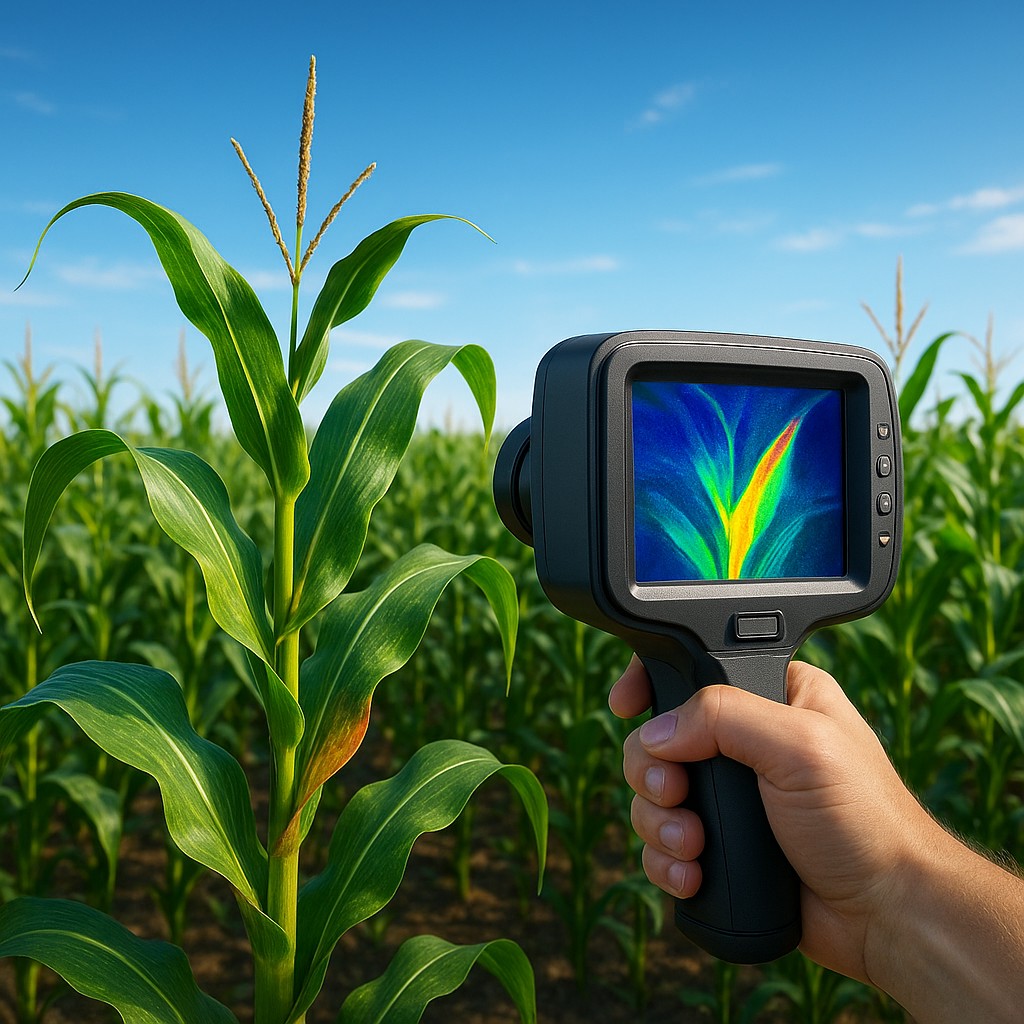
Imagine standing in the middle of a sprawling cornfield in mid-July. To the naked eye, it looks like a sea of vibrant, healthy green. You might walk the rows, inspect the leaves, and feel confident that the season is going well. However, deep inside the cells of those plants, a silent crisis could be unfolding. Perhaps a specific fungus has started to attack the chloroplasts (the parts of the cell that handle photosynthesis), or the soil has become so dry that the roots can no longer pull up enough water to stay firm. By the time you notice a yellowing leaf or a slight wilt, the damage is done, and your harvest has already been hit.
This "invisible lag" between the start of a biological problem and the moment it becomes visible has frustrated farmers for ten thousand years. Traditionally, farming has been a game of reacting to trouble rather than stopping it. We wait for a problem to appear, then we treat the entire field with water or chemicals just to be safe. But a revolution is changing how we "see" our food. By using hyperspectral imaging, we are moving past the limits of human sight. We are tapping into light signatures that reveal the internal health of a plant long before it shows any outward signs of struggle.
The Spectrum Beyond the Rainbow
To understand how we can see plant stress before it happens, we first have to realize how little of the world we actually see. Human eyes are tuned to a narrow band of light known as the electromagnetic spectrum, roughly from 400 to 700 nanometers. We see the "RGB" world: red, green, and blue. When light hits a leaf, the chlorophyll absorbs most of the red and blue light to power the plant and reflects the green. This is why plants look green to us. However, a massive amount of "information" bounces off those leaves in wavelengths we cannot perceive, particularly in the near-infrared and short-wave infrared regions.
Hyperspectral sensors differ from standard cameras because they don't just capture three broad channels of light. Instead, they break the spectrum into hundreds of narrow, side-by-side bands. Think of a standard camera as a piano player who can only hit three notes: low, middle, and high. A hyperspectral sensor is the full 88-key keyboard, plus another five keyboards stacked on top that play notes only dogs or bats could hear. By capturing these tiny slices of light, scientists can create a "spectral signature" for a plant. This signature acts like a fingerprint, revealing nitrogen levels, the thickness of cell walls, and the exact water content tucked inside the leaf tissues.
Decoding the Language of Leaf Chemistry
The magic happens when we look at how these light signatures change under pressure. When a plant is healthy, its cells are plump and full of water. This causes the plant to reflect near-infrared light in a specific, high-intensity pattern called the "infrared plateau." As soon as a plant lacks water, even before it wilts, those cell walls begin to lose their strength and the way they scatter light changes. The infrared plateau drops. To a human, the leaf is still green, but to a hyperspectral sensor, the leaf is screaming for a drink.
Similarly, chlorophyll levels are a primary indicator of nutrient problems or disease. Long before a leaf turns yellow (a process called chlorosis), the concentration of chlorophyll begins to dip. Hyperspectral sensors can detect a shift in the "red edge," which is the area where light reflection changes rapidly between the red and near-infrared spectrums. If this edge slides even slightly toward shorter wavelengths, it is an alarm for a farmer that the plant is starving for nitrogen. This level of detail allows for a move from "broad-acre" farming to "per-plant" management, where every square meter of a farm is treated like an individual patient with its own medical record.
| Sensor Type |
Wavelength Range |
Main Biological Indicator |
Practical Use Case |
| Human Eye |
400 - 700 nm |
Color, wilting, dead tissue |
Spotting late-stage damage |
| Multispectral |
3 - 10 broad bands |
Overall greenness and growth |
General field health mapping |
| Hyperspectral |
100+ narrow bands |
Chlorophyll, pigments, water |
Early stress and disease detection |
| Thermal Infrared |
7,000 - 14,000 nm |
Leaf surface temperature |
Measuring if pores are closing |
The Challenge of Biological Noise and Calibration
While hyperspectral data is incredibly rich, it is also notoriously difficult to understand without careful calibration. A plant's light signature isn't permanent; it changes based on the angle of the sun, cloud cover, humidity, and the specific variety of the crop. A "stressed" signature in a specialty tomato might look like a "perfectly happy" signature in a desert shrub. This is where advanced data science comes in. Researchers must build massive libraries of light data to serve as a baseline for comparison.
One of the biggest hurdles is telling the difference between different types of stress that look similar. For example, a lack of nitrogen and a certain type of root rot might both cause chlorophyll to drop. If a farmer sees a dip in the red-edge reflection and assumes it is a nutrient problem, they might dump expensive fertilizer on a field that actually needs a fungicide. To solve this, experts use these "fingerprint" libraries. By analyzing the entire spectrum, they can catch subtle differences. Perhaps a nitrogen deficiency affects one specific band of light, while a fungal infection creates a unique dip in another. This level of detail ensures the cure matches the disease.
Precision Agriculture in a Changing Climate
The ultimate goal of using these "eyes in the sky" (drones) or "eyes on the ground" (sensors mounted on tractors) is to use resources as efficiently as possible. In a world where water is becoming scarce and the environmental impact of chemical runoff is a major concern, we can no longer afford to guess. Using hyperspectral data, a farmer can program an automated irrigation system to skip the three acres that have deep soil moisture and only turn on the sprinklers for the specific patch showing early signs of thirst.
This approach, known as Variable Rate Application (VRA), turns the farm into a high-tech laboratory. Beyond just saving the harvest, this technology helps reduce the amount of chemicals we put into the Earth. When we only apply pesticides where a sensor has detected the invisible chemical signs of an insect invasion, we prevent unnecessary pollution of the ecosystem. We aren't just farming faster; we are farming smarter, using light to bridge the gap between human observation and the complex, hidden reality of how plants live.
As we look toward feeding a growing global population, our success will depend on our ability to listen to what the plants are telling us. Through the lens of hyperspectral imaging, the field is no longer a silent, green mystery. It is a data-rich environment where every leaf is broadcasting its health, its needs, and its potential. By learning to read these invisible signals, we move from being reactive observers of nature to precise partners in its growth, ensuring we can grow more with less while protecting the balance of our planet.