In the concrete jungles of the modern world, we have reached a spatial stalemate. We know that trees are the ultimate biological machines for scrubbing carbon dioxide from the air, yet our cities are often so packed with pipes, subway lines, and foundations that there is simply no room for roots to take hold. We want the benefits of a forest, but we have built a landscape where a sapling would have to fight through three layers of asphalt and a high-voltage power line just to find a drink of water. This creates a paradox: the areas that need air purification most, such as congested intersections and smoggy industrial zones, are the very places where traditional nature cannot survive.
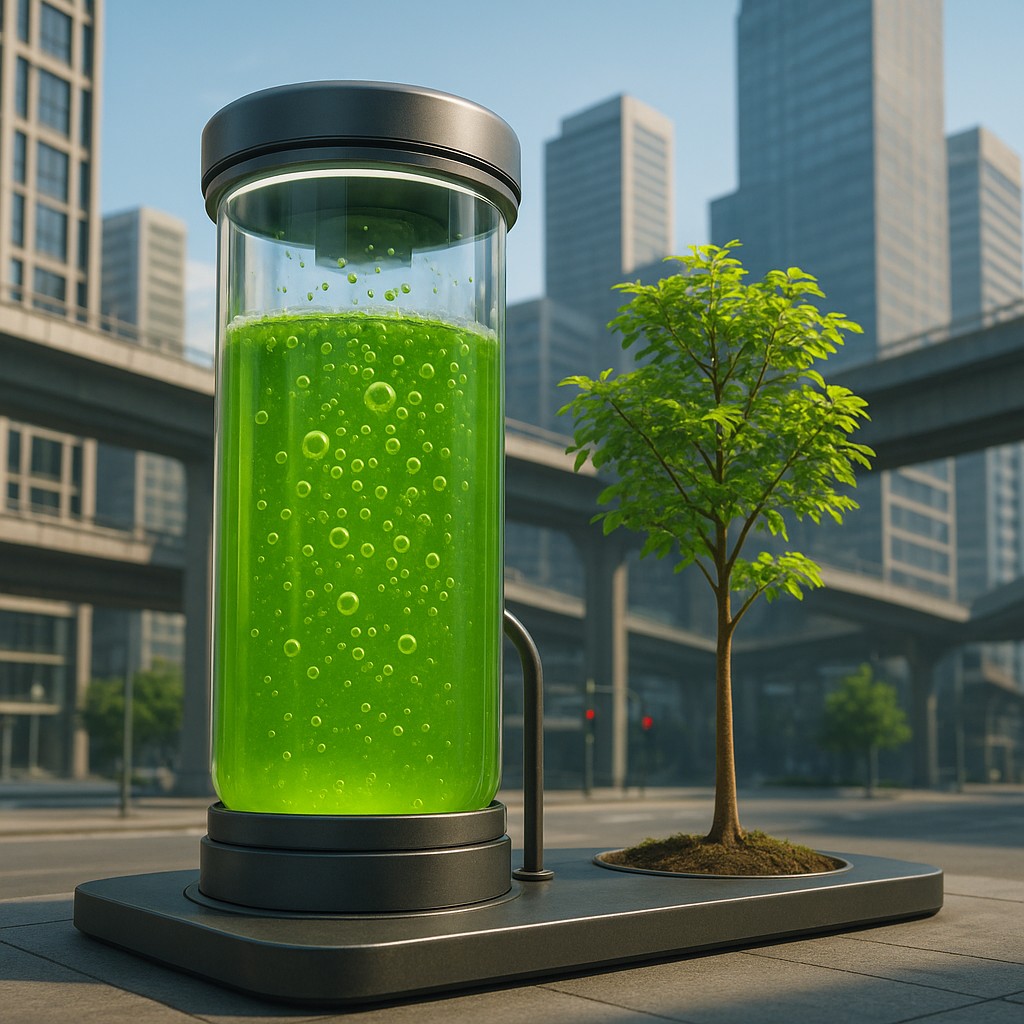
To solve this, scientists have begun to rethink what a tree actually is. If you strip away the bark, branches, and leaves, the core "engine" of a tree is photosynthesis, the process of using light to turn carbon dioxide into energy and oxygen. It turns out that you do not necessarily need a wooden trunk to run that engine. By moving the biological hardware into a tank of water and using microalgae, researchers have created "liquid trees." These sleek, glass canisters filled with bubbling green fluid represent a shift in thinking. Instead of seeing nature only as a decorative garden project, we are starting to treat air quality as a high-tech utility that can be scaled up as needed.
The Biological Engine Inside the Glass
At the heart of a liquid tree is a colony of microalgae, the microscopic organisms that have been the quiet heroes of Earth's atmosphere for billions of years. While we often give Amazonian rainforests all the credit for our oxygen, the phytoplankton and algae in our oceans actually produce about half of the world's supply. In a liquid tree, specifically the models being tested in cities like Belgrade, about 600 liters of water are filled with these single-celled powerhouses. Because algae live in water and do not need to spend energy building heavy trunks or thick bark, they move through their life cycles at an incredible pace.
The "liquid" part of the tree acts as a high-efficiency bioreactor, a vessel designed to support a biological environment. In a standard oak or pine, photosynthesis is limited by the surface area of the leaves and the changing seasons. Microalgae, however, are essentially "all leaf." Every part of the organism is actively working, and because they live in a controlled liquid environment, they can work year-round. This allows a single liquid tree unit to match the carbon-scrubbing power of two ten-year-old trees or 200 square meters of lawn, despite taking up a tiny fraction of the space. It is a dense, hyper-charged version of the forest floor, squeezed into the size of a park bench.
Engineering a City's Breath
To keep this green soup alive and effective in the middle of a bustling city, the system acts more like a life-support machine than a flower pot. A liquid tree is usually equipped with a small solar panel on its roof, which collects energy during the day to run a bubbling system. This pump pulls in the surrounding urban air, which is heavy with carbon dioxide and car exhaust particles, and forces it through the water. As the bubbles rise, the algae "grab" the carbon molecules to feed their own growth and release pure oxygen back into the air.
This bubbling mechanism is vital because it solves the bottleneck of gas exchange. In a traditional forest, gas exchange happens slowly through the tiny pores on leaves. In a liquid tree, the mechanical stirring ensures that every single alga cell gets a fresh supply of CO2 as quickly as possible. This efficiency is why the system is often cited as being up to 50 times more effective than a land-based tree of similar mass. It is a fascinating hybrid of biology and mechanical engineering, where the solar panel and the pump serve as the "lungs" that keep the internal "heart" of the algae colony beating.
Managing the Green Waste Stream
One common misconception about liquid trees is that they are "set it and forget it" installations. Unlike a redwood that can stand for centuries with very little help, a photobioreactor is a living, growing system that eventually becomes a victim of its own success. As the algae consume carbon and multiply, the water becomes crowded. If left alone, the algae would eventually block the light from reaching the center of the tank, causing the colony to collapse and die.
To keep the system running, crews must regularly harvest the excess algae. This "organic waste" is actually a valuable resource rather than a burden. The harvested biomass is essentially a concentrated cake of nutrients and stored energy. Depending on the species used, this byproduct can be processed into high-quality fertilizer for city parks, used as a base for carbon-neutral biofuels, or even dried and pressed into building materials. This turns the liquid tree into a tool for a circular economy: it cleans the air, creates a useful product, and starts the process over with a fresh, thinned-out population.
| Feature |
Traditional Hardwood Tree |
Liquid Tree (Bioreactor) |
| Primary Requirement |
Soil, deep root space, and time |
Water, solar power, and maintenance |
| CO2 Efficiency |
Moderate (limited by leaf surface) |
High (3D suspension) |
| Space Footprint |
Large (needs root and canopy room) |
Small (compact, vertical design) |
| Primary Benefit |
Shade, biodiversity, beauty |
Targeted air cleaning, nutrient yield |
| Maintenance |
Low (trimming, watering) |
Medium (harvesting, pump upkeep) |
| Best Location |
Parks, residential streets |
Intersections, bus stops, factories |
Navigating the Tradeoffs of Artificial Nature
It is important to view liquid trees not as a replacement for nature, but as a specialized tool for extreme environments. Critics often point out that a glass tank of green water lacks the soul of an ancient oak tree. They are right. Liquid trees do not provide a leafy canopy to cool the sidewalk through "sweating," known as transpiration, nor do they give birds a place to nest or offer the mental calm of a wooded grove. A city made only of liquid trees would feel sterile and industrial, lacking the complex ecosystem benefits that real trees provide to soil health and urban wildlife.
However, the choice for urban planners is rarely between an oak or a tank. Instead, the question is usually whether to have a blank concrete wall or a tank. In the highly polluted "canyons" created by skyscrapers, the soil is often so toxic or packed down that no tree could ever survive. In these specific spots, the liquid tree is a hero. It functions as a flexible utility, much like a streetlight or a fire hydrant, that can be dropped into a high-traffic area to immediately begin cooling the air and scrubbing smog. It is a practical solution for places where the battle for traditional nature has already been lost to pavement.
Scaling the Future of Living Infrastructure
As we look toward the future, the concept of the liquid tree is likely to evolve beyond standalone benches and into the very fabric of our buildings. Some architects are already experimenting with "bio-facades," which are essentially giant liquid trees built into the windows of skyscrapers. These systems could theoretically provide natural shade for the people inside, trap heat to insulate the building, and scrub the air for an entire city block at once. By treating carbon capture as a distributed network rather than a single task, we can begin to turn our cities from carbon sources into carbon sinks.
The real magic of the liquid tree lies in how it forces us to expand our definition of what "green" looks like. It teaches us that the best solutions often lie at the intersection of different fields, combining the ancient wisdom of the ocean’s oldest inhabitants with the precision of modern engineering. While it may look like a futuristic aquarium, the liquid tree is a reminder that even in our most crowded, paved-over environments, biology is still our greatest ally in keeping the planet breathable.
The next time you walk through a city center and feel the heavy weight of stagnant air, imagine a network of glowing green cylinders quietly pulsing with life, working 50 times harder than the grass under your feet to keep the atmosphere clear. Innovation like this proves that we aren't just stuck with the environments we’ve built; we have the power to upgrade our world with living technology. By embracing these "liquid forests," we aren't just cleaning the air, we are proving that even in the middle of a concrete desert, we can find a way to let nature, and ourselves, thrive once again.