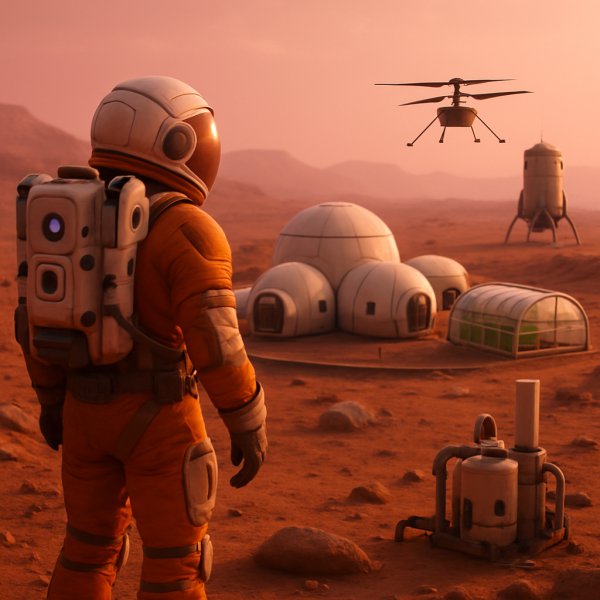
Imagine waking under a pink sky: what life on Mars would actually feel like
Picture this: you unzip the outer layer of a habitat module and step outside into thin, cold air beneath a sky that looks faintly pink. The Sun is smaller, the horizon feels farther away, and gravity tugs at you less than at home, so your steps have a floaty quality - like walking in a slow-motion lake. You are not on a movie set. You are on Mars, and every breath, every sip, every tool you use has been designed to keep you alive against a planet that does not do home comforts naturally.
That image makes Mars seem romantic, but the reality is practical, rigorous, and oddly beautiful. Living there would be a continuous negotiation with physics, chemistry, and human psychology. You would trade some freedoms - like walking outdoors without protective gear - for others, such as the daily excitement of working at the frontier of human knowledge. Below we unpack what life on Mars would be like in concrete terms, grounded in current science, enriched by analog experiments on Earth, and arranged so you can imagine, plan, or prepare for such a life yourself.
The Martian environment in plain language - cold, thin, and full of surprises
Mars is smaller than Earth, colder than a freezer in much of the year, and wrapped in an atmosphere that is almost all carbon dioxide. The average surface temperature is about minus 60 degrees Celsius, but it swings dramatically from a balmy minus 20 C near the equator at midday to well below minus 100 C at night and near the poles. Air pressure at the surface is about 0.6 percent of Earth sea level, which means an unprotected human would quickly lose consciousness and die from lack of pressure and oxygen.
Gravity is about 0.38 of Earth gravity, so your bones and muscles would feel lighter, and your stride and throwing ability would change. But that lower gravity is a double-edged sword - we do not yet know the full long-term effects on human health. Cosmic radiation is a significant problem because Mars has only a thin atmosphere and no global magnetic field to deflect charged particles; instruments on NASA's Curiosity rover measured radiation levels that, if replicated during a round-trip mission, would present serious cancer risk without shielding. Winds move Martian dust into planet-wide storms, and that dust is fine, clingy, and chemically reactive - it contains perchlorates that complicate growing food. All together, these factors make Mars habitable only with technology and planning.
A quick comparison you can remember: Earth versus Mars
| Feature |
Earth |
Mars |
| Gravity |
1 g |
0.38 g |
| Atmospheric pressure |
1013 mbar |
~6 mbar (0.6% of Earth) |
| Main atmospheric gas |
Nitrogen, oxygen |
Carbon dioxide |
| Average temperature |
+14 C |
-63 C |
| Radiation at surface |
Low, shielded by atmosphere and magnetosphere |
High; Curiosity measured ~0.6-0.7 mSv/day on surface |
| Day length |
24 hours |
24.6 hours |
| Seasons |
Yes, mild |
Yes, longer and more extreme due to orbital eccentricity |
These numbers help show why we must live in sealed habitats, wear protective suits outside, and build robust life-support systems. A helpful mental image is to think of Mars as “Earth, but with a much thinner blanket.”
Where you would live and how your home would work - habitats, suits, and life support
Your living space on Mars would be a sealed, pressurized module or a cluster of modules designed to imitate an Earth-like environment. These habitats would maintain Earth-like pressure and breathable air, recycle water and oxygen, remove carbon dioxide, and filter out dust and radiation where possible. Designs range from inflatable habitats that save launch mass to rigid modules flown from Earth, to structures built out of local regolith using 3D printing technologies. The concept of in-situ resource utilization, abbreviated ISRU, is central: it means using Martian materials to make water, oxygen, construction materials, and fuel so that missions are less dependent on Earth resupply.
Outside those habitats, you would wear a spacesuit that provides pressure, oxygen, temperature control, and communication. Spacesuits will be heavy, clumsy, and precious - like a lifesaving motorcycle jacket that you must never drop. The Mars 2020 mission demonstrated a step toward ISRU with the MOXIE experiment, which successfully produced oxygen from atmospheric CO2 on Perseverance, proving that the raw materials you need are available locally, and suggesting that future habitats could generate at least part of their life support from the planet itself.
Eating, sleeping, and staying healthy - the rhythms of Mars life
Food on Mars would come from a mix of Earth-supplied stores and local production. Initially, missions would bring calorie-dense, shelf-stable foods, but long-term settlement requires growing plants. Greenhouses would recycle CO2 into oxygen and provide fresh food and psychological benefits. However, Martian soil is not Earth soil - it contains toxic perchlorates, lacks organic matter, and has different mineral chemistry. Hydroponics, aeroponics, and soil remediation techniques would play central roles. Closed-loop systems that recycle nutrients and water are essential for sustainability.
Daily life will require stringent hygiene and exercise routines to combat the effects of lower gravity and confinement. On the International Space Station, astronauts follow strict exercise protocols to mitigate bone and muscle loss; on Mars, gravity will be higher than microgravity but lower than Earth, so exercise will remain crucial. Sleep could be easier because Mars has a day length close to Earth, but psychological strains from isolation, limited sunshine, and the knowledge of distance from Earth will require mental health supports, social structures, and meaningful work to keep crews resilient.
Work, community, and culture - how society might organize itself on Mars
Work on Mars will be practical, varied, and mission-critical. Roles include habitat maintenance, ISRU engineering, agriculture, geology, medicine, and vehicle operation. But beyond tasks, culture will emerge in food rituals, shared stories, holidays that mark Earth dates, and Martian-created traditions. Expect novel timekeeping choices - do you use Earth Coordinated Universal Time, or a Martian time called "sols" that are 24.6 hours? Early crews may use hybrid systems, and games, art, and informal language will evolve quickly to define group identity.
Governance and law will also be new territory. Who owns resources? How are disputes resolved when help from Earth is days or months away? International treaties like the Outer Space Treaty provide a starting framework, but settlers will need practical governance structures for safety, fairness, and cooperation. Social experiments in Antarctic stations and analog habitats on Earth show that small communities need clear roles, conflict resolution mechanisms, and shared purpose to thrive. Building a thriving Martian culture will be as important as building reliable oxygen systems.
Hazards you must be ready for, and myths to throw out the airlock
Mars is not a second Earth waiting to be terraformed overnight. Terraforming would take centuries to millennia, if it is even practical. You cannot go outside without a pressurized suit, and you cannot assume the thin air will protect you from radiation. Cosmic rays and solar energetic particles will require heavy shielding or underground habitats to lower cancer risks. Martian dust storms can coat solar panels and obscure surface operations for weeks, so energy systems must be resilient, and backup power is essential.
Common misconceptions deserve attention. One myth is that Mars has easily accessible liquid water at the surface; actually, stable liquid water is rare because low pressure and temperature make it freeze or evaporate, though subsurface ice and occasional transient brines exist. Another myth is that Martian gravity will protect you from muscle loss; evidence from long-duration spaceflight shows that any gravity significantly lower than Earth’s reduces bone and muscle mass, and the long-term health effects of 0.38 g are unknown. Finally, the idea that private companies will send tourists next year is optimistic; substantial infrastructure, testing, and funding are necessary before ordinary civilians can visit safely.
Real-world experiments and stories that teach us about living on Mars
Earth-based analogs provide crucial lessons. HI-SEAS on Mauna Loa simulated long-duration isolation for crews living in a dome, testing psychology, habitability, and food preparation. The Concordia Station in Antarctica is another analog, where extreme cold, isolation, and long periods of darkness teach how teams maintain mental health and operations. These studies show that food variety, meaningful work, clear leadership, and recreation are more important than luxury for crew well-being.
Technological milestones also offer real proof of concept. NASA's Perseverance rover, which carried MOXIE, converted carbon dioxide into oxygen on Mars, demonstrating practical ISRU. The Ingenuity helicopter proved powered flight is possible in Mars' thin atmosphere, hinting at future aerial scouting and logistics support. These real missions remind us that complex engineering problems can be solved step by step, and that human presence on Mars is not just science fiction but a multi-decade project grounded in iterative testing.
"Somewhere, something incredible is waiting to be known."
Carl Sagan
This quote captures the spirit behind Mars exploration, a mix of curiosity, persistence, and rigorous science.
Small challenges and "what if" thought experiments to stretch your imagination
- What would you pack for a month-long field trip on Mars, assuming resupply is months away? Try listing items ranked by life-preservation priority, psychological comfort, and scientific value. This forces you to think about mass, redundancy, and morale.
- Design a simple plan to grow salad greens in a small module using only recycled water and artificial light. Which plants would you choose, and how would you manage nutrients and light cycles?
- Imagine a community of 20 people on Mars. Draft rules for conflict resolution and resource allocation that could be enforced when communication with Earth is delayed by up to 22 minutes one-way.
These exercises help translate abstract risks into practical solutions and highlight the interplay between engineering and human factors.
Practical steps if you want to be part of Mars, or help make it possible
If you dream of contributing to Mars exploration, there are concrete paths you can take. Pursue STEM education that matches mission needs - aerospace engineering, planetary science, robotics, life sciences, agriculture, medicine, and systems engineering are all relevant. Volunteer for or join analog habitat projects, citizen science like planetary image classification, or university research groups that work on ISRU or habitat design. Gain practical skills such as welding, farming, electronics, or remote vehicle operation; missions need people who can fix things with limited spare parts.
For those who are curious but not looking to go, support the science by advocating for robust space programs, participating in public outreach, or following and sharing mission results. A small, fun experiment you can try at home is growing plants under low light cycles or experimenting with hydroponics to understand water reuse, nutrient balance, and the joy of watching things grow in constrained environments.
Final picture: life on Mars as a mix of challenge, community, and discovery
Living on Mars will be demanding, and it will require humility about what humans can control. It will also be profoundly rewarding: you would wake up every day as both caregiver and explorer, stewarding fragile life systems while expanding human presence into the solar system. Life there will blend high-tech systems with simple human rituals, quiet scientific observations with communal storytelling, and rigorous safety culture with the creativity needed to improvise when systems fail.
If you keep one image in your head, let it be this: Mars will not simply be a copy of Earth with red soil. It will be a new context for human ingenuity, where the everyday acts of making a cup of water, growing a salad, and mending a suit are also acts of pioneering. The journey there is as instructive as the destination, teaching us how to live better on our own planet while preparing us for the challenges and joys of life beyond Earth.