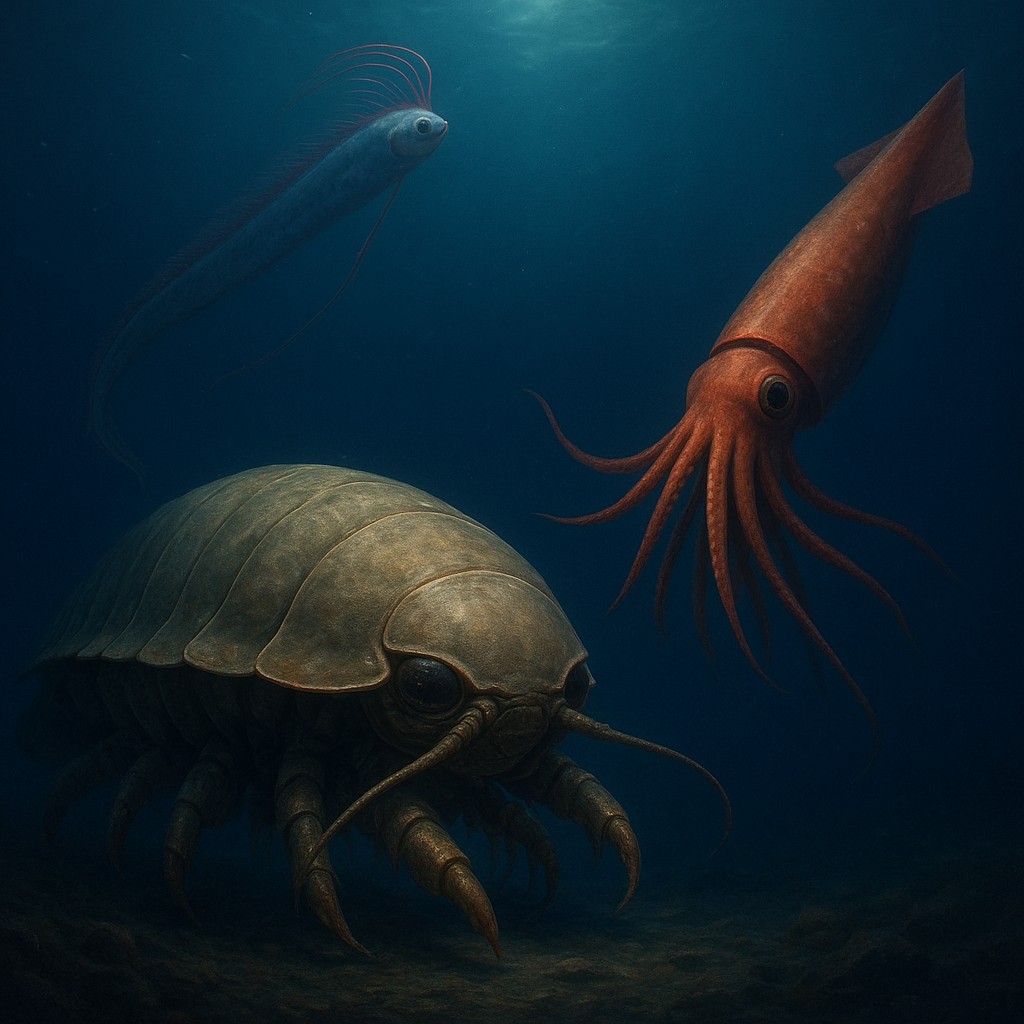
Imagine you are drifting down through the sunlight zone, past the turquoise shallows where colorful coral reefs teem with life, and into the "Twilight Zone," where the blue turns to a bruised purple. As the pressure builds and the temperature drops to a bone-chilling crawl, the rules of biology seem to shift. In the upper reaches of the ocean, a common isopod might be the size of your thumbnail, looking like a tiny pill-bug of the sea. But as you descend into the midnight depths of the abyss, you might find its cousin, the Giant Isopod. This creature looks less like a garden pest and more like a terrifying, armored football. This strange transformation, where animals grow to proportions that seem to defy logic, is one of the most intriguing mysteries of the deep.
Scientists have long marveled at why the most inhospitable places on Earth produce some of its largest inhabitants. We are talking about the Giant Squid, with eyes as large as dinner plates, and the Oarfish, a shimmering silver ribbon that can stretch over thirty feet long. While the surface world is full of fast-paced competition, the deep sea is a realm of slow-motion evolution. To understand why these creatures become behemoths, we have to look at how extreme physics meets patient biology. The deep sea is not just a place where monsters live; it is a massive laboratory where time slows down, cells grow larger, and survival depends on how well you can wait for your next meal.
The Chemistry of Slowness and Longevity
In the depths of the ocean, the water stays just above freezing, usually between zero and three degrees Celsius. For cold-blooded animals, or ectotherms (creatures whose body heat comes from the outside), internal temperature is dictated by the water around them. In these frigid conditions, every chemical reaction in their bodies slows to a crawl. This is known as a reduced metabolic rate. While a tropical fish might burn through its energy in a frantic dash for a snack, a deep-sea creature operates on a budget that makes a miser look like a big spender. Because their "engines" idle so low, they do not wear out their biological machinery as quickly as their shallow-water relatives.
This slow pace has a profound effect on the animal’s life cycle, specifically by delaying sexual maturity. In the animal kingdom, there is usually a trade-off between growing and breeding. Once an animal reaches reproductive age, it often stops putting energy into getting bigger and starts pouring it into making offspring. However, in the abyss, the biological clock ticks much slower. It can take years, or even decades, for a deep-sea invertebrate to reach the age where it is ready to spawn. During all those extra years "in the waiting room," the animal just keeps growing. It is as if they have stumbled upon a fountain of youth that allows them to stay in a growth phase for an exceptionally long time.
Furthermore, the physical building blocks of life change under these conditions. Research suggests that colder temperatures actually encourage the development of larger individual cells. This happens partly because oxygen dissolves more easily in cold water. In the freezing depths, there is a generous supply of dissolved oxygen available to power biological processes, even if those processes move slowly. When cells are larger, the organism as a whole can reach massive sizes without needing a massive number of cells. This cell-level expansion provides the foundation for the giant structures we see in creatures like the Colossal Squid.
Engineering Strength Under Crushing Weight
Gravity is a constant on land, but in the ocean, the primary physical force is hydrostatic pressure (the weight of the water overhead). For every ten meters you go down, the pressure increases by one "atmosphere," or the amount of pressure we feel from the air at sea level. At the bottom of the Mariana Trench, the pressure is like having an elephant stand on your thumb. You might think this would crush an animal into a pancake, but water cannot be compressed. Since deep-sea animals are mostly made of water, they do not pop like balloons; instead, they have evolved to function perfectly within that squeeze. However, this pressure does affect how they build their bodies. They need tougher, more resilient cell membranes to prevent the delicate machinery of the cell from collapsing.
The relationship between pressure and size is complex, but one theory suggests that high pressure impacts how well enzymes work and how fluid cell membranes stay. To counteract the "stiffening" effect of the pressure, deep-sea organisms often use different types of fats and proteins in their bodies. These adaptations are not just for survival; they provide a sturdiness that supports a larger frame. When you combine this structural strength with the abundance of oxygen mentioned earlier, you have a recipe for a body that can handle being huge. A bigger body is also more efficient at maintaining its internal balance against the crushing weight of the outside world.
| Factor |
Shallow-Water Relative |
Deep-Sea Giant |
| Water Temperature |
Warm to Temperate (15-25°C) |
Near Freezing (0-3°C) |
| Metabolic Rate |
High; fast energy use |
Low; extreme energy conservation |
| Growth Period |
Short; matures quickly |
Long; maturity is delayed |
| Cell Size |
Smaller; more numerous |
Larger; fueled by high oxygen |
| Survival Strategy |
Fast reproduction and agility |
Efficient travel and energy storage |
The Logistics of Finding Food in a Desert
The deep sea is often described as a biological desert. There is no sunlight, which means no photosynthesis can occur, and therefore no plants or algae exist at the base of the food chain. Most food comes from "marine snow," which is a polite way of describing the bits of dead fish, waste, and rotting matter that drift down from the surface. Because meals are so rare and unpredictable, being small can be a disadvantage. If you are a tiny shrimp, you are limited in how far you can travel to find a fallen whale carcass or a scrap of food. You are essentially trapped in your own small neighborhood.
Being a giant changes the logistics of survival. Large bodies are much more efficient at traveling long distances while using very little energy. A giant squid can glide through the water using much less energy relative to its size than a tiny crustacean can. This efficiency allows giants to patrol vast territories in search of food. Furthermore, a large body acts as a storage tank for fat and nutrients. When a deep-sea giant finally finds a significant meal, it can gorge itself and store that energy for months, or even years. In the abyss, being big is the ultimate insurance policy against starvation.
This "feast or famine" lifestyle also favors animals that can intimidate or overpower what they find. While many deep-sea creatures are scavengers, others are formidable predators. The sheer size of an Oarfish or a Giant Squid makes them less likely to be eaten by smaller hunters, giving them a "size refuge" from being preyed upon. If you are the biggest thing in the neighborhood, you do not have to spend as much energy hiding or fleeing. You can focus all your limited resources on the two things that matter most in the dark: finding the next meal and, eventually, finding a mate.
Myths of the Deep and the Small Exceptions
It is easy to imagine that everything in the deep sea is a behemoth, but that is a common misconception. Deep-sea gigantism is a trend, not a universal law. For every giant isopod, there are thousands of tiny species of worms, snails, and crustaceans no bigger than a grain of rice. These smaller creatures have found a different way to win at survival. They often specialize in very specific spots, such as the tiny cracks in hydrothermal vents (underwater volcanic springs) or within the mud of the seafloor. They do not need to travel far because they live exactly where their food is produced by bacteria that eat chemicals.
Another myth is that these giants are "monsters" in the sense of being aggressive or dangerous to humans. In reality, most deep-sea giants are incredibly fragile and slow-moving. An Oarfish, despite looking like a dragon, does not even have real teeth; it filters tiny organisms from the water. Their bodies are often jelly-like or lightly muscled because building heavy bone and dense muscle requires a lot of energy. If you brought a giant squid to the surface quickly, it would not be a terrifying kraken; it would be a delicate, floppy creature that would struggle to support its own weight without the buoyancy of the deep ocean.
We also see this gigantism in polar regions, like the waters around Antarctica. This is known as "polar gigantism," and it supports the idea that cold water and high oxygen levels are the main drivers of size. In the Southern Ocean, you can find sea spiders the size of dinner plates, while their cousins in warmer waters are nearly invisible to the naked eye. This suggests that while pressure matters in the deep sea, the magic ingredient for growing large is often the cold itself. The cold provides the slow-motion life needed to build a massive body, and the oxygen provides the fuel to keep it going.
Embracing the Mystery of the Abyss
Learning about deep-sea gigantism reminds us that "normal" is a relative term. We tend to think of our sunlit, warm world as the standard for how life should behave, but the vast majority of our planet’s living space is dark, cold, and pressurized. To the creatures of the deep, we are the strange ones, living our lives at a frantic pace in a thin layer of atmosphere. The giant squid and the oarfish are not biological accidents; they are perfectly engineered masterpieces of efficiency, designed to thrive in an environment that would destroy us in seconds. They teach us that there are many paths to success in nature, and sometimes, the best way to move forward is to slow down.
The study of these deep-sea giants is still in its early stages, as we have explored less than five percent of the world’s oceans. Every time a new submersible reaches the seafloor, we find something that challenges what we know about biology. Whether it is a new species of giant jellyfish or a crustacean that lives for centuries, the abyss continues to offer lessons in patience and resilience. Let the mystery of the deep inspire you to look beneath the surface. Just as the crushing pressure of the ocean creates giants, the challenges we face can often be the very things that push us to grow beyond our limits.