Imagine you are a farmer responsible for hundreds of acres of almond trees or corn. For decades, the standard way to check if your "clients" were thirsty was to stick a finger in the dirt or bury a sensor in the soil to measure moisture. This is a bit like trying to decide if a marathon runner needs a drink by checking the humidity in the stadium air. It gives you a hint about the environment, but it tells you nothing about the actual physical state of the runner. You might be pouring water into the ground while the plant, for its own biological reasons, refuses to drink. This leads to soggy roots and wasted resources.
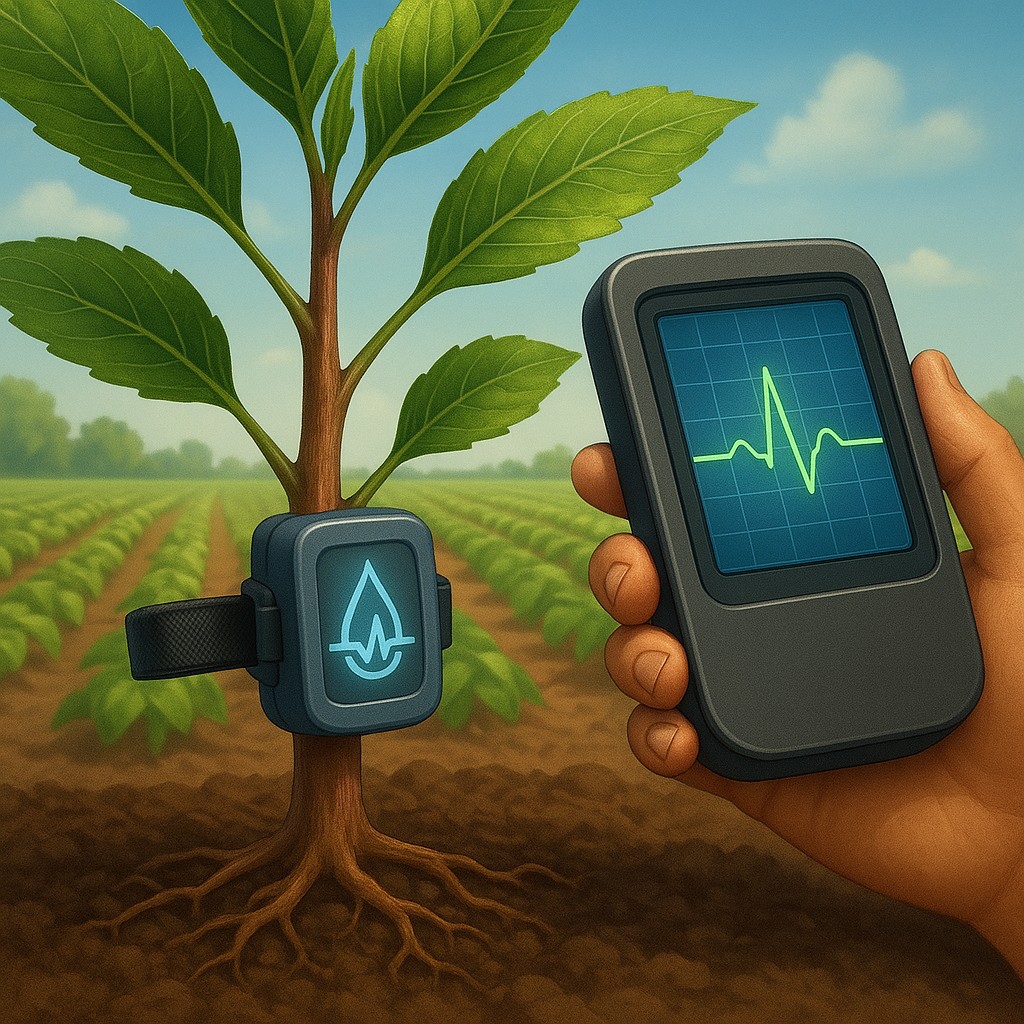
The game is changing because we are finally moving the "stethoscope" from the soil directly onto the "skin" of the plant. By strapping tiny, high-tech sensors to the stems and trunks of crops, we can now eavesdrop on their internal circulatory system. This technique, known as sap flow monitoring, allows us to listen to the plant’s own heartbeat, or more accurately, its pulse of hydration. Instead of guessing based on outside conditions, farmers can see exactly how many milliliters of water a tree pulls from the earth every hour. This offers a level of surgical precision that was once the stuff of science fiction.
The Plumbing Beneath the Bark
To understand how a sensor can tell if a plant is thirsty, we first have to appreciate the miraculous physics of how water moves in nature. Unlike humans, who have a muscular heart to pump blood through our veins, plants rely on a passive but powerful system called Cohesion-Tension Theory. High up in the leaves, tiny pores called stomata open to take in carbon dioxide for photosynthesis. When they open, water evaporates into the air, a process called transpiration. This evaporation creates a "tug" that pulls water molecules all the way up from the roots through a network of microscopic pipes called the xylem.
The xylem is essentially the plant's plumbing system, and the fluid moving through it is the sap. When we talk about sap flow, we aren't talking about the thick, sticky maple syrup you put on pancakes. Instead, it is a watery, mineral-rich soup that acts as the lifeblood of the organism. The speed of this flow is a direct indicator of the plant's metabolic health. If the sap is racing upward, the plant is productive, cooling itself, and photosynthesizing at its best. If the flow slows to a crawl during the heat of the day, it is a clear signal that the plant is "holding its breath" to avoid dehydration, even if the leaves haven't started to droop yet.
Monitoring this flow involves a clever bit of thermodynamics. Most modern sap flow sensors use a "heat pulse" method. They consist of a tiny heater and two temperature probes inserted into or strapped onto the stem. The heater sends a quick burst of warmth into the sap, and the sensors measure how long it takes for that "heat signature" to travel a certain distance up the stem. If the heat arrives at the top sensor almost instantly, the water is rushing; if it takes its time, the flow is sluggish. It is a non-invasive way to get a real-time readout of the plant's internal speed.
Why the Soil is a Liar
For a long time, we assumed that if the soil was wet, the plant was happy. However, plants are surprisingly moody biological machines. Just because there is water available in the dirt doesn't mean the plant is actually absorbing it. Factors like soil salt levels, root health, and even the temperature of the ground can prevent a plant from drinking. Furthermore, soil sensors only tell you about the tiny patch of dirt where they are buried. In a large field, soil moisture can vary wildly from one yard to the next, leading farmers to overwater some areas while others remain bone dry.
This is where "plant-based sensing" becomes a revolutionary framework. By measuring the sap flow, we bypass the middleman of the soil entirely. We are measuring the "demand" side of the equation rather than the "supply" side. This prevents the common disaster of root rot. Root rot often happens when a farmer sees a wilting plant on a hot day and assumes it needs more water, when in reality, the plant has shut its pores to protect itself and the soil is already soaked. Adding more water in this scenario literally drowns the roots, cutting off their oxygen and inviting fungal diseases to move in.
By following the sap, a grower can identify "water stress" hours or even days before there are any visible signs of trouble. Think of it as a low battery warning on your phone. You don't wait for the screen to go black before you look for a charger; you react when the indicator hits 10 percent. Sap flow sensors provide that indicator, allowing farmers to irrigate at the exact moment the plant’s internal "pressure" starts to drop. This ensures the crop never enters a state of panic that might stunt its growth or reduce its yield.
The Stomata Strategy and the Cooling Effect
The true masterminds of this entire process are the stomata, those microscopic pores on the surface of the leaves. You can think of stomata as the plant's windows. When it is time to work, the plant opens the windows to let in CO2, but the "price" it pays is losing water vapor to the atmosphere. This isn't just a side effect; it is also the plant's primary way of staying cool. Just as we sweat to lower our body temperature, a plant transpires to keep its leaves from literally cooking in the sun.
When a plant senses that water is becoming scarce, it faces a dire choice: keep the windows open to eat (photosynthesize) but risk drying out, or close the windows to save water but stop growing. This decision is reflected instantly in the sap flow data. If a sensor shows that sap flow has plummeted during the peak intensity of the afternoon sun, it means the stomata have closed. The plant has entered "survival mode." For a farmer, this is the ultimate data point. It indicates that the plant is no longer productive because it lacks the hydraulic "confidence" to keep its pores open.
| Feature |
Soil Moisture Sensing |
Sap Flow Monitoring |
| Focus |
External Environment (Supply) |
Internal Physiology (Demand) |
| Speed |
Slow (detects changes in dirt) |
Real-time (detects plant's reaction) |
| Accuracy |
Varies by soil type and location |
High (specific to the plant's health) |
| Risk Prevention |
General hydration |
Prevents overwatering and root rot |
| Primary Metric |
Volumetric water content |
Velocity of xylem fluid |
| Visual Cue |
Often requires waiting for wilting |
Detects stress before visible signs |
The fascinating thing about this "internal pulse" is that it is also affected by humidity and wind. On a very humid day, water doesn't evaporate as easily, so sap flow might be slower even if the plant is well watered. On a dry, windy day, the "pull" from the atmosphere is much stronger, causing sap to race through the stem. By layering sap flow data over local weather forecasts, farmers can use AI models to predict exactly how much water a grove will need tomorrow afternoon, rather than reacting to what happened yesterday.
Managing the Hidden Hunger
One of the most profound shifts in agricultural thinking brought about by these sensors is the move toward "Regulated Deficit Irrigation" (RDI). In certain crops, like wine grapes or almonds, giving the plant exactly as much water as it wants isn't always the goal. Sometimes, you want to stress the plant just a little bit at specific times in its life cycle. Controlled stress can encourage a grapevine to stop growing excess leaves and instead put all its energy into developing sugars and complex flavors in its fruit.
Before sap flow sensors, RDI was a high-stakes guessing game. If you stressed the plant too much, you’d kill the crop; if you didn't stress it enough, you’d end up with watery, flavorless berries. With sensors strapped to the vines, a winemaker can maintain a precise "stress tension." They can monitor the sap flow to ensure the vine is in a state of "mild discomfort" rather than total "systemic failure." It is the difference between a controlled workout and total exhaustion.
This technology also addresses the escalating global water crisis. Agriculture accounts for about 70 percent of all freshwater use worldwide. Much of that is lost to evaporation or deep drainage where the roots can't even reach it. By shifting from a "broadcast" method of watering to a "just-in-time" delivery system based on sap flow, some farms have reported water savings of up to 30 to 40 percent without any loss in crop quality. This isn't just about saving money on the water bill; it is about the long-term survival of many regions that are currently seeing their underground water supplies vanish.
A Future of Wearable Tech for Trees
As we look forward, the hardware is becoming even more impressive. Early sap flow sensors were somewhat clunky and required wires to be run through the fields. Today, we are seeing the rise of "wearable" plant tech, thin, flexible films that can be wrapped around a stem like a bandage. These devices are equipped with tiny wireless transmitters that send data to the cloud, allowing a farmer to check the "thirst levels" of their entire orchard from a smartphone while sitting at a kitchen table miles away.
There is even research into "needle-like" sensors that are so small they can be inserted into the stalks of delicate cereal crops like wheat or rice. When we combine this physiological data with satellite imagery and drone flyovers, we create a multi-layered view of the farm. The satellite gives us the big picture of which fields are green or brown, the drone identifies specific pest outbreaks, and the sap flow sensor tells us how the individual plant is "feeling" on the inside. It is a holistic approach that treats the farm as a living, breathing system rather than a factory floor.
The ultimate goal is a "closed-loop" irrigation system. Imagine a field where the pumps are connected directly to the sap flow sensors. When the combined "pulse" of the corn field indicates that the pores are beginning to close and the internal pressure is dropping, the irrigation system triggers automatically. Once the sensors detect that the sap flow has returned to an ideal speed, the water shuts off. No human intervention, no guessing, and no wasted drops.
Stepping into this future requires us to stop viewing plants as passive objects that just sit in the sun. They are highly responsive, communicative organisms that have been "speaking" to us for millennia through the movement of their fluids and the tension in their stems. We simply didn't have the right hearing aids to listen. By embracing sap flow monitoring, we are finally learning the language of the leaf, transforming the ancient art of farming into a precise, data-driven dialogue that benefits the grower, the consumer, and the planet alike. May you never look at a quiet garden the same way again, knowing that just beneath the surface, a silent, high-speed river is rushing to keep the world green.