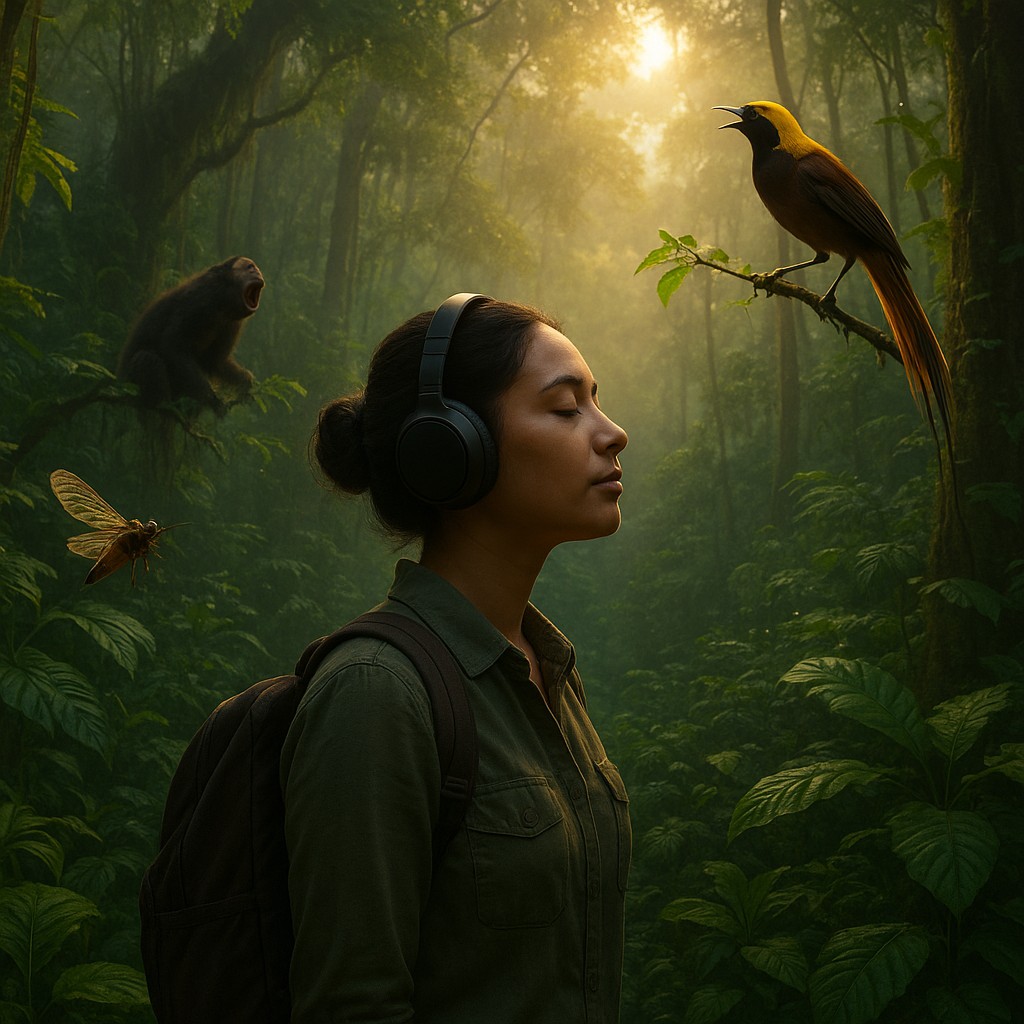
Imagine standing in the heart of a dense tropical rainforest at daybreak. The air is heavy with moisture, and the sound is nearly deafening. You hear the rhythmic pulse of cicadas, the sharp, melodic call of a bird of paradise, and the distant, territorial hoot of a primate. For decades, this "orchestra of the wild" was considered beautiful but scientifically hard to pin down. Conservationists would hike through these woods with clipboards, hoping to catch a glimpse of a rare species through binoculars. They often missed the very creatures they were trying to protect because the animals were shy or the canopy was too thick to see through.
Today, that wall of sound is being turned into a high-tech financial ledger. We are entering an era where forest songs are no longer just wonders of nature; they are verifiable data points backing a new kind of economy. Biodiversity credits are bridge builders between the corporate world and the environment. They turn ecological restoration from a vague, feel-good donation into a precise asset people can invest in. By using artificial intelligence to "listen" to the pulse of a landscape, we can finally prove that nature is returning, one chirp and whistle at a time.
Shifting from Carbon Counting to Investing in Nature
For a long time, businesses mainly helped the environment by buying carbon credits. The math was simple: if you release a ton of carbon in one place, you pay someone else to trap a ton of carbon elsewhere, usually by planting trees. While this was a good start, it had a major flaw. A clearing planted with only one type of non-native pine tree might soak up carbon well, but it is often a "green desert" where no birds sing and no insects thrive. Carbon credits focus on the air, but they sometimes overlook the life on the ground.
Biodiversity credits are designed to close this "integrity gap." Unlike carbon credits, which track a single gas, biodiversity credits represent the overall health of an entire ecosystem. They are units of exchange that show a specific, measurable increase in the variety and amount of life within a certain area. When a company buys a biodiversity credit, they aren't just making up for their environmental footprint; they are funding a real result, like a rare frog returning to a wetland or a migratory bird path being restored. This shift requires a level of precision that traditional conservation never had, leading us into the world of high-tech "nature accounting."
Translating the Language of the Forest with AI
How do you prove to a skeptical investor in London or New York that a specific patch of forest in Indonesia is actually getting healthier? A photo of a tree isn't enough. This is where bioacoustics - the study of sounds made by living things - comes in. By using autonomous recording units (ARUs), which are rugged, weatherproof microphones, scientists can record the sounds of a forest 24/7. These devices capture everything from the high-pitched clicks of bats to the low thrum of large mammals.
However, raw audio is a data nightmare. A single month of recording can produce thousands of hours of sound that no human could listen to in a lifetime. This is where modern Artificial Intelligence takes over. Computer algorithms trained on huge libraries of animal calls can sift through these recordings at incredible speeds. They can identify the unique "signature" of a rare bird, count how many individuals are calling, and even track if the variety of species is growing over time. This creates a "biophony" map - a digital fingerprint of a healthy forest that serves as the ultimate proof that a biodiversity credit is legitimate.
Comparing Ways to Monitor Nature
To see why bioacoustics is such a game-changer, it helps to see how it compares to other ways we keep tabs on nature. No single method is perfect, but using these tools together provides a much clearer picture of ecological success.
| Monitoring Method |
Main Strengths |
Main Limitations |
Best Use Case |
| Direct Human Survey |
High accuracy for visible species; can check plant health. |
Expensive, slow, and limited by what the person happens to see. |
Small, specific research projects. |
| Satellite Imagery |
Great for measuring forest cover and tree density. |
Cannot see under the leaves or detect if animals are there. |
Tracking deforestation or large-scale land use. |
| Camera Traps |
Captures photos of shy mammals and birds. |
Narrow view; often misses small insects or birds in high trees. |
Monitoring large predators or ground animals. |
| Bioacoustics |
Continuous 24/7 monitoring; captures a wide range of life. |
Only works for vocal species; creates massive amounts of data. |
Measuring overall ecosystem "vibrancy" and bird/insect health. |
| Environmental DNA (eDNA) |
Finds species via skin cells or waste in water and soil. |
Cannot tell if an animal is currently there or just passed through. |
Identifying rare water species or tiny soil organisms. |
The Challenge of the Silent Majority
While the "ears" of AI are impressively sharp, they don't know everything. One of the most important hurdles in bioacoustics is the "silence problem." Not every creature is noisy. Many of the world’s most critical species - such as reptiles, many amphibians, and a huge variety of spiders and beetles - live their lives in total silence. If we relied only on microphones to value a piece of land, we might overlook a thriving population of rare snakes or butterflies just because they don't have a song to sing.
This is why the best biodiversity projects use a multi-pronged approach. To create a truly verifiable "nature asset," developers often combine bioacoustics with other methods like eDNA or satellite monitoring. For example, a project might use microphones to track songbirds, which act as "indicator species" (animals that signal the health of the insects they eat). At the same time, they might test water from a local stream for eDNA to confirm a silent salamander species is still there. This layered data ensures that the "value" of the forest isn't just based on who can scream the loudest.
Turning Conservation into a Verifiable Investment
The goal of this technology is to move away from the "charity model" of conservation. In the past, a company might give a million dollars to a "Save the Rainforest" campaign and get a nice brochure in return, but they rarely knew exactly what their money accomplished. With biodiversity credits backed by bioacoustic data, that transaction changes. The investment is based on performance. A credit might only be issued once sensors prove that the variety of species has increased by 15 percent compared to the starting point three years earlier.
This level of transparency turns nature into a data-driven investment. It allows a global market to form where the product isn't just "the environment," but specifically "the restoration of an African savannah" or "the recovery of a Malaysian peatland." For local communities and Indigenous groups, this is a massive opportunity. They are often the best guardians of the land, and these credits provide a way for them to be paid directly for the services their land provides to the planet. Instead of being forced to clear-cut a forest for farms to survive, they can earn a living by keeping their ancestral homes loud and full of life.
The Ethics of Nature Markets
As with any new financial frontier, there is plenty of skepticism and debate. Critics worry that putting a price on nature is a slippery slope toward treating life itself as a commodity. There is a fear that if we value a forest based on sound, we might ignore "quieter" ecosystems that are just as important but harder to measure, like deserts or the deep sea. There is also the risk of "greenwashing," where companies buy credits to distract from damage they are doing elsewhere.
To fight this, organizations are creating strict "integrity principles." These include "additionality" (the credits must fund conservation that wouldn't have happened otherwise) and "permanence" (the protection must last for decades, not just a few years). The beauty of bioacoustics is that the data is hard to fake. You cannot easily recreate the complex, chaotic soundscape of an ancient forest with a recording. AI is trained to detect the subtle interactions of a real ecosystem, making it a powerful tool against fraud.
A Future Where Every Voice is Heard
Transitioning to a nature-positive economy is a huge task, but for the first time in history, we have the tools to listen to what the planet is actually telling us. We are moving past the era of guesswork. Our relationship with the Earth is becoming defined by data and mutual benefit. When we use AI to analyze the hum of a beetle or the whistle of a hawk, we are doing more than just collecting data; we are acknowledging that these sounds have value. Their presence is the ultimate proof that we are succeeding as stewards of the globe.
Imagine a world where a business's success is measured not just in dollars, but in the volume of a thriving forest. In this world, an investor can log onto a screen and hear the direct results of their money through a bird’s song recorded halfway around the world. This blend of ancient biology and modern technology gives us a rare reason to be optimistic. It suggests that by learning to listen more closely, we might finally find a way to live in harmony with the wild. A healthy planet is not just a dream: it is a verifiable, valuable, and vibrant reality.