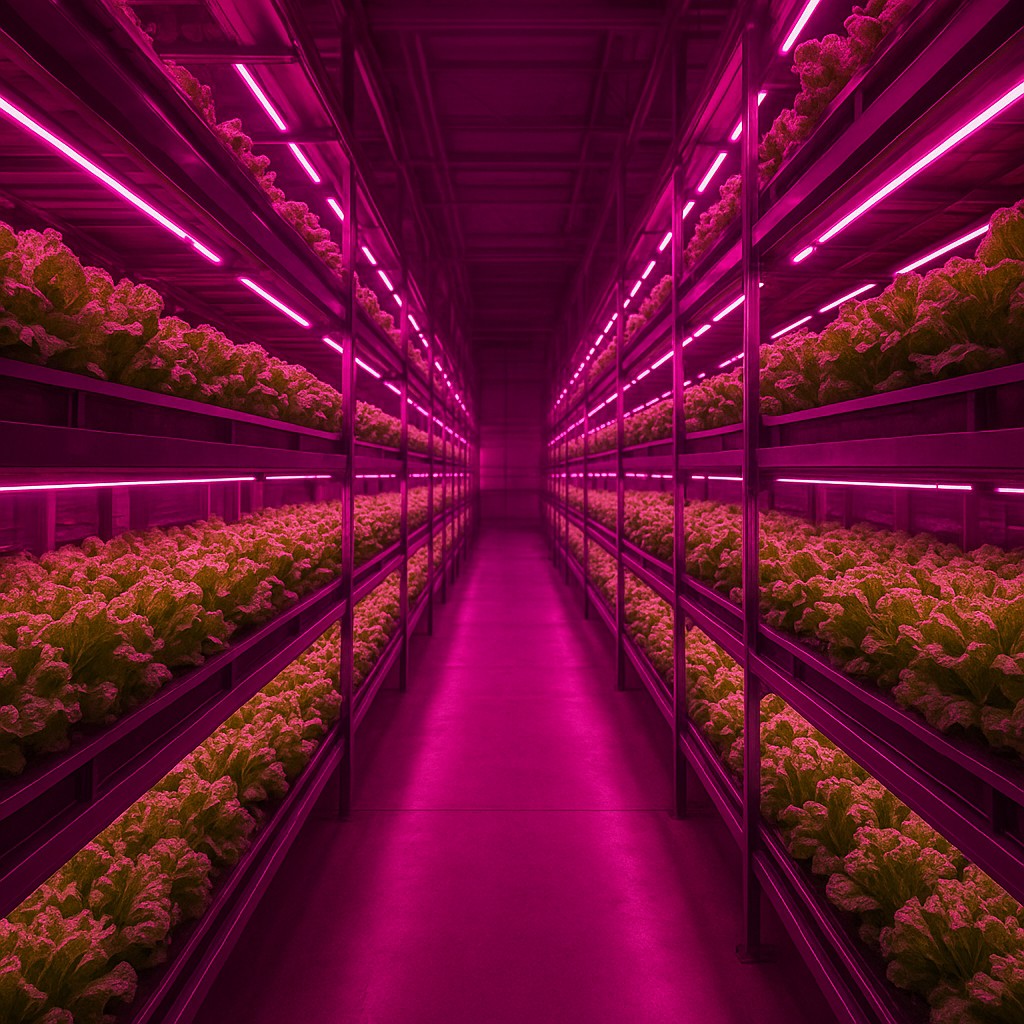
Imagine walking into a warehouse in the middle of a busy city. The air is filtered, the temperature is a steady, comfortable 72 degrees, and the walls are lined thirty feet high with vibrant green lettuce. There is no soil, not a tractor in sight, and most surprisingly, no sun. Instead, the entire space glows with a futuristic, deep magenta light. This isn't a scene from a sci-fi movie about a colony on Mars, though this technology might get us there one day. This is the reality of modern vertical farming, a bold new way to feed a planet that is quickly running out of farmland and stable weather.
For most of history, farming has been a gamble with the elements. We planted seeds and prayed for the right amount of rain and sunlight. If the clouds stayed too long or the sun scorched the earth, the harvest failed. Vertical farming flips this script. It moves the "outdoors" inside, replacing the chaos of nature with the precision of computer software. At the heart of this change is a breakthrough called "light recipes." This method lets farmers "hack" a plant’s biology by giving it exactly the light it needs and nothing it doesn't.
The Flaw in the Golden Sun
To understand why vertical farms look like neon-pink discos, we have to recognize a surprising truth: plants are picky about the sun. While sunlight looks white or yellow to us, it is actually a mix of every color in the rainbow. We learned in school that plants are green because they reflect green light. This means plants evolved to survive under the sun, but they never evolved to use all of its light efficiently. In fact, much of the sun’s spectrum is just "noise" to a plant. It provides energy the plant can’t process easily or heat that the plant has to work hard to get rid of.
Traditional farming relies on this "whole food" version of light, where the plant has to pick through a messy buffet to find what it likes. In a controlled indoor farm, we can provide a curated "tasting menu" instead. Using LED bulbs, scientists can skip the waste of white light. Most plants mainly use blue light to grow leaves and produce chlorophyll, while red light tells them when to flower and grow fruit. When you see a vertical farm glowing purple, you are seeing a high-tech environment where "wasteful" green and yellow light has been removed to save energy and speed up growth.
Decoding the Language of Light Recipes
A light recipe is much more than just a color setting on a bulb. It is a precise, timed script that tells a plant how to behave from seed to harvest. Think of it as a conversation. By changing the balance of red and blue light, or adding small amounts of "far-red" light (which is just past what humans can see), farmers can trick a plant. They can make it think the days are longer, the seasons are changing, or even that it is being shaded by a neighbor. This last trick, called the "shade avoidance response," makes plants grow taller or produce larger leaves as they reach for a sun that doesn't actually exist.
These recipes are top-secret and unique to each crop. A head of butterhead lettuce might need a "sunrise" of gentle blue light to wake up its stomata (the tiny pores on a leaf), followed by an intense red "noon" to power growth, and a finish of far-red light before "sunset" to make the leaves bigger. Meanwhile, a basil plant might get a recipe designed to stress it just enough to produce more oils, making the herb more fragrant and flavorful. This control allows indoor farmers to pack months of outdoor growth into just a few weeks, often doubling or tripling the yearly yield of a traditional field.
The Growth Engine and Energy Efficiency
The main reason for these high yields is a faster rate of photosynthesis, the process plants use to turn light into food. In a field, this process often hits a limit because of things like low carbon dioxide or high temperatures. In a vertical farm, every variable is tuned to the light. Because specific LED lights produce very little heat compared to old-fashioned bulbs, they can be placed just inches from the leaves without burning them. This allows for "layering" crops, where ten acres of produce can be grown in a space the size of a single backyard.
Efficiency isn't just about speed; it's about the math of energy. When a farmer uses a specific light recipe, almost every watt of electricity is turned into a light particle that the plant is ready to catch. This keeps the building from getting too hot, which means the farm spends less on air conditioning. It is a win-win cycle: better light leads to less heat, which leads to lower costs, finally making indoor farming a real competitor to traditional agriculture.
| Feature |
Field Farming |
Vertical Farming (LED) |
Impact of Light Recipes |
| Light Source |
Full-spectrum Sun |
Specific-spectrum LED |
Cuts energy waste by 50-80% |
| Growth Cycle |
Seasonal (1-2 harvests) |
Year-round (12+ harvests) |
Speeds up growth with timing |
| Water Usage |
High (evaporation) |
Minimal (recycled) |
Light drives efficient water use |
| Land Used |
Large (flat) |
Minimal (stacked) |
Intense light allows layering |
| Flavor/Nutrition |
Fluctuates with weather |
Consistent and optimized |
Recipes can "dial up" vitamins |
The Calorie Barrier and the Wheat Problem
If vertical farming is so efficient, why aren't we growing all our food this way? This is due to the "Calorie Barrier." Right now, vertical farming is best for lettuce, microgreens, and expensive herbs. These crops have a high market value and are mostly made of water, so they don't need much light energy to reach a weight you can sell. You can grow a head of lettuce with just a little electricity because you are essentially selling structured water and fiber.
The story changes for "staple" crops like wheat, corn, or rice. To grow a single loaf of bread indoors, a plant has to do a massive amount of work to create dense carbs and proteins. The light energy needed to create those calories is so high that the electricity bill would make a loaf of bread cost forty dollars. Researchers are working on "dwarf wheat" and better light recipes, but for now, the sun is the only "free" energy source strong enough to power the world's grain supply. We have mastered the salad, but the sandwich is a challenge for the future.
Beyond the Plate: Environment and Security
The real magic of light-optimized farming isn't just the lettuce; it’s where you can grow it. Because these systems don't depend on the climate, they can sit in the middle of a desert, in the freezing Arctic, or in the heart of cities like Singapore or New York. By growing food miles away from the shopper instead of continents away, we cut the pollution from long-haul trucks and ships. There is no need for harsh pesticides in a sealed room, and no fertilizer runoff because every drop of water is recycled.
This technology also offers a new kind of food security. As climate change makes outdoor weather more unpredictable, having a "food factory" that produces the same amount of food regardless of droughts or freezes is a huge advantage. It shifts the definition of a "rich" country from one with good soil to one with cheap, renewable energy and the tech to run these systems. We are moving from a world where we find food to a world where we manufacture it.
The Future of the Electric Harvest
In the next decade, light recipes will likely become "dynamic." Instead of a set script, sensors will watch a plant's health in real-time and change the light if the plant looks stressed or hungry. We might even see "personalized" vegetables, where the light is adjusted to boost specific vitamins for a customer's health needs. As LED chips get cheaper and more efficient, they slowly lower the costs that stop us from growing more complex crops.
The journey from the first basic grow lamps to today’s specific light recipes shows what human creativity can do. We have taken the engine of life, photosynthesis, and learned to tune it like a race car. While we aren't growing all our calories in skyscrapers yet, the progress with leafy greens has built the foundation for a more resilient, local, and sustainable food system. The purple glow of a vertical farm isn't just a strange light; it is the color of a future where no one has to worry about the weather to put food on the table.
The next time you eat a crisp, flavorful piece of arugula in the middle of winter, think about the science behind it. You aren't just eating a plant; you are eating the result of a perfectly timed symphony of light. This mastery of light lets us protect our wild spaces by needing less farmland, feed growing cities, and treat the mystery of life with the precision of a programmer. The electric harvest has just begun, and the future looks very bright.