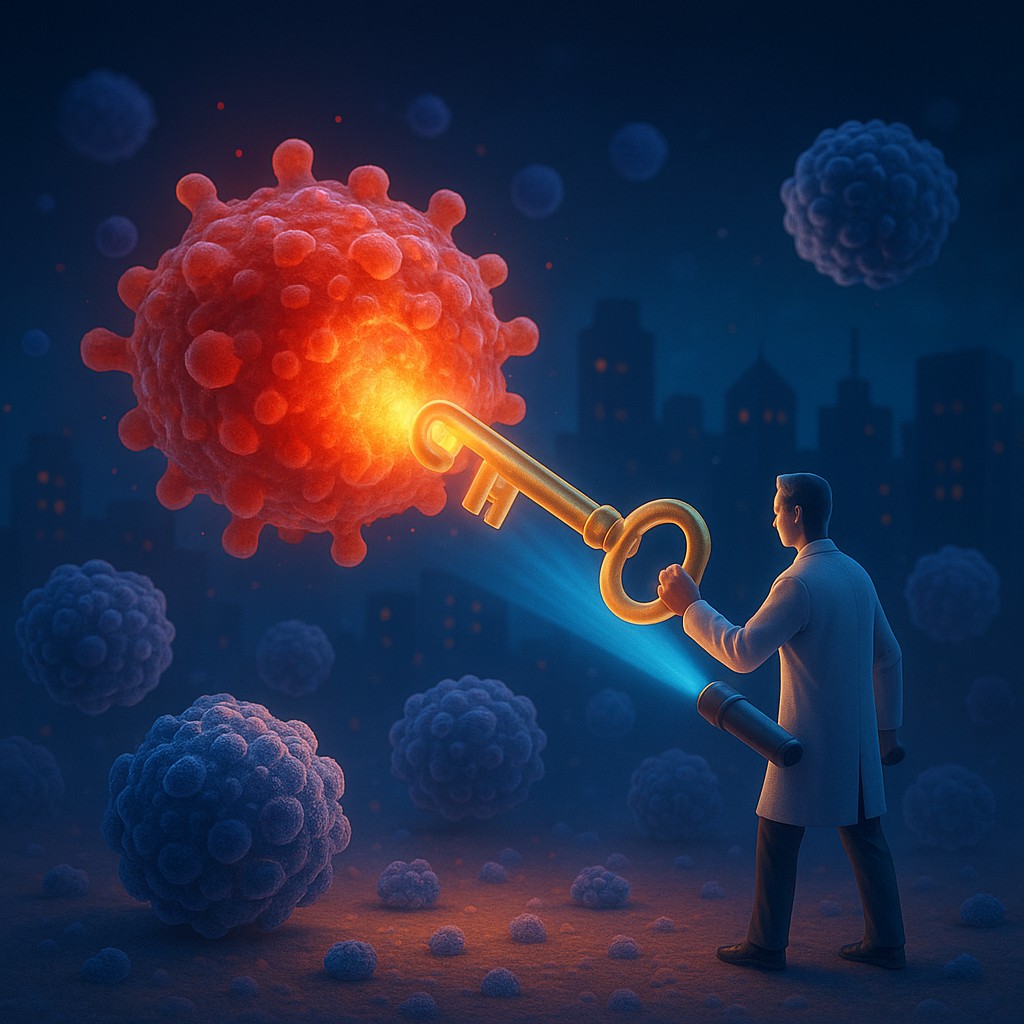
Imagine for a moment that you are a molecular locksmith. You have been tasked with stopping a specific group of troublemakers hiding inside a crowded, bustling city. The problem is that these troublemakers look almost exactly like the law-abiding citizens around them. If you send in a heavy-handed security team, you might catch the bad guys, but you will almost certainly cause chaos for everyone else.
This is the central dilemma of traditional cancer treatment. Chemotherapy and radiation are often called "scorched earth" policies because they struggle to tell the difference between a fast-growing cancer cell and a healthy cell that is simply doing its job well. For a long time, we have looked for a way to be more surgical, more precise, and frankly, more clever about how we tackle disease at the cellular level.
Enter the world of Photodynamic Therapy, or PDT. This is more than just a medical procedure; it is a masterclass in chemical teamwork. It relies on a "dual-key" system that ensures the treatment is active only at the right time and in the right place. By using light-sensitive compounds that stay completely harmless until they are "switched on" by a specific color of light, doctors can turn a patient's own biology into a precision strike team. It is a perfect example of how we have learned to use the physics of light to perform biological miracles. Instead of a blunt instrument, we use a biological flashlight to find and remove threats without disturbing the peace of the surrounding healthy tissue.
The Secret Life of Photosensitizers
At the heart of this technology is a special class of molecules known as photosensitizers. In their natural state, these drugs are remarkably inactive. If they were injected into your body, they would simply float through the bloodstream like any other nutrient. They do not attack cells, they do not damage DNA, and they do not cause the systemic nausea or hair loss we usually associate with "toxic" medicine. However, they have one unique trait: they are incredibly sensitive to energy. Specifically, they are tuned to absorb energy from very specific wavelengths of light, much like a radio is tuned to one specific station.
These molecules also happen to be "sticky" when it comes to tumors. While the drug travels through the entire body, it leaves healthy tissue relatively quickly. Cancer cells, however, tend to hoard them. Because cancer cells divide rapidly and have an unusual metabolism, they soak up these photosensitizers and hold onto them much longer than a normal muscle or organ cell would. This creates a "window of opportunity." By waiting a few hours or days after giving the drug, the concentration of the medicine becomes much higher in the tumor than anywhere else. At this point, the patient is essentially "primed" for the next step.
Igniting the Spark of Reactive Oxygen
When the doctor is ready, they aim a specialized laser or a high-intensity LED at the tumor. This is not a heat-based laser that burns tissue like something out of a sci-fi movie. Instead, it is a "cold" laser with a wavelength chosen specifically to wake up the photosensitizer molecules hiding inside the cells. When the light hits the drug, the molecule enters an "excited state." It becomes restless and looks for a way to get rid of that extra energy. It finds a partner in the form of ordinary oxygen molecules already floating inside the cell.
The energized drug transfers its energy to the oxygen, transforming it into what scientists call "singlet oxygen." This is an extremely aggressive form of oxygen that acts like a molecular wrecking ball. This singlet oxygen reacts with everything it touches, shredding cell membranes and destroying the vital machinery that keeps a cancer cell alive. Because singlet oxygen has a very short lifespan, it can only travel a tiny distance, about the width of a single cell, before it turns back into harmless, regular oxygen. This means the "toxic burst" is contained entirely within the area hit by the light. If the light doesn't touch the tissue, the drug stays asleep, and the healthy tissue remains safe.
A Comparative Look at Treatment Strategies
To understand why this is such a leap forward, it helps to see how it compares to the traditional methods we have used for decades. Treatment isn't just about killing cancer; it is about what happens to the patient during and after the process. By comparing how these approaches work, we can see why PDT is becoming a popular choice for specific cancers, especially those on or just under the skin.
| Feature |
Traditional Chemotherapy |
Radiation Therapy |
Photodynamic Therapy (PDT) |
| Precision |
Systemic (affects the whole body) |
Regional (affects a broad area) |
Highly Localized (cell-level precision) |
| Trigger |
Active as soon as it enters the body |
High-energy rays |
Dual-key (drug + specific light) |
| Side Effects |
Often severe (nausea, hair loss) |
Localized burns, fatigue |
Extreme light sensitivity for weeks |
| Repeatability |
Limited by total body toxicity |
Limited by permanent tissue damage |
Can be repeated many times |
| Primary Target |
All rapidly dividing cells |
DNA in the path of the beam |
Cells containing both drug and light |
The Threefold Path of Destruction
Photodynamic therapy does more than just kill individual cells; it uses a three-pronged strategy to make sure the tumor does not return. The first, as mentioned, is the direct kill. The reactive oxygen simply shreds the cancer cell from the inside out. But cancer is resilient, and sometimes a few cells might survive the initial burst. That is where the second mechanism comes in: vascular damage. Tumors are greedy and grow their own network of tiny blood vessels to feed themselves. PDT is remarkably effective at damaging the lining of these "copycat" vessels. By cutting off the supply lines, the therapy starves any remaining cancer cells of the nutrients they need to recover.
The third mechanism is perhaps the most exciting for the future of medicine: the immune response. Normally, cancer cells are masters of disguise, hiding from the body's immune system by pretending to be normal tissue. However, when PDT destroys a cancer cell, it does so in a "messy" way that spills the cell's internal contents. This effectively unmasks the cancer. The immune system sees these broken pieces, realizes they are invaders, and sends white blood cells to the area. This can create an "immunological memory" where the body learns how to fight that specific cancer, potentially attacking any stray cancer cells that may have wandered far away from the original treatment site.
Navigating the Shadow Side of Light
As brilliant as this technology is, it does have a unique and somewhat inconvenient catch. Remember how the photosensitizer drug is harmless unless it is exposed to light? That doesn't just apply to the doctor's laser. It applies to almost any bright light, including the sun or even powerful indoor lighting. Because it takes a while for the liver to fully process and remove the drug, the patient becomes a bit like a modern-day vampire for several weeks after the procedure.
During this recovery period, the skin and eyes are incredibly vulnerable. Exposure to direct sunlight can cause severe, painful reactions that look like a mix of a chemical burn and a very bad sunburn. Patients are often told to wear wide-brimmed hats, gloves, and sunglasses, and to stay indoors during the brightest parts of the day. Interestingly, it isn't just UV rays that are the problem; even the visible light we use to see can trigger the drug. Doctors usually recommend a "slow re-entry" into the light, where patients gradually expose small patches of skin to see if the drug has finally cleared their system. It is a small price to pay for a targeted treatment, but it does require a disciplined lifestyle change for a short time.
The Future of Illuminated Medicine
We are currently only scratching the surface of what light-activated medicine can do. Researchers are developing new "third-generation" photosensitizers that are even better at targeting specific proteins, making them even more accurate. There is also a push toward using infrared light, which can penetrate deeper into human tissue than the red light used today. This would allow doctors to treat tumors deep inside the body, rather than just those on the skin or the lining of internal organs. Combining these drugs with fiber-optic technology means we could eventually reach almost any corner of the human body with a tiny, glowing wire.
What makes this field so inspiring is that it changes how we think about "poison." In the past, a drug was either a medicine or a toxin based on what it was. In the world of PDT, a drug is only a toxin based on where you shine the light. It is a beautiful marriage of chemistry, physics, and biology that proves we can be gentle with the body while being incredibly tough on disease. As we continue to refine these "molecular light switches," we move closer to a world where cancer treatment isn't a traumatic ordeal for the whole body, but a quiet, precise conversation between a doctor, a drug, and a beam of light.