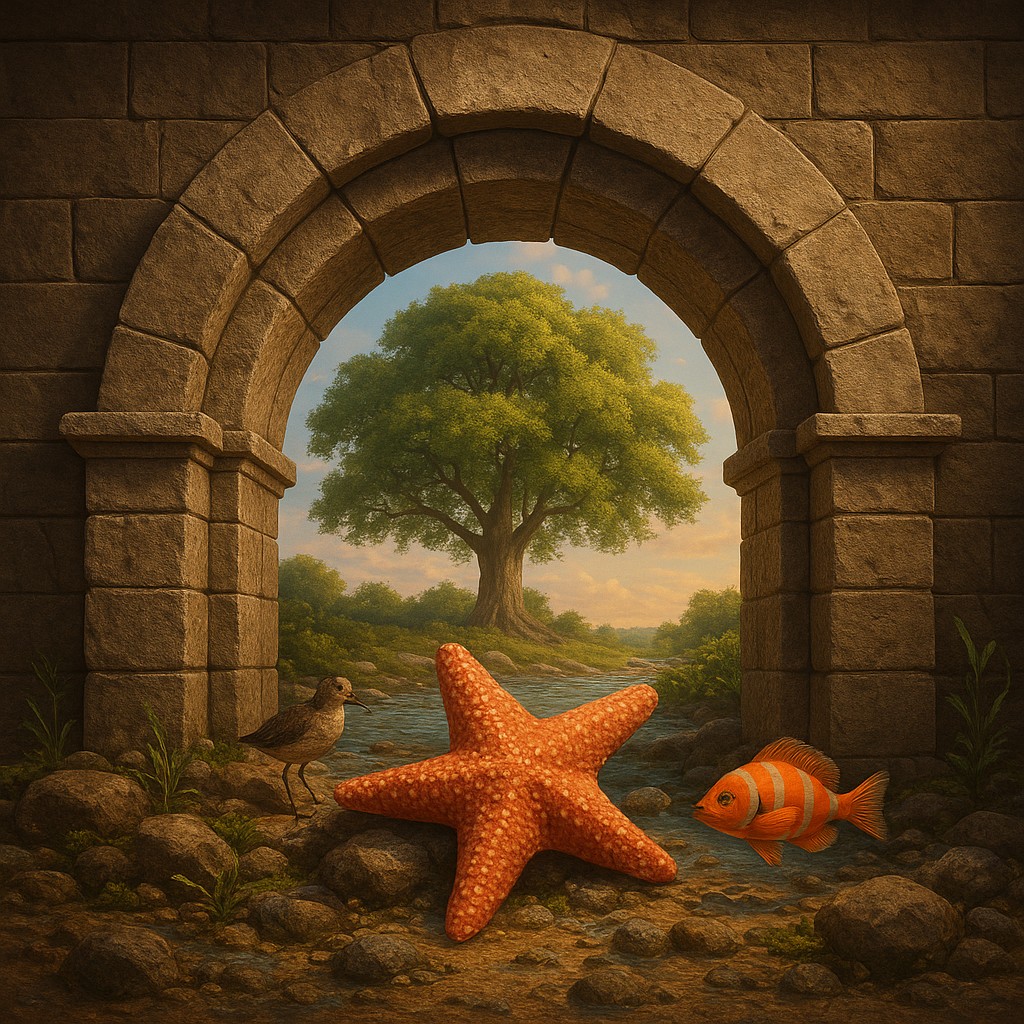
Imagine you are an architect responsible for a centuries-old stone cathedral. Looking up at a massive, vaulted arch, you spot a single wedge-shaped stone at the very peak. It doesn't look like much, and it certainly doesn't carry the bulk of the building's weight. Yet, if you pulled that one stone out, the entire roof would collapse. In architecture, this is the keystone.
Nature has its own version of this. Certain organisms hold the structural integrity of their entire world together. These species "punch far above their weight class," exerting an influence on their environment that is much larger than their actual numbers would suggest.
The tricky thing about these biological anchors is that you might not notice them until they are gone. Unlike massive herds of wildebeest or endless carpets of grass, a keystone species often has a small population. They act as quiet regulators or "invisible hands," stopping aggressive species from taking over. Without them, a vibrant, diverse habitat can quickly turn into a biological wasteland. They aren't just important animals; they are the specific gears that keep the entire environmental engine from seizing up.
The Accidental Architect of the Tide Pools
We discovered this concept in the 1960s thanks to an ecologist named Robert Paine. He wasn't studying lions or elephants; instead, he spent his time in the salt-sprayed tide pools of the Washington coast. Paine noticed a purple sea star (Pisaster ochraceus) living among colonies of mussels, barnacles, and limpets. In an experiment that became famous in the scientific world, he began tossing the sea stars into the ocean, removing them entirely from the local ecosystem. He was essentially playing a high-stakes game of ecological Jenga.
The results were more dramatic than anyone expected. With the sea star gone, the mussel population, which the sea star usually ate, exploded. Without a predator to keep them in check, the mussels crowded everything else out. They blanketed the rocks, leaving no room for barnacles to attach or for algae to grow. Within a few years, a diverse community of fifteen different species was cut in half, replaced by a boring "monoculture" of nothing but mussels. The sea star was the keystone. Even though it wasn't the most common creature, its presence created the space necessary for everyone else to survive.
The Ripple Effect: Trophic Cascades
When a keystone species disappears, the damage rarely stops with its direct neighbors. Instead, it triggers a "trophic cascade." Think of this as a line of falling dominoes that starts at the top of the food chain and tumbles all the way down to the plants and soil.
The most famous modern example happened in Yellowstone National Park when gray wolves were brought back in the mid-1990s. Wolves had been missing for decades, and in their absence, elk populations had skyrocketed. These elk ate everything in sight, especially the young willow and aspen trees along the riverbanks.
When the wolves returned, they did more than just hunt elk; they changed the way elk behaved. This is called a "landscape of fear." The elk stopped loitering in open valleys where they were easy targets, which finally allowed the overgrazed plants to recover. As the trees grew back, songbirds returned. Beavers arrived to eat the willows and build dams, creating ponds for fish and frogs. Even the shape of the rivers changed because new plant roots stabilized the soil and stopped erosion. The return of one predator reshaped the entire geography of the park.
The Different Faces of Ecological Influence
Many famous keystones are "apex predators" at the top of the food chain, but they aren't the only ones holding the fort. Ecological influence comes in many forms. Some species earn their status through hard labor or unique habits. These organisms can be grouped by how they affect their surroundings.
| Keystone Category |
Primary Function |
Example |
Ecosystem Impact |
| Predators |
Control prey numbers to keep resources from running out. |
Sea Otters |
Stop sea urchins from eating entire kelp forests. |
| Engineers |
Physically build or change habitats for others. |
North American Beaver |
Create wetlands that support hundreds of species. |
| Mutualists |
Provide essential services like pollination. |
Honeybees / Fruit Bats |
Allow specific plant communities to reproduce. |
| Foundation Species |
Provide the actual physical structure of the habitat. |
Reef-Building Corals |
Build the framework for the entire marine food web. |
Beavers are the classic "engineers." Without them, thousands of species of insects, birds, and fish would lose their homes. By building dams, beavers slow down water and create lush wetlands that act as natural filters. Similarly, African elephants act as keystones by knocking down trees and clearing brush. This might look destructive, but it prevents the savanna from turning into a thick forest. This ensures that grasses thrive for millions of grazers, like zebras and gazelles, that need open plains to survive.
The Mystery of the Sea Otter and the Kelp Forest
In the ocean, the sea otter is a perfect example of a keystone. These furry mammals are famous for being cute, but they are also fierce predators of sea urchins. Sea urchins are like the lawnmowers of the ocean; they have a massive appetite for kelp. If left alone, urchins will multiply until they have eaten entire kelp forests, leaving behind "urchin barrens" where almost nothing else can live. Kelp forests are vital because they act as underwater jungles, soaking up carbon dioxide and acting as nurseries for young fish.
Because sea otters have a very high metabolism, they have to eat a huge number of urchins every day to stay warm. By keeping urchin numbers low, the otters indirectly protect the kelp. A relatively small number of otters can protect miles of underwater forest. However, this also shows how fragile these systems are. If water quality drops or otters are hunted, the kelp forest can disappear almost overnight. The health of the entire forest is literally tied to the health of the otter.
Changing Roles: When a Keystone Steps Down
A common myth is that once a species is labeled a "keystone," it holds that title forever. In reality, this status depends entirely on the environment. An animal might be a keystone in one place but just another face in the crowd in another. For example, a predator might be a keystone in a simple food web with few competitors. But if that same predator lives in a complex forest with five other types of hunters, its individual impact is watered down.
Environmental shifts can also strip a species of its crown. If climate change or human activity introduces an invasive species that takes over the keystone's job, the balance of power shifts. Nature isn't a static museum piece; it is a moving puzzle. Recognizing this helps conservationists realize that we cannot just save one animal in a vacuum; we have to save the relationships between them.
New Priorities for Conservation
Since we have limited time and money, we cannot protect every acre of land with the same intensity. This is where the keystone concept becomes a powerful strategy. Instead of spreading resources thin by managing every single beetle and blade of grass, we can focus our "biological budget" on keystone species. By protecting the sea otter, we are effectively protecting the kelp, the fish, and the coastline's ability to store carbon. It is a "buy one, get ten free" deal for biodiversity.
However, we shouldn't ignore other species entirely. While the keystone keeps the roof from falling in, a cathedral still needs its walls, windows, and floors to function. The goal is to find the most effective leverage points. If we can keep the "anchors" in place, the rest of the system has a much better chance of surviving climate change and habitat loss on its own.
A Legacy of Balance
The lesson of the keystone species is a reminder that in nature, value isn't always about high numbers or brute strength. Sometimes, the most important player is the one that keeps the competition fair. It is a story of balance, where the presence of a predator leads to more life, not less. It challenges us to stop looking at the world in pieces and start seeing how every organism is a thread in a larger tapestry.
Whether you are in a local park or a vast wilderness, invisible ties connect every living thing. The health of our planet depends on these biological anchors. By protecting these critical species, we aren't just saving a few animals; we are ensuring that the beautiful, resilient structures of nature remain standing for generations to come.