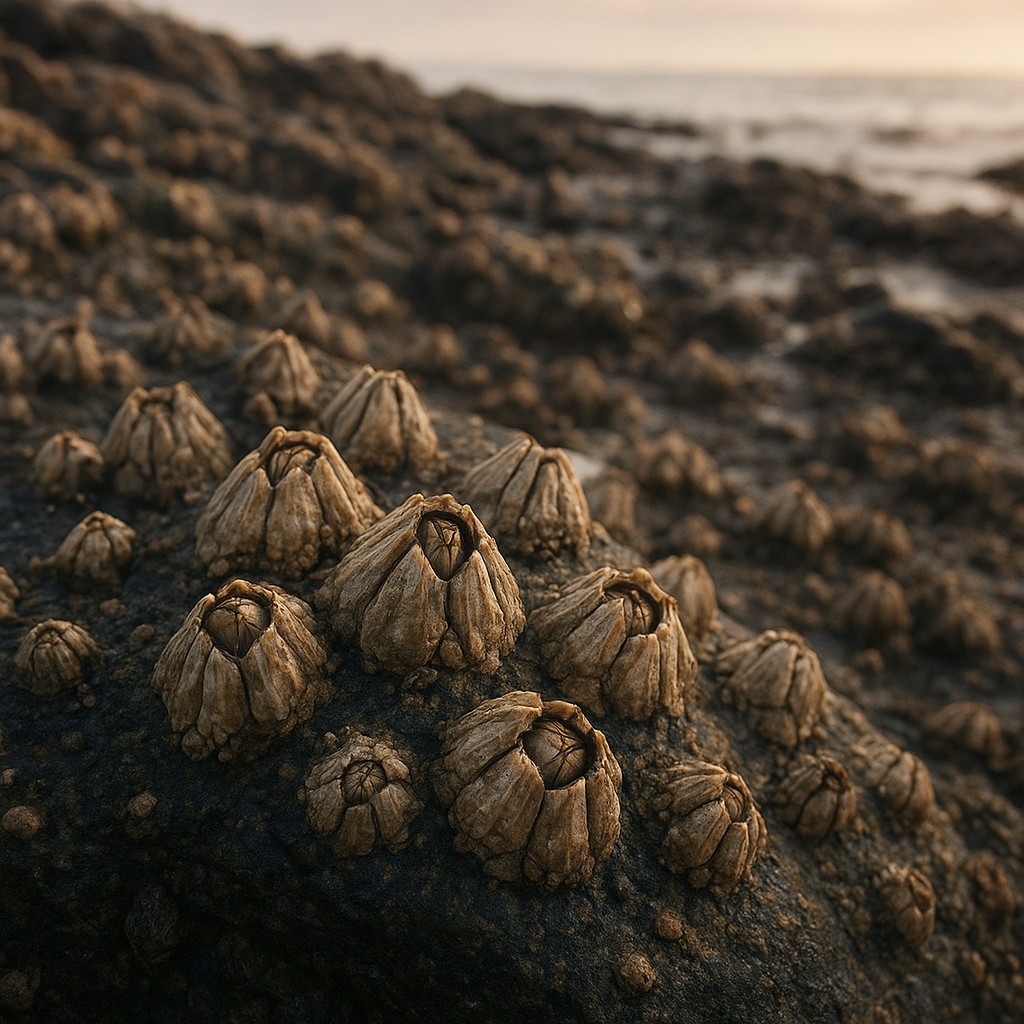
Imagine walking along a rocky coastline at low tide. The air is thick with the scent of salt, and the sound of crashing waves echoes in the distance. Underfoot, the rocks are encrusted with thousands of tiny, sharp, volcano-like cones that scrape against your boots. To most people, these are just lifeless bumps on the scenery - perhaps a nuisance for sailors or a hazard for barefoot swimmers. Yet, beneath those rugged calcium carbonate shells lies one of the most bizarre and successful survival stories in nature. These are barnacles. Far from being simple "sea rocks," they are highly sophisticated crustaceans that have mastered the art of living upside down, glued to a wall by their own foreheads.
For centuries, even the most brilliant scientific minds were stumped by these creatures. Because they spend their adult lives encased in hard shells and never move an inch, early naturalists categorized them as mollusks, grouping them with clams and snails. It was only when scientists observed them as larvae - their microscopic baby stage - that the truth came out: barnacles are actually cousins to crabs, lobsters, and shrimp. They are essentially adventurous little shrimp that decided, at a very young age, to build a fortress, move in permanently, and spend the rest of eternity kicking food into their mouths with their legs. This transition from a free-swimming traveler to a permanent resident involves some of the most intense engineering found in the animal kingdom.
The Secret Life of a Squatting Crustacean
To understand a barnacle, you first have to unlearn everything you know about how animals move. Most creatures spend their lives searching for food, mates, or shelter, but the barnacle does all its searching in its youth. An adult barnacle is "sessile," meaning it is fixed in one place for life. It achieves this by producing what is arguably the strongest natural glue on Earth. This cement is so powerful that it can withstand immense pressure, extreme temperature shifts, and the constant scouring of the ocean tide. Scientists have spent decades trying to copy this underwater adhesive, but the barnacle remains the reigning champion of heavy-duty bonding.
Once the barnacle is stuck, it builds its home. This house is not a single piece but a series of overlapping plates. Think of it as a tiny, armored teepee with a retractable roof. When the tide is out and the barnacle is exposed to the air, it closes its top plates tightly to trap moisture inside, which keeps it from drying out in the sun. When the tide comes back in, the "doors" at the top swing open, and the barnacle reveals its true nature. It extends several pairs of feathery, hair-like limbs called "cirri." These are actually its legs, and they sweep through the water like tiny fans, catching microscopic plankton and pulling them down into the shell where its mouth is waiting.
From Drifter to Homeowner
The journey toward becoming a permanent rock-dweller is a dramatic two-stage process. It begins when an egg hatches into a "nauplius," a tiny, one-eyed creature that looks nothing like its parents. This larva drifts with the ocean currents for several weeks, eating and shedding its skin several times. At this stage, the world is its oyster, and it spends its days swimming and growing. However, it eventually turns into a second stage called the "cyprid." The cyprid is a specialist scout. It does not eat; its only mission is to find the perfect piece of real estate. It uses sensitive antennae to "walk" across surfaces, sniffing out the chemical signals left by other barnacles to ensure it is choosing a neighborhood where its kind can thrive.
Once a cyprid finds its forever home, it performs a literal headstand. It attaches its antennae to the surface using a temporary protein "glue" while it does a final inspection. If the spot is perfect, it releases its permanent cement, and the transformation begins. The cyprid's body undergoes a massive reorganization, shedding its swimming shell and growing the heavy armor of an adult. It is a one-way trip; once that glue sets, the barnacle will never move again. This commitment is why they are so picky. If a cyprid picks a bad spot, such as an area that stays dry too long or is too crowded, it won't survive, making the selection process a high-stakes game of biological real estate.
Diversity Under the Shell
While the white cones on seaside rocks are the most famous, the barnacle family is surprisingly diverse. There are over 1,000 species of barnacles, and they have colonized some of the most extreme environments on the planet. Some prefer the shoreline where they are hammered by waves, while others prefer the deep sea or even the skin of living animals. There are even parasitic barnacles that have done away with shells entirely, choosing instead to live inside other crustaceans. To better understand how these different types compare, we can look at the two primary forms most people encounter in the wild.
| Feature |
Acorn Barnacles (Sessile) |
Gooseneck Barnacles (Pedunculate) |
| Appearance |
Dome-shaped, volcano-like shells. |
Long, fleshy stalks with shells at the end. |
| Attachment |
Glued directly to a hard surface. |
Attached via a flexible, muscular "neck." |
| Preferred Habitat |
Shoreline rocks, boat hulls, and piers. |
Drifting wood, buoys, and deep-sea vents. |
| Flexibility |
Rigid and immobile. |
Can sway with currents to find better food. |
| Feeding Style |
Rapid kicking of legs in the waves. |
Passive filtering in sweeping currents. |
Acorn barnacles are the tough guys of the shoreline, built to take a beating from the surf without flinching. Gooseneck barnacles, on the other hand, look like something out of a science-fiction movie. Their long stalks allow them to reach further into the water to catch food, and they are often found in massive, writhing clusters on pieces of driftwood or even on the skin of whales. In some cultures, particularly in Spain and Portugal, gooseneck barnacles are considered a high-end delicacy, prized for a sweet, briny flavor that tastes like a concentrated version of the ocean.
The Long-Distance Romance of the Stationary
Being glued to a rock presents a major challenge when it comes to starting a family. Most barnacles are hermaphrodites, meaning they have both male and female reproductive organs, but they generally do not fertilize themselves. Instead, they need to reach out to their neighbors. Since they cannot get up and go on a date, the barnacle has evolved a record-breaking solution. To reach a neighbor while remaining firmly glued in place, barnacles possess the longest penis relative to their body size of any animal in the world. In some species, this organ can extend up to eight or nine times the length of the barnacle’s body.
This biological adaptation allows them to "search" the surrounding area for a mate. The organ is highly flexible and can retract back into the shell once the job is done. In areas where barnacles are too far apart for this physical connection, some species have been observed "leak-casting," or releasing sperm into the water to be captured by the neighbors' feeding fans. This ensures that even the loneliest barnacle on the edge of the colony has a chance to pass on its genes. It is a remarkable example of how evolution finds a way around the physical limits of being stuck in one place.
Friends, Foes, and the Battle of the Hull
Barnacles are often viewed as "hitchhikers." While they are generally harmless to large hosts like whales, they can cause significant problems for human technology. This process is called "biofouling." When barnacles attach themselves to the hull of a ship, they create immense drag. A ship covered in barnacles requires significantly more fuel to move through the water, leading to billions of dollars in lost revenue and increased carbon emissions for the shipping industry every year. For centuries, sailors have had to "careen" their ships - pulling them into shallow water or onto beaches to scrape off the barnacle crust by hand.
Despite their reputation as pests to sailors, barnacles are vital members of the marine ecosystem. They are "pioneer species," often being the first to move onto new surfaces and providing a textured home for smaller organisms like algae and tiny worms. They are also a major food source for various predators, including sea stars, whelks (a type of sea snail), and even some fish. In the grand web of the ocean, the barnacle acts as a tiny filtration plant, processing enormous amounts of water and turning microscopic plankton into energy that supports the larger food chain.
Correcting the Myths of the Crusty Sea Cone
One of the most persistent myths about barnacles is that they are related to snails because of their hard shells. If you look closely at a barnacle's anatomy, however, you will find no "foot" for crawling and no sandpaper-like tongue for grazing. Instead, you find jointed legs and a segmented body that clearly marks them as arthropods, the group that includes insects and crabs. Another common misconception is that they "eat" the whales or turtles they live on. In reality, barnacles are just looking for a ride. By attaching to a whale, they get a free trip to waters full of nutrients, and the movement of the whale provides a constant stream of food. It is a relationship known as commensalism, where the barnacle benefits and the host is mostly unaffected, though a very heavy load of barnacles might cause some skin irritation for the whale.
There is also an ancient and bizarre myth from the Middle Ages concerning "Barnacle Geese." People noticed that gooseneck barnacles had feathery legs that looked like bird feathers. Since no one had ever seen a goose nest (because they nested in the far north), a legend arose that geese actually hatched from these barnacles. This was a convenient myth for religious reasons; it allowed people to eat "barnacle geese" during fast days when meat was forbidden, arguing that the birds were technically fish! While we now know better, the name "Barnacle Goose" still exists today as a living reminder of a time when the line between the sea and the sky was a little more blurred.
The Engineering Genius of a Tiny Underdog
The more we study barnacles, the more they reveal about the possibilities of natural engineering. Their cement is a marvel of chemistry, hardening even in salt water, which usually destroys most glues. It consists of specialized proteins that link together to form a waterproof barrier, protecting the barnacle's delicate inner body from both predators and the elements. Researchers are currently looking at these proteins to develop new types of medical glues that could be used to close wounds or repair bones during surgery without the need for traditional stitches.
Furthermore, the design of the shell itself is a masterclass in structural strength. The overlapping plates allow the shell to grow from the bottom up, meaning the barnacle can expand its home without ever having to leave it. The shape of the shell is also efficient in the water, designed to break the force of crashing waves. When you look at a barnacle-covered rock, you aren't just looking at a mess of shells; you are looking at thousands of tiny, perfectly designed fortresses that have stood the test of time, surviving through ice ages and changing oceans for over 500 million years.
As you reflect on the humble barnacle, it is worth considering the sheer toughness of its lifestyle. It is a creature that has traded the freedom of movement for the absolute security of a home made of stone and glue. It spends its life standing on its head, kicking its legs at the world, and thriving in environments that would crush or dry out almost any other animal. The barnacle teaches us that there is no single "right" way to live. Whether you are a wandering whale or a stationary speck on a rock, success is about finding your niche and sticking to it with everything you’ve got. Next time you see these jagged little icons of the tide, take a moment to appreciate the complex, persistent, and surprisingly romantic lives hidden inside those tiny white volcanoes.