Imagine you are moving into a new apartment, but there is a major catch. The only way to get your furniture inside is to fire it through the front door with a high-powered cannon, and every pound of weight costs you thousands of dollars. In this scenario, you probably wouldn't pick a heavy, solid oak dining table that takes up half the room. You would look for something lightweight – perhaps something that comes in a flat box and can be assembled once it is safely inside.
For decades, our approach to building space habitats was the "oak table" method. We built heavy, rigid metal cylinders on Earth and crammed them into rockets, simply accepting that we were paying a premium to launch "dead air" into the cosmos.
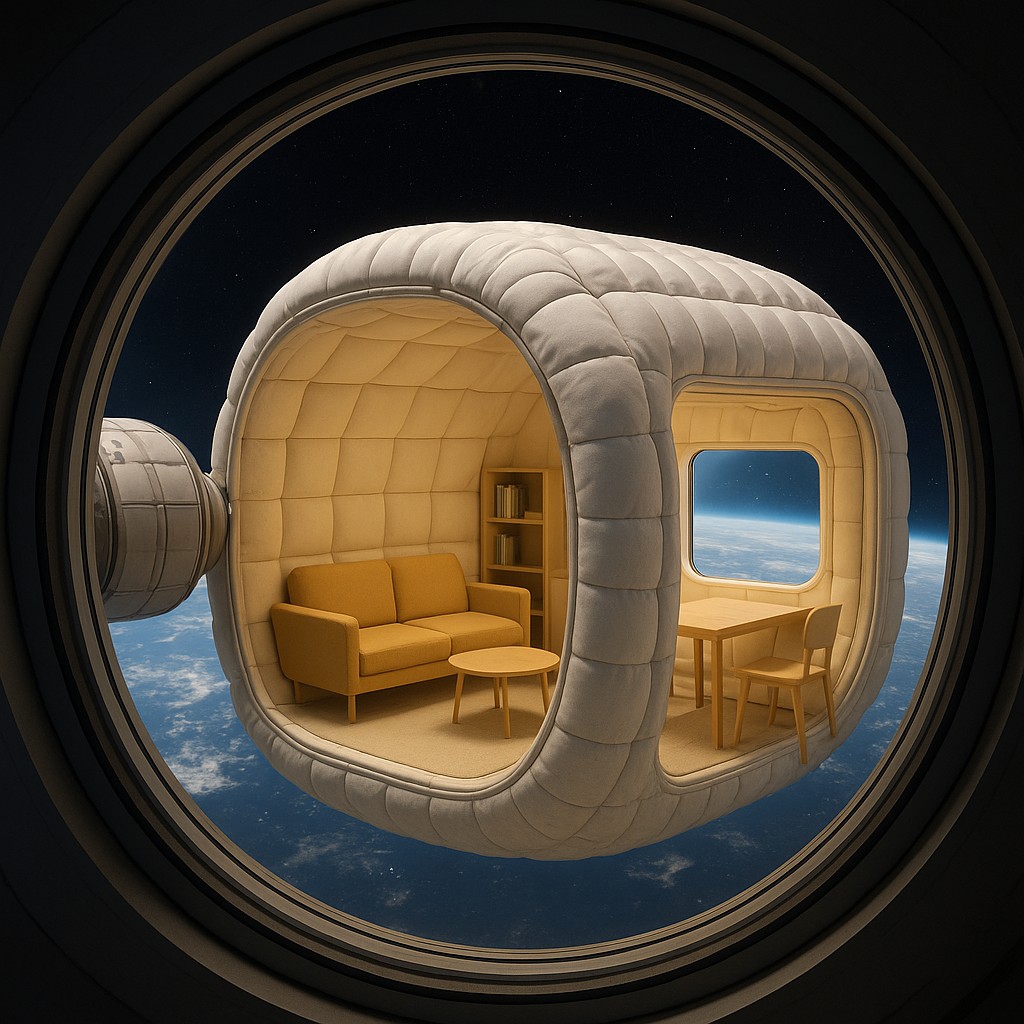
The philosophy of space construction is undergoing a radical shift. We are moving away from these metal soda cans and toward something that looks more like a high-tech bouncy house. Engineers have realized that to live and work in orbit for long periods, we need more elbow room than a narrow aluminum tube can provide. By using expandable modules, we can pack a massive living area into a small, lightweight package. These modules stay folded tight during the bumpy ride uphill and only blossom to their full size once they reach the vacuum of space. It is a solution as elegant as it is practical, solving the primary bottleneck of space exploration: the high cost and physical size limits of rocket nose cones.
The Physical Limits of the Metal Tube Era
To understand why we are switching to expandable fabrics, we have to look at the history of the International Space Station (ISS). The ISS is a marvel of engineering, but it was built piece by piece using rigid modules that had to fit perfectly inside the cargo bay of a Space Shuttle or the shroud of a Russian Proton rocket. This meant the diameter of every room in the station was strictly limited by the width of the rocket carrying it. If a rocket is 15 feet wide, your room can only be about 14 feet wide.
This "size tax" has kept astronauts living in cramped, corridor-like environments for over 20 years. In these spaces, every square inch is a precious commodity shared by science experiments, exercise bikes, and sleeping quarters.
Beyond the size constraints, rigid modules are incredibly heavy. To survive the intense vibrations of a rocket launch while holding in pressurized air, these aluminum shells must be thick and sturdy. This weight requires more fuel, which requires a larger rocket, which costs more money. In the aerospace world, mass is the enemy. Every kilogram of metal used for the "walls" of a station is a kilogram that cannot be used for water, food, or scientific gear. For a long time, this was just the price of doing business in orbit, as we lacked the material science to trust anyone’s life to a "soft" structure.
The final hurdle for traditional metal modules is their vulnerability in the shooting gallery of space. While aluminum feels strong, it is actually quite brittle when hit by a tiny pebble or a piece of space junk traveling at 17,000 miles per hour. When an object hits a metal wall at those speeds, it tends to shatter and create a "shotgun blast" effect that can pierce the entire hull. As we look toward a future with more commercial stations and satellites, the risk of these impacts only grows. We needed a material that doesn't just block an impact, but one that can actually absorb the energy of a cosmic collision.
Folding a Mansion into a Suitcase
The magic of modern expandable modules lies in their sophisticated layering. These are not simple balloons; they are complex, multi-layered "sandwiches" of synthetic fibers. Many designs use materials like Kevlar or Vectran, the same high-strength fibers found in bulletproof vests and professional racing sails. These fibers have incredible tensile strength, meaning they are very hard to pull apart. When woven together in specific patterns, they create a fabric that is significantly stronger than a sheet of aluminum of the same weight.
When one of these modules is launched, it is packed into a compressed configuration. It looks like a dense cylinder of fabric wrapped around a central structural core. This allows a relatively small rocket to carry a module that, once inflated, provides the volume of a two-story house.
Once the module reaches orbit and docks, air is slowly pumped into the internal bladder. The fabric layers unfurl and tighten, becoming rock-hard under the pressure of the internal atmosphere. The result is a pressurized environment that feels as solid as a traditional room but offers three or four times the usable space for the same launch weight.
One of the most surprising benefits of this fabric approach is how it handles space junk. Unlike a rigid metal wall that shatters on impact, the layered synthetic fibers act like a giant catcher’s mitt. When a small object hits the outer layer, the fabric deforms and absorbs the energy, spreading the force across a wide area. Some designs include layers of ceramic fabric and foam that break up the incoming projectile before it even reaches the inner layer that holds the air. Tests have shown that these expandable shells are actually more puncture-resistant than the metal modules we have used for decades.
Comparing Traditional and Expandable Structures
To see why engineers are so excited about this shift, it helps to look at the trade-offs. The following table summarizes the key differences between the legacy "rigid" approach and the modern "expandable" philosophy.
| Feature |
Rigid Metal Modules |
Expandable Fabric Modules |
| Launch Volume |
Large; must fit the rocket exactly. |
Small; compressed during launch. |
| On-Orbit Volume |
Fixed; cannot change after launch. |
Massive; expands many times its size. |
| Weight-to-Volume |
Heavy; metal is dense. |
Light; fibers are strong but airy. |
| Impact Resistance |
Brittle; prone to shattering. |
Flexible; absorbs and spreads energy. |
| Primary Material |
Aluminum and Titanium alloys. |
Kevlar, Vectran, and polymers. |
| Complexity |
Simple to build; hard to transport. |
Hard to build; easy to transport. |
As the table shows, the expandable approach wins in almost every category that matters for a budget-conscious space program. However, it does have challenges. While it is easy to "inflate" a module, maintaining it for 20 years is a different story. Engineers must account for "creep," which is the tendency of materials to slowly stretch or deform over long periods under constant tension. If the walls stretch too much, the structure could fail. This requires constant monitoring with sensors to ensure the skin is behaving exactly as predicted.
The Psychology of Extra Elbow Room
We often talk about the physics of space, but we rarely talk about the human side. Imagine living in a hallway with five coworkers for six months. You eat, sleep, and exercise there, and you can never leave. Over time, that lack of personal space leads to cabin fever, stress, and a drop in productivity. Astronauts on the ISS have often said the most popular spots are the ones with the most space, simply because they offer a sense of openness.
Expandable modules change the fundamental experience of being an astronaut. With the massive increase in room, we can design stations with "quiet zones," recreation areas, and private quarters that don't feel like vertical coffins.
This is not just about comfort; it is about mission success. On long trips, such as a mission to Mars, the mental health of the crew is as critical as the oxygen supply. If a crew is stuck in a tiny metal tube for nine months, they might arrive exhausted and irritable. Giving them a spacious, fabric-based home allows for a much higher quality of life, leading to a safer and more effective mission.
Furthermore, the extra space allows for larger and more complex scientific tools. In a rigid module, every experiment must be shrunk to fit into a tiny rack. With an expandable module, we can fly larger equipment, expansive gardens for growing food, and even manufacturing facilities. This extra room allows space stations to grow from small laboratories into true industrial hubs.
Monitoring the Invisible Stress of the Shell
The engineering of these modules must be incredibly precise. The most critical part is the "restraint layer." This is the part of the fabric sandwich that takes the brunt of the pressure. In the vacuum of space, the air inside pushes outward with about 14 pounds of pressure on every square inch. Across a large habitat, that adds up to hundreds of thousands of pounds of force trying to rip the fabric apart. This is why the weave of the Kevlar and the way it is anchored to the metal frames are closely guarded secrets.
Engineers use sensors to keep tabs on the health of these flexible walls. Strain gauges, which detect tiny changes in how much a material stretches, are embedded in the layers. Ultrasonic sensors also "listen" for micro-cracks or fibers snapping.
Because the walls are not rigid, they also handle heat differently. In a metal module, the walls help move heat around, but fabric is a great insulator. This means managing the temperature inside is more like heating a well-insulated tent than a tin shed. It requires complex air circulation to prevent "dead spots" where carbon dioxide could pool or moisture could turn into mold.
There is also the matter of radiation. In deep space, astronauts are hit by high-energy particles. Aluminum is actually a poor shield; particles can hit metal atoms and create "secondary radiation" that is even more harmful to humans. Some expandable designs use layers of water or specialized plastics that are much better at slowing down these particles. By choosing the right materials for the fabric sandwich, we can create a home that is safer from radiation than a traditional metal station.
A Future Built on Flexible Horizons
The move toward expandable modules shows that we are finally settling into space. We are moving past the "survival" era of cramped canisters and entering the era of "habitation," where we build structures designed for long-term human life.
Companies like Bigelow Aerospace paved the way with experimental modules like BEAM, which has been attached to the ISS for years without a single problem. Now, a new generation of companies is using that data to plan massive commercial stations that will serve as orbital hotels, research parks, and refueling stops.
The potential for this technology goes far beyond Earth’s orbit. When we eventually build bases on the moon or Mars, we will face the same weight limits. Shipping heavy concrete or metal to the Moon is a logistical nightmare. However, landing a compact, folded habitat that can be inflated and covered with lunar soil for protection is a much better plan.
The "bouncy house" in space is not just a gimmick; it is the building block that will allow us to become a multi-planet species. The future of humanity might not be built of steel and rivets, but of woven fibers and air. We are no longer limited by the size of our rockets, but only by the strength of our fabrics and the reach of our imagination. The era of the metal tube is closing, and the era of the expandable frontier has begun.