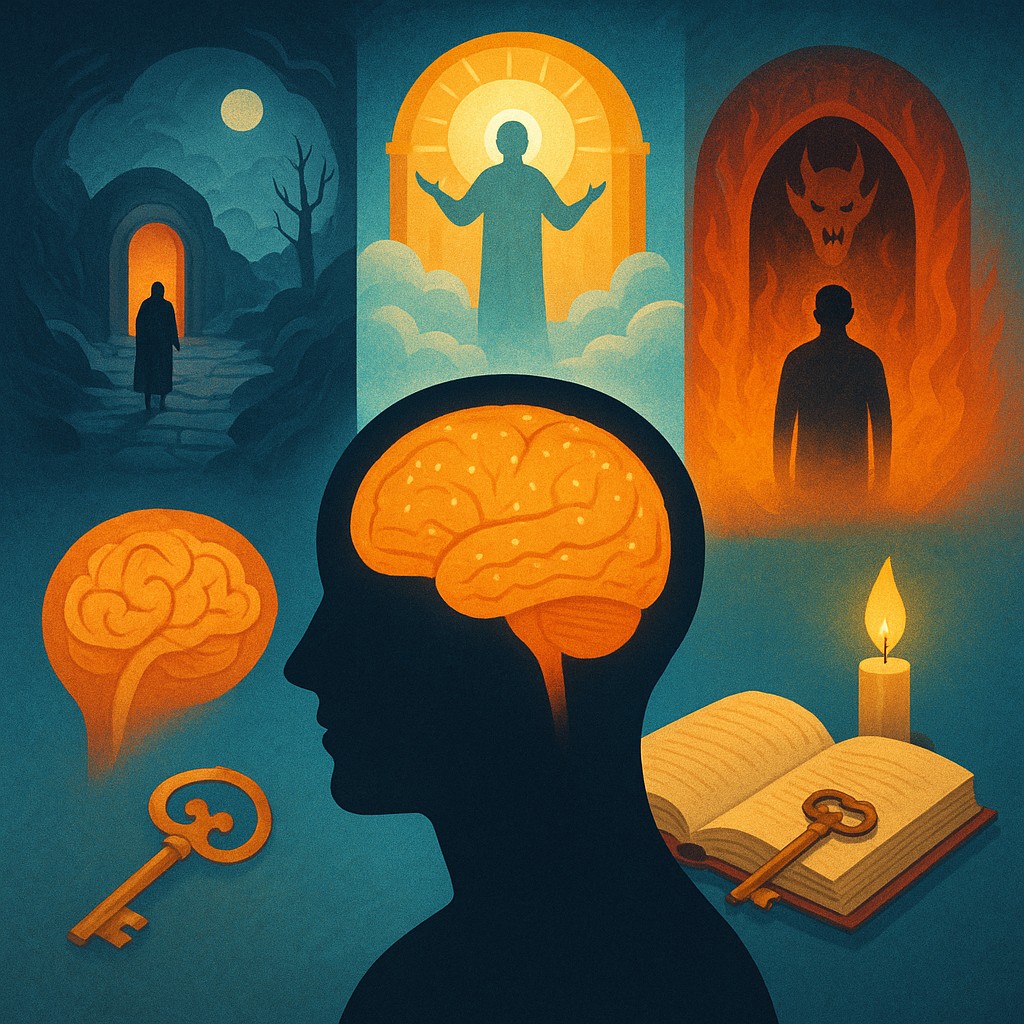
We all stand, at one time or another, under the same sky and ask the same question: what happens when the lights go out for good? Whether whispered at a bedside, debated in classrooms, or painted on the walls of ancient temples, ideas about life after death shape how we grieve, how we behave, and how we imagine meaning beyond our brief lives. This curiosity is not morbid; it is practical. The answer we lean on affects what we value, how we comfort one another, and what we do with the time we have.
This piece will guide you through what people have believed, what science can and cannot say, and what philosophers and religions mean when they talk about paradise and hell. I will correct common misunderstandings, contrast major views in a handy table, and leave you with practical steps for living so the unknown feels less frightening and more motivating. Think of this as a friendly map for a territory every culture has tried to chart.
Tales and teachings: how cultures imagine the next stage
People have told stories about journeys after death for millennia. In many ancient myths, the dead travel to an underworld - a shadowy mirror of life where memory and identity are fragile. Later religious traditions developed richer, more moral pictures: the righteous are rewarded, the wicked punished, or souls are recycled until liberation. These stories serve two purposes at once: they explain the mystery of death, and they anchor a moral order.
In monotheistic faiths like Christianity and Islam, dominant images are a final judgment followed by eternal reward or punishment. Christianity often emphasizes resurrection and a heaven where God and the redeemed dwell, contrasted with hell for those separated from God. Islam speaks of Jannah, paradise, and Jahannam, hell, with an afterlife that reflects divine justice and mercy. Judaism offers diverse views - from Olam Ha-Ba, the world to come, to older or more reserved ideas of Sheol, and in some mystical streams even reincarnation.
Eastern traditions offer different frameworks. Hinduism and many forms of Buddhism present rebirth - a cycle of lives driven by karma - with liberation, moksha or nirvana, as the escape. Buddhist teachings often treat paradise and hell as states of mind and karmic results, not eternal destinations. Indigenous and folk traditions worldwide add rich variations: ancestor realms, spirit journeys, and land-based continuities between the living and the dead.
What science can study - and where it reaches its limits
Science studies what is observable, repeatable, and measurable. When it comes to death, neuroscience offers clear findings: consciousness correlates strongly with brain activity. Severe structural damage to the brain, prolonged lack of oxygen, or total brain death reliably correlate with the end of wakeful, reportable consciousness. From a scientific standpoint, there is no confirmed mechanism by which personal consciousness continues in an organized, memory-rich way after the brain ceases to function.
That said, science cannot categorically prove a negative. Near-death experiences, or NDEs, have attracted scientific interest because some people report vivid, transformative episodes - bright lights, a sense of peace, encounters with deceased relatives, or a life review - during times when brain function was severely impaired. Research finds common elements across many NDE reports, and some studies claim veridical perceptions during clinical death. Critics point to methodological problems: memory reconstruction, drugs, oxygen-deprivation effects, and cultural expectations that can shape what people remember.
A balanced take is this: the best evidence we have shows consciousness as brain-dependent. NDEs are real phenomena worth studying, but they do not yet constitute reliable proof of an immaterial soul surviving bodily death. The question remains empirically open in principle, but constrained by the reality that extraordinary claims require extraordinary evidence.
Common features often reported in near-death experiences:
- A sense of floating out of the body or observing the scene from above
- Intense feelings of peace, love, or being in the presence of light
- A life review, or a feeling that actions are seen from the perspective of others
- Encounters with figures interpreted as deceased relatives, spiritual beings, or guides
- A boundary or decision point prompting return to life
Philosophical ways of thinking about survival and identity
Philosophers break the afterlife question into two linked puzzles: does anything like a soul exist that can survive bodily death, and if so, what counts as the same person after death? Dualist positions suggest mind and matter are distinct, so personal identity could, in principle, persist without a body. Physicalist views argue that mental life supervenes on brain processes, making survival after total brain cessation impossible in the traditional sense.
Philosophers who focus on personhood emphasize continuity: memory, character, and relational ties make someone the same person over time. If afterlife promises resurrection or rebirth with preserved memories, those scenarios preserve psychological continuity. If the afterlife offers an existence where memory is erased, philosophers ask whether that is really the same person being saved or punished.
There are creative modern proposals too - for example, the information-theoretic idea that if a complete record of a person’s brain state could be preserved and restored, identity might continue by re-creating those patterns. That view raises moral and metaphysical puzzles about what truly matters in survival - the pattern, the continuity of experience, or something irreducibly first-person.
In short, philosophical reflection shows that "survival" is not a simple yes or no. It splits into different kinds of survival - bodily, psychological, and informational - each with different implications and challenges.
Paradise and hell: literal places, moral systems, or metaphors for inner life
When religious texts mention paradise and hell, they do several things at once. They describe a destination after judgment, they teach about moral cause and effect, and they provide psychologically powerful images that shape behavior. Some traditions insist on literal, eternal places. Others read these images as symbolic descriptions of inner states or karmic processes.
If paradise is literal, it promises enduring joy, reunion, and union with the divine. If hell is literal, it promises suffering or separation as a response to wrongdoing. If metaphorical, paradise and hell become descriptions of profound inner well-being or suffering - peace versus torment that arise from one’s relationships, choices, and attitudes. Buddhism, for example, often treats these as conditions produced by mental states and ethical actions rather than eternal, fixed zones.
Beyond metaphysics, these images serve social and psychological functions. Belief in reward and punishment can encourage social cooperation, provide solace to the bereaved by promising reunion, and motivate moral reform. But such beliefs have also been used coercively, so it helps to distinguish the ethical core - accountability, compassion, and responsibility - from cultural abuses.
Here is a concise comparison of major religious and philosophical positions.
| Tradition or view |
Core claim about what happens |
What qualifies for paradise |
What leads to hell or suffering |
Is it literal or metaphorical? |
| Classical Christianity |
Resurrection and final judgment; eternal communion with God or separation |
Faith, repentance, grace, moral life |
Rejection of God, unrepented harm |
Many hold literal; some interpret metaphorically |
| Islam |
Life after death, Barzakh, final judgment with Jannah or Jahannam |
Faith, good deeds, God’s mercy |
Persistent injustice, denial, major wrongs |
Often literal but rich moral symbolism |
| Hinduism |
Cycle of rebirth (samsara); liberation (moksha) ends cycle |
Liberation, righteous living, realization |
Bad karma leads to lower rebirths or suffering |
Mostly metaphorical-symbolic, also cosmological |
| Buddhism |
Rebirth driven by desire and ignorance; nirvana ends suffering |
Nirvana, freedom from craving and rebirth |
Continued attachment and unwholesome actions |
Primarily metaphorical/psychological |
| Secular materialism |
Consciousness is brain-based; personal death ends experience |
Not applicable - meaning found in life |
Not applicable - suffering as life condition |
Literal non-survival |
| Philosophical dualism |
Mind or soul distinct from body and may survive |
Depends on soul’s fate or continuity |
Separation from goods or justice |
Open to literal interpretation |
Sorting myths from plausible features
There are many comforting or frightening claims about the afterlife that deserve correction. One common myth is that near-death experiences prove immortality. As noted earlier, NDEs are compelling and sometimes persuasive to those who have them, but they are not definitive proof of a soul surviving death. Another myth is that all religions teach the same paradise or hell. They do not: the details and underlying metaphors differ widely, and sometimes they conflict sharply.
People often assume modern medicine has simplified the issue by defining brain death, and therefore death is a single moment. Medical definitions help with organ donation and clinical decisions, but the boundary between dying and dead can be complex. Some patients in coma-like states recover unexpectedly; some organs stop and restart under extraordinary medical intervention. Medical certainty about death is strong in many cases, but the social and existential meanings of death remain contested.
Finally, the emotional force of belief can make two different things seem equally true: that a loving God would not condemn people, and that justice must be served perfectly in the afterlife. Both are powerful moral intuitions, and traditions negotiate them in different ways - through doctrines of mercy, repentance, purification, or karmic rebalancing.
How this affects the way people live: practical and moral consequences
Beliefs about the afterlife have direct, practical consequences for how people act now. If an afterlife is likely, religious motifs can encourage long-term thinking, sacrifice for future rewards, and strong community bonds. If there is no afterlife, people may feel unmoored, but many find freedom and urgency to make meaning within a single lifetime.
Ethically, the idea that actions matter beyond this world underpins many moral systems. But even without metaphysical promises, accountability, empathy, and the desire to reduce suffering provide strong moral anchors. Rituals for the dead - funerals, memorials, prayers - are psychologically adaptive. They help process grief, preserve social memory, and bind communities.
Here are practical ways people orient themselves, regardless of their metaphysical stance:
- Create legacy projects that matter to others, such as mentorship, art, or community service
- Practice rituals that help with grief, like storytelling, commemorations, or symbolic acts
- Engage in conversations about end-of-life preferences and legal planning to reduce uncertainty
- Cultivate virtues - compassion, honesty, gratitude - that make life richer here and now
How to talk about death with courage and curiosity
Conversations about death are easier when we come prepared with empathy and a few good questions. Start by listening. People’s beliefs are often less rigid than they sound and are tied to fear, loss, and hope. Ask what gives them comfort, what they fear, and which stories shaped their views. Avoid trying to fix someone with arguments; instead, offer presence and openness.
If you want to explore your own beliefs, try thought experiments: would you want to be resurrected with no memory of your past life? What kind of continuity matters to you? Reading across traditions can be illuminating - it reveals that many different answers converge on similar ethical advice: treat others well, cultivate inner peace, and care for the vulnerable.
Books, interfaith dialogues, scientific overviews of consciousness, and grief counseling resources can all help. If you are dealing with immediate bereavement or existential dread, professional support from counselors or spiritual advisors is often the most compassionate step.
You do not need certainty to live wisely. Understanding the strengths and limits of each view allows you to borrow practices that improve life without demanding metaphysical allegiance.
Final thought to carry forward
We cannot yet produce a laboratory report that ends the debate about paradise and hell, but we can make a good life. Whether you lean toward literal afterlife beliefs, prefer a metaphorical reading, or see no survival at all, the core insight across traditions is strikingly practical: our actions affect others, our attitudes shape experience, and rituals help us move through loss. Use that knowledge like a compass. Live so the life you leave behind would be a welcome memory in any story about what comes next.
If you feel unsettled, try one small experiment: call someone you love and say something you rarely say. Or write down one kind thing you want to be remembered for. The answers you get back, and the peace that follows, may be the nearest thing to paradise that is entirely within reach.