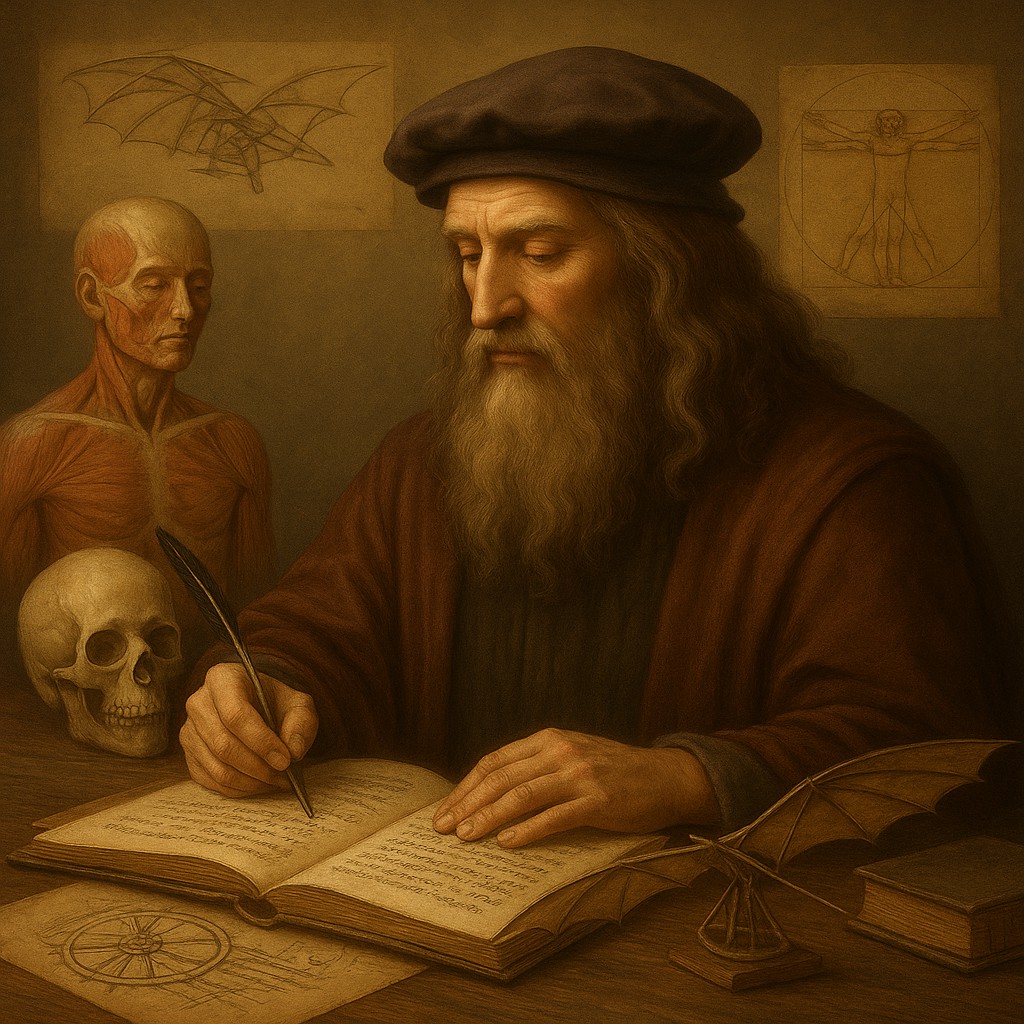
Imagine a man born illegitimate in a tiny Tuscan village in 1452, who had little schooling beyond basic reading and writing, yet grew up to become one of history’s most celebrated minds. Not just an artist. Not just a scientist. Not just an inventor. He mastered all three and kept going. Leonardo da Vinci not only painted the Mona Lisa; he dissected human corpses to learn anatomy, sketched flying machines centuries before the Wright brothers, and filled thousands of pages with mirror writing (right-to-left notes) on everything from water flow to facial mechanics. His mind did more than wander - it soared, darted, dug deep, and leapt across fields we now teach as separate subjects. So when people call him a genius, they are naming something rare: a curiosity so hungry, a precision so exact, and a creative fearlessness that still amazes us more than 500 years later.
But let’s be honest - we use "genius" too loosely. We call someone a genius for solving a Rubik’s cube fast or for cracking a hard math problem. Leonardo’s genius was different. It was the ability to see connections others missed. It was the habit of questioning what everyone else accepted without thought. It was applying beauty and exactness not only to art, but to science and engineering. What made him special wasn’t a single great invention or one famous painting - it was the relentless way he chased understanding across fields, with the eye of a poet and the discipline of a lab technician. To see why people still call him a genius, we need to look past the label and into how he thought, worked, and looked at the world.
The Artist Who Painted Questions, Not Just Faces
When most people think of Leonardo da Vinci, they picture the Mona Lisa - that mysterious woman with the slight smile, looking out from a dark background at the Louvre. Or they think of The Last Supper, the tense moment when Jesus tells his disciples, "One of you will betray me." These are masterpieces, yes, but their revolution was not just fame or beauty. Leonardo treated painting as inquiry, not decoration.
Take the Mona Lisa. Why is her smile so hypnotic? It is not only the curve of her lips. It is how the edges of her mouth and eyes blur a little, a technique he developed called sfumato, Italian for "smoke." He built up paint in very thin glazes, sometimes as thin as a micron, blending tones so subtly that light seems to ripple across her face. That was not mere style; it came from studying how human vision works. He knew our eyes do not see sharp outlines at the edges of things - especially in peripheral vision. So he painted how we actually see, not how simplified drawings suggest we should.
Then there is her expression. Is she happy? Sad? Amused? She seems to change as you study her. That "living" quality was no accident. Leonardo dissected facial muscles and carefully sketched how nerves connect to the face. He understood that emotion lives not just in the smile, but in tiny crinkles around the eyes, the tilt of the brows, the tension in the cheeks. When he painted Lisa Gherardini, he was not only making a likeness - he was capturing a psychological moment, a brief human flicker.
The Last Supper shows another kind of insight: storytelling through science. Artists used to paint the apostles in stiff, symmetrical rows. Leonardo broke that rule. He grouped them dynamically in threes and used perspective to pull the eye to Christ at the center. The deeper cleverness is in the expressions. Each apostle reacts differently - shock, denial, anger, sorrow - and every face is a study in emotion. Leonardo did not invent these reactions; he observed them. He sketched people in markets and taverns, collecting what he called "the gestures of the people." He believed true art must come from truth, from how people really look when they feel.
Leonardo never split art from science - he fused them. For him, painting was another way of exploring reality. Every brushstroke was guided by observation, anatomy, optics, and psychology. That is why his paintings are more than images. They are records of a mind that saw no boundary between making beauty and seeking truth.
The Inventor Who Built the Future in His Mind
Now move from the painted canvas to the crowded notebook. In his sketches you find helicopters, tanks, parachutes, and robots - all drawn in the late 1400s. Hundreds of years before powered flight, he designed a machine with a screw-like rotor meant to lift off the ground. He called it the aerial screw, and while it would not have worked with the materials of his time - he imagined it powered by human muscle, which is not enough - the idea resembles a modern helicopter.
His drawings were not wild guesses. They read like detailed blueprints with notes on mechanics, balance, and airflow. His tank sketch shows a circular armored vehicle with cannons around the edge and a hand-cranked gear system for the wheels. Oddly, the gears were drawn backward, which would have made steering impossible. Some say he did that on purpose - he did not want warlords to copy his designs. Others call it a mistake. Either way, the central idea - a mobile, protected weapon platform - appeared centuries before the first tanks in World War I.
Perhaps the most striking thing about Leonardo’s inventions is how many were grounded in real science. Look at his studies of flight. He did not only dream of flying; he watched birds for years. He drew different wing shapes, tracked air currents, and built models. His ornithopter design, which copied flapping wings, grew from detailed drawings of bird and bat anatomy. He calculated weight-to-wing ratios and tested materials like linen and cane for flexibility and strength. He tried different pilot positions to reduce drag.
None of his flying machines left the ground, of course. But the method mattered. He was doing aeronautical research. He asked, "How does a bird stay aloft?" and searched for measurable answers. He tested wind resistance by sticking his hand out of a moving cart. He studied how air moves over curved surfaces and saw that the upper curve of a wing can create lower pressure and help lift - but without formal fluid dynamics, he could not fully solve sustained flight.
Still, the spirit was there: question, observe, model, test. That is the scientific method, long before thinkers like Galileo or Newton formalized it. Leonardo’s genius was not in building a working helicopter. It was in thinking like an engineer while most of Europe still relied on myth and guesswork. His inventions were not pure fantasy - they were early prototypes of a mindset: use nature as your textbook, and let curiosity drive invention.
| Invention |
Modern Equivalent |
Key Insight |
Did It Work? |
| Aerial Screw |
Helicopter |
Lift via rotating blades |
No (underpowered) |
| Ornithopter |
Flapping-wing aircraft |
Mimicking bird flight |
No (human muscle too weak) |
| Parachute |
Modern parachute |
Air resistance slows descent |
Yes (tested in 2000) |
| Robot Knight |
Humanoid robot |
Mechanical joints and movement |
Partial (movable armor) |
| Armored Tank |
Combat tank |
Mobile defense and offense |
No (steering flaw) |
This table shows how far ahead of his time Leonardo was. While most people were not even asking how flight or automation might work, he sketched solutions and built test pieces. He never patented anything and never built most of these machines. Still, by imagining and designing with rigor, he planted seeds for modern engineering.
The Scientist Who Dissected the World, Literally
We often date the Scientific Revolution to the 1600s, with telescopes and labs. But Leonardo was doing real science a century earlier - with a scalpel. In a time when the Catholic Church restricted human dissection, he secretly got corpses - likely from hospitals or executed prisoners - and worked by candlelight. Over decades he dissected about 30 bodies and drew detailed sketches of muscles, organs, nerves, and bones.
What made his work remarkable was not just cutting bodies open. He wanted to know how things worked. He tore through muscle layers to see how they attach to bone and drew the mechanics of movement. He traced nerves from the spine to the limbs to figure out how the brain controls the body. He even compared layers of the skull to rock strata, suggesting both formed over time through natural processes.
One of his most striking findings came in cardiology. He injected wax into an ox heart to make a mold of its chambers. When the wax hardened, he could see the valves and how they opened and closed. He noticed that blood did not simply flow in a straight line - it swirled in vortices, what we now call turbulence. He guessed correctly that these vortices helped the valves close efficiently. It would take nearly 500 years and modern MRI scans to confirm what Leonardo saw with wax and a blade.
He also studied the eye, not just as an organ but as a tool for perception. He worked with the camera obscura (a dark room with a tiny hole that projects an upside-down image of the outside world) and concluded the eye works like a lens, inverting images on the retina. He even suggested the brain flips the image so we see it right-side-up - a basic idea of neural processing long before neuroscience existed.
His curiosity extended beyond humans. He mapped how rivers bend, how eddies form, and where sediment settles. He compared blood flow to river currents, making an early link between biology and physics. He wrote about tree growth, noting that the total thickness of branches at any height equals the trunk's thickness - a rule modern botanists still call Leonardo’s Rule.
Most of these findings were never published. After his death, many notebooks were lost or scattered. When scholars later rediscovered them, scientists were astonished. Here was a 15th-century man making observations that would become basic to anatomy, physiology, and fluid dynamics. He had no microscope or computer - only pen, ink, and an insatiable need to see beneath the surface. His genius was not that he was always right - some ideas were off - but that he asked the right questions and let observation guide him.
The Thinker Who Saw Across Disciplines Like No One Else
Perhaps the most underrated part of Leonardo’s genius was his refusal to specialize. Today we train narrow experts: a neurosurgeon rarely studies art, and an aerospace engineer rarely dissects cadavers. Leonardo treated knowledge as one large, connected web. He believed patterns repeat across nature - in a swirling water vortex, the branching of a tree, or the motion of muscles. To understand one, you must study them all.
When he painted The Last Supper, he did more than compose a religious scene. He used geometry to place Christ at the vanishing point, psychology to shape the apostles’ reactions, and optics to figure how light falls across the painted hall. He did not break knowledge into compartments; he combined it. For him, beauty and truth were two ways of seeing the same thing.
This cross-discipline approach gave him fresh insights. His studies of water influenced how he painted waves and curls in hair. His anatomy work made his drawings and sculptures lifelike. His knowledge of mechanics helped him design better tools for grinding pigments or lifting heavy sculpture pieces.
He was relentless in curiosity. He wrote questions in the margins of his notebooks: "Describe the tongue of the woodpecker." "Why is the sky blue?" "How does a lizard walk on walls?" These were not idle notes. He followed up on them, dissecting a woodpecker’s long, sticky tongue that wraps around its skull, and guessing that the sky is blue because light scatters in the atmosphere - an effect later explained as Rayleigh scattering.
Leonardo did not simply collect facts. He looked for rules under the facts. He wanted the why behind the what. In this way he was more than a Renaissance man - he anticipated modern scientists, engineers, and artists all at once. His genius lay not in single achievements but in how he linked them, building a private universe of knowledge that ignored artificial borders.
Today we face problems like climate change, artificial intelligence, and public health that no single field can solve. Leonardo’s legacy reminds us breakthroughs often happen at the edges, where fields overlap. His life is a lesson in curiosity-driven learning: look closely, question constantly, and never assume you already know.
So why do people call Leonardo da Vinci a genius? Not because he had a higher IQ or was born with magic talent. Because he shaped an attitude: everything deserves a question, beauty and truth can be allies, and the world is a big, fascinating puzzle to solve. He did not just invent machines or paint famous works. He invented a way of thinking - one still useful in a world that needs minds willing to connect dots across fields, notice what others miss, and create with both heart and mind. If that is not genius, it is hard to imagine what is. And the best part? That kind of genius is not locked in the past. It is a mindset anyone can choose to develop. Start with a question. Scribble it in the margin. See where your curiosity takes you.