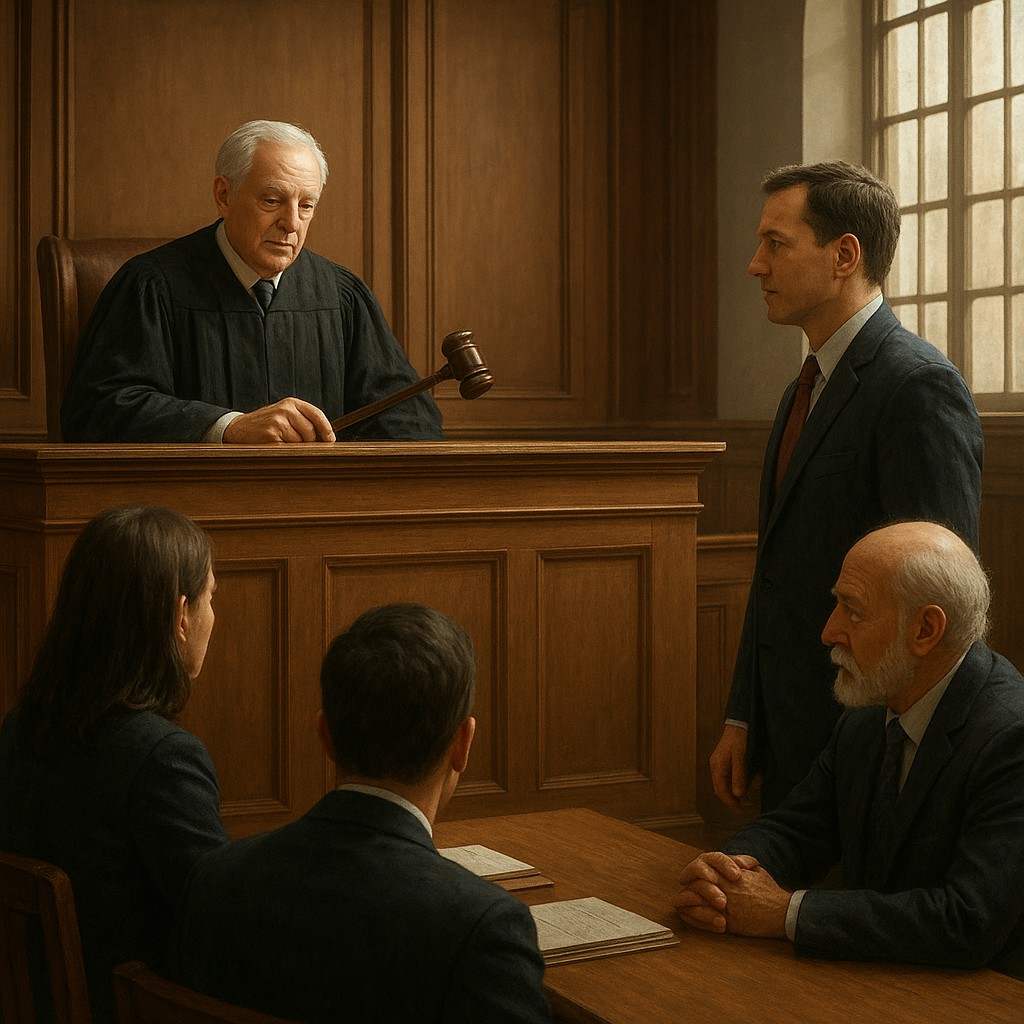
Imagine standing in a courtroom where a judge is presiding over a complex inheritance case. The facts are a mess, the biology is clear, and yet the judge looks at everyone in the room and calmly declares that a person who died several hours ago is, for legal purposes, still alive. You might look around for a doctor or a miracle worker, but what you are actually seeing is one of the most sophisticated "operating systems" ever designed. This is not a hallucination or a lie. It is a legal fiction: a deliberate, transparent assumption of a fact we know to be false, used to ensure the gears of justice keep turning when reality gets complicated.
We often think of the law as a rigid set of rules carved in stone, but it actually functions much like a high-level programming language. Just as a software developer might use a "placeholder" or a "virtual environment" to test a new app without breaking the whole system, lawyers and judges use fictions to bridge the gap between ancient statutes and the unpredictable chaos of real life. By pretending something is true, the law can grant rights to those who cannot speak for themselves, hold massive organizations accountable as if they were individuals, and ensure your final wishes are respected even after your heart stops beating. It is a tool of pure logic used to solve problems that cold facts alone cannot handle.
Bridging the Gap Between Biology and Boardrooms
At its core, a legal fiction is an agreement to ignore a literal truth in favor of a functional one. This exists because reality is often too fluid for the "black and white" nature of legislation. For example, consider "Corporate Personhood." We all know a multinational coffee chain is not a sentient being with a favorite color or a soul. It cannot go to jail, feel remorse, or hold a birth certificate. However, if the law did not treat a corporation as a "person," it would be nearly impossible for you to sue one for a broken contract or hold it responsible for property damage.
By creating the fiction that a corporation is a legal person, the system allows the business to sign contracts, own land, and be held liable in court. This does not mean the CEO is "the person," nor is the building itself the person. The "person" is a conceptual layer sitting on top of physical assets and employees. This allows the law to apply centuries of established rules regarding human interaction to a massive group of people working toward one goal. Without this fiction, every single shareholder would have to sign every single contract, and the legal system would collapse under its own weight within a week.
The beauty of this tool is that it is wide open. When a judge uses a legal fiction, they are not trying to trick the public. Everyone in the room knows the corporation is not a flesh-and-blood human. The fiction is a shorthand - a common language that lets us move past definitions and get to the heart of a case. It is a way of saying, "Let us assume X is true so we can apply rule Y fairly." In this sense, legal fictions are the ultimate form of being practical, choosing a useful "untruth" over a useless, literal fact.
The Ghostly Hand of the Doctrine of Survival
One of the most moving ues of this mechanism involves the transition from life to death. Biology is often sudden and inconvenient, but distributing an estate is a long, bureaucratic process. This is where we find the "Doctrine of Survival." Imagine a tragic scene where two people - perhaps a grandfather and his grandson - pass away within hours of each other in different places. If the grandfather died first, his property would technically pass to the grandson. If the grandson then died an hour later, the property would move to the grandson’s heirs. But if they died at the exact same moment, or if the order of death is unclear, the legal gears might lock up.
To solve this, many regions use a fiction that treats a beneficiary as having outlived the deceased for a specific amount of time, even if they actually died shortly after. This ensures that property moves in the direction the original owner intended rather than getting stuck in a legal vacuum. By pretending someone is "legally alive" for five days past their medical death, the law prevents a family’s wealth from being swallowed by unintended taxes or diverted to distant relatives because of a 15-minute difference in a hospital room.
This "survival" is not a claim of literal immortality. It is an administrative bridge. It allows the person managing the will (the executor) to pretend the deceased person can still receive a gift, only to immediately pass it to the next person in line. It is a way of honoring a person's intent over their pulse. The law recognizes that your impact on the world and your property rights do not evaporate the millisecond your brain activity stops; the legal fiction provides a graceful exit strategy for your worldly affairs.
Comparing the Literal with the Legal
To better understand how these fictions serve as a bridge, it helps to contrast the legal view of a situation with the view of a scientist or a regular person. The following table highlights common scenarios where "legal truth" intentionally departs from "physical truth" to achieve a specific goal for society.
| Concept |
Literal Fact |
Legal Fiction |
Purpose of the Fiction |
| Corporate Personhood |
A collection of assets, buildings, and employees. |
A single human-like entity with rights and duties. |
Allows the entity to be sued, own property, and sign contracts. |
| Doctrine of Survival |
A person has medically died at a specific time. |
The person is "alive" for a set period after death. |
Ensures estate assets flow to the intended beneficiaries. |
| Constructive Notice |
A person has not actually read a specific legal document. |
The person is treated as if they have read and understood it. |
Prevents people from avoiding responsibility by claiming ignorance. |
| Adoption |
A child has no biological link to their new parents. |
The child is the "legally born" offspring of the parents. |
Grants full inheritance and parental rights identical to biological kin. |
| Finding Property |
An item is lost on the ground with no current owner. |
The landowner is "in possession" of the item even if they don't know it's there. |
Clarifies who is responsible for the item and prevents theft. |
As the table shows, a fiction is never used just for the sake of it. It always serves a specific administrative or moral purpose. In the case of adoption, for example, the fiction is perhaps one of the most heartwarming tools in the legal shed. By treating the adopted child as "legally born" to the parents, the law erases any distinction between biological and non-biological children. This ensures the child has a rock-solid right to support, education, and inheritance, protecting them from being treated as "second-class" family members in court.
Avoiding the Trap of "Procedural Absurdity"
You might wonder why we don't just write better laws that cover every possibility. Why rely on "pretending" when we could just be more specific? The reason is that life is infinitely more creative than any legislature. If we tried to write a rule for every single variation of a car accident, a business deal, or a family tragedy, our law books would be thousands of miles long. Legal fictions allow the law to stay flexible. We can take an old, trusted rule about "property owners" and, through the fiction of corporate personhood, apply it to a tech startup that didn't even exist when the rule was written.
This also prevents what lawyers call "procedural absurdity." Imagine a rule that says a person must personally sign a document to transfer their land. Now imagine that person falls into a coma. Without a legal fiction - like "Power of Attorney," where another person is treated as the "alter ego" of the first - the land would be stuck forever. The family could not sell it to pay for medical bills, and the property would fall into ruin. By using the fiction that the representative is the same as the owner, the law allows life to continue. The fiction is the oil in the machine of society.
It is also vital to tell the difference between a legal fiction and a lie or a "legal loophole." A lie is meant to deceive and gain an unfair advantage. A loophole is a mistake in the writing of a law that lets someone bypass the intent of the rule. A legal fiction, however, is transparent. When a judge uses it, they state it clearly in their written opinion. They explain that while the facts say A, they are applying the law as if B were true to ensure a just result. It is an honest admission that the world is messy and the law needs a little bit of imagination to keep things fair.
The Evolution of the Legal Operating System
Throughout history, legal fictions have evolved to meet the needs of the times. In ancient Roman law, if a citizen was captured by an enemy, they lost their legal rights because they were no longer "free." If they died in captivity, their will would be invalid because they weren't technically a citizen at the moment of death. To fix this, the Romans created the "Fiction of Cornelian Law," which pretended the captive had died the moment before they were captured. This allowed their family to inherit their property according to the will, rather than the state seizing everything.
Today, we see these fictions moving into the digital world. We treat "digital assets" like physical property, even though they are just sequences of ones and zeros on a server. We treat a "domain name" as a piece of real estate that can be "trespassed" upon. These are all fictions that let us take our existing understanding of "stealing" or "owning" and apply it to things that have no physical weight. By doing this, we don't have to reinvent the concept of "theft" every time a new technology appears.
This flexibility is what makes the law a living, breathing entity. If the law were purely a description of physical facts, it would be as cold and indifferent as a rock. Because it uses fictions, it can be empathetic. It can "look the other way" regarding biological reality to ensure a child is supported or a widow is not left penniless by a clerical error. It allows the law to have a "spirit" that matters more than its literal "letter."
Expanding the Boundaries of Fairness
While we have talked about inheritance and corporations, legal fictions also play a massive role in daily civil rights and public safety. Consider the concept of "Constructive Possession." If the police find a banned item in the trunk of a car, the driver might say, "I didn't have it on me! It wasn't in my pockets!" To prevent people from simply placing illegal items inches away from their bodies to dodge the law, the system uses a fiction: because you have the keys to the trunk, you "possess" everything inside it.
This fiction creates a zone of responsibility around an individual. It forces us to be mindful of the spaces we control. Similarly, "Constructive Notice" assumes that if a legal document is filed in a public office, you "know" what it says, even if you’ve never visited that office. If the law didn't do this, everyone could claim they didn't know the law as a defense. "I didn't know I couldn't build a skyscraper in my backyard!" would be a valid excuse. The fiction that "everyone knows the public record" ensures society can function on a shared set of rules.
- Logic over Literalism: Fictions allow the law to prioritize the "result" over the "definition."
- Stability: Old laws can be applied to new inventions (like the internet) without a total rewrite.
- Equity: Fictions help judges reach a fair conclusion when strictly following the facts would cause an injustice.
- Efficiency: They provide a "shorthand" that keeps the legal system from getting stuck in deep debates about the meaning of "personhood" or "life."
When you look at it this way, the law becomes much less intimidating. It isn't a collection of traps designed to catch you; it is a creative toolkit designed to keep a diverse population living together in peace. It is the art of the "useful assumption."
Seeing the Law with New Eyes
Understanding legal fictions changes the way you see the world. You begin to realize that our society is built on a foundation of shared stories and useful imaginings. When you sign a contract with a company, you aren't just signing a piece of paper; you are participating in a grand fiction that allows commerce to last longer than any single human life. When you read about an estate being settled, you are seeing the law's attempt to extend a person's kindness and intent beyond their physical presence.
This realization should be inspiring. It shows that the law is not a dead, dusty thing from the past, but an active and imaginative force. It is a system that allows us to build structures of justice that are stronger than their individual parts. It reminds us that "truth" in society is often about more than just what we can see or touch; it is about what we value and the kind of world we want to live in.
So, the next time you hear a legal term that sounds a bit "unreal," don't roll your eyes at the jargon. Instead, look for the problem the law is trying to solve. Look for the bridge it is trying to build. You will find that underneath the complex language and the "pretend" facts, there is a deeply human desire to make sure the world makes sense, even when it doesn't. You now have the "code" to understand how reality is shaped in the courtroom, and that makes you a much more informed citizen of the world.