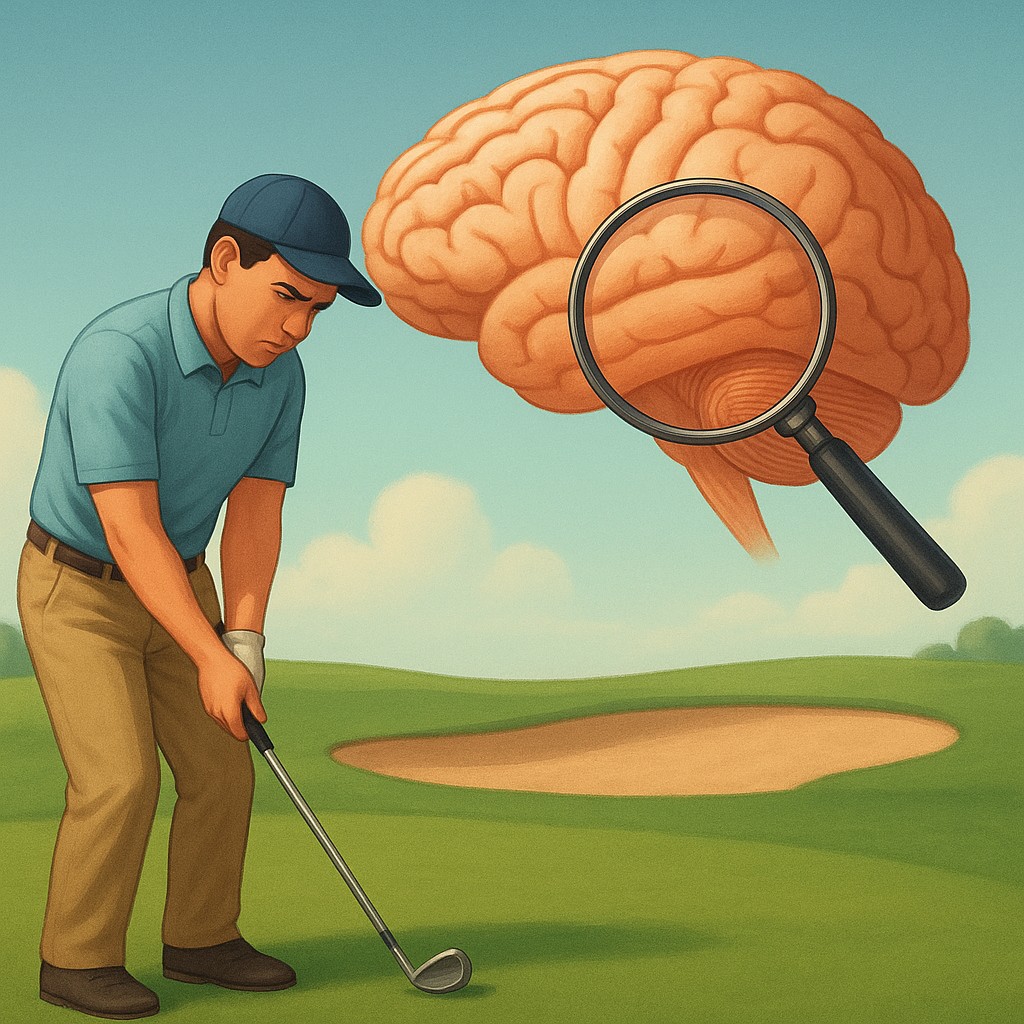
Imagine you are standing on a pristine green, a golf club gripped in your hands, staring at a small white ball that seems to mock you with its stillness. You have watched the pros on television dozens of times, and you have a mental image of exactly what a perfect swing looks like. You pull the club back, shift your weight, and swing with the confidence of a champion, only to send the ball skittering uselessly into a sand trap thirty feet to the right. Your first instinct is likely frustration, or perhaps a desire to apologize to the grass you just mangled. You might think the path to success is simply trying to mimic the "correct" move over and over until it sticks, but your brain uses a much more surprising and effective strategy to help you succeed.
The human brain is not a photocopier; it does not learn simply by seeing a perfect image and trying to reproduce it through endless repetition. Instead, your nervous system is a sophisticated machine designed to detect mistakes. It actually thrives on your failures. While it feels like you are failing when you miss that shot, your cerebellum, a dense cluster of nerve cells at the base of your brain, is having the time of its life. It is busy measuring the "prediction error," which is the neurological gap between what you intended to do and what your body actually did. This process, known as error-driven learning, suggests that the secret to mastery isn't just practicing what is right, but becoming deeply and clearly aware of exactly what went wrong.
The Cerebellum: The Architect of Accuracy
The cerebellum represents only about ten percent of the brain's volume, but it houses over half of your total neurons. This high density is necessary because the cerebellum acts as a high-speed processing plant for a massive stream of sensory data. When you move your arm, your brain sends two signals: one to your muscles to move, and a "carbon copy" to the cerebellum. This copy tells the cerebellum what the internal model of your brain expects to happen. When sensory feedback comes back from your eyes, your inner ear, and the nerves in your joints, the cerebellum compares reality to those expectations. If your hand was two inches to the left of where it should have been, the cerebellum doesn't just make a note of it; it generates a spike of electrical activity to mark the difference.
This mechanism works much like a high-tech flight stabilizer in a modern jet. The computer constantly makes tiny adjustments because the wind, the weight of the fuel, and the air pressure are always changing. In the human body, your muscles might be tired, or you might be holding a racquet that is heavier than the one you used yesterday. By focusing on the error rather than the "perfect" move, the brain creates a flexible system that can adapt to any environment. Instead of memorizing a rigid sequence of actions, you are teaching your brain to recognize and shut down the specific nerve pathways that lead to failure.
Weighting and Magnifying the Senses
One of the most fascinating parts of error-driven learning is a phenomenon called sensory weighting. When the brain detects a major mismatch between expectation and reality, it temporarily turns up the "volume" on the sensory signals coming from that part of the body. If you swing a bat and miss the ball entirely, your brain creates a massive error signal that makes you hyper-aware of the tilt of your shoulders or the grip of your fingers. It is as if the brain is shining a giant spotlight on your mistake so you cannot possibly ignore it. This serves as a neurological "stop" command, preventing you from locking a bad habit into your long-term memory.
Research has shown that we actually learn faster when our errors are slightly magnified. In labs, scientists sometimes use robotic arms or virtual reality to trick a subject’s brain into thinking their mistakes are twice as large as they actually are. Surprisingly, these people often learn the correct movement much faster than those who see their mistakes accurately. This happens because the larger error signal triggers a stronger correction response in the cerebellum. By making the mistake feel "louder," the brain is forced to prioritize fixing that specific movement plan, weeding out the weak connections that caused the slip-up in the first place.
Why Mindless Repetition Fails the Brain
We are often told that "practice makes perfect," but this is a dangerous half-truth. If you go to the driving range and hit five hundred balls while thinking about what you want for dinner, you are not actually engaging in error-driven learning. Without deep focus, your brain does not generate the necessary prediction signals to compare against reality. This is often called "arrested development," where a person reaches a plateau of being "good enough" and never improves despite years of activity. To the brain, if you aren't paying attention to the outcome, there is no error to correct, so the current neural map remains unchanged.
To truly trigger the cerebellum’s learning machinery, you must have a clear, specific goal for every single repetition. This requires a high level of mental effort because you are forcing your brain to stay in a state of constant self-evaluation. It is the difference between "just swinging the club" and "aiming to hit the ball exactly three inches above the base of the tee." When you have a precise target, every miss becomes a piece of data. Without a target, a miss is just a random event that the brain ignores. This is why ten minutes of hyper-focused practice is often more valuable than two hours of "zoning out" at the gym.
| Feature |
Mindless Repetition |
Error-Driven Learning |
| Brain Goal |
Completing the task |
Reducing movement error |
| Cerebellum State |
Low activity / Autopilot |
High activity / Comparison mode |
| Neural Outcome |
Reinforces existing habits |
Prunes bad habits and builds new ones |
| Feedback Loop |
Ignored or filtered out |
Amplified and prioritized |
| Pace of Growth |
Plateaus quickly |
Consistent, long-term improvement |
Pruning the Wrong Path
In the early stages of learning a skill, your brain is like a chaotic city with too many roads and no traffic lights. There are thousands of different ways your neurons could fire to move your arm. Error-driven learning acts as a master urban planner that systematically shuts down the roads that lead to dead ends. Each time you make a mistake and your brain registers that error signal, it weakens the synaptic connections (the links between nerve cells) associated with that specific movement pattern. This process is known as "long-term depression" - not the emotional kind, but a physical reduction in the strength of those links.
On the other hand, when the error signal is small or non-existent, the brain begins to "potentiate," or strengthen, the connections that led to that success. Over many sessions, the noise of the error signal grows quieter. This isn't because you've stopped making mistakes entirely, but because your internal mental map of the movement has finally aligned with the physical reality of your body. The "perfect" movement isn't something you find; it is what remains after you have systematically eliminated every possible way to do it incorrectly. This is why experts in any field look so effortless. Their brains have pruned away all the unnecessary muscle tension and conflicting signals, leaving only the most efficient path.
High Variability: A Learning Shortcut
It may seem backward, but practicing in an inconsistent environment can actually speed up your learning. If you are learning to throw a ball, practicing from the exact same spot with the exact same weight every time can make your brain "lazy." Because the environment is so stable, the error signals become predictable and eventually vanish. However, if you throw balls of slightly different weights or stand at different angles, you are constantly feeding your cerebellum new problems to solve. This is known as "variable practice."
When you introduce variety, you force the cerebellum to constantly recalculate the relationship between effort and outcome. This creates a much more robust mental map. A golfer who only practices on a flat, indoor mat often struggles on a real course with hills, wind, and varying grass heights. The player who has practiced in the wind and rain has a cerebellum that is an expert at handling large error signals and making rapid adjustments. By inviting small mistakes into your practice routine, you are effectively "future-proofing" your skills against the unpredictability of the real world.
Embracing the Frustration of the Error
Understanding the science of error-driven learning changes the way we should view the feeling of frustration. That "itchy," slightly annoyed feeling you get when you can't quite master a move is actually the feeling of your brain's chemistry changing to make learning possible. When you recognize an error, your brain releases chemicals like acetylcholine and norepinephrine, which increase your focus and mark the specific nerve cells that need to be updated. Frustration is effectively a biological signal that your brain is "open for business" and ready to improve.
Next time you are struggling to learn a new language, a musical instrument, or a sport, stop trying to avoid the mistakes. Instead of being discouraged by the gap between your performance and your goals, lean into it. Recognize that every missed note or fumbled word is a loud, clear instruction to your cerebellum. You aren't just practicing a skill; you are debugging the software of your mind. By welcoming the error and maintaining a razor-sharp focus on why you missed, you are harnessing the most powerful learning system ever devised by nature. Perfection is not a starting point; it is the quiet that settles once you have finally taught your brain how to silence the errors.