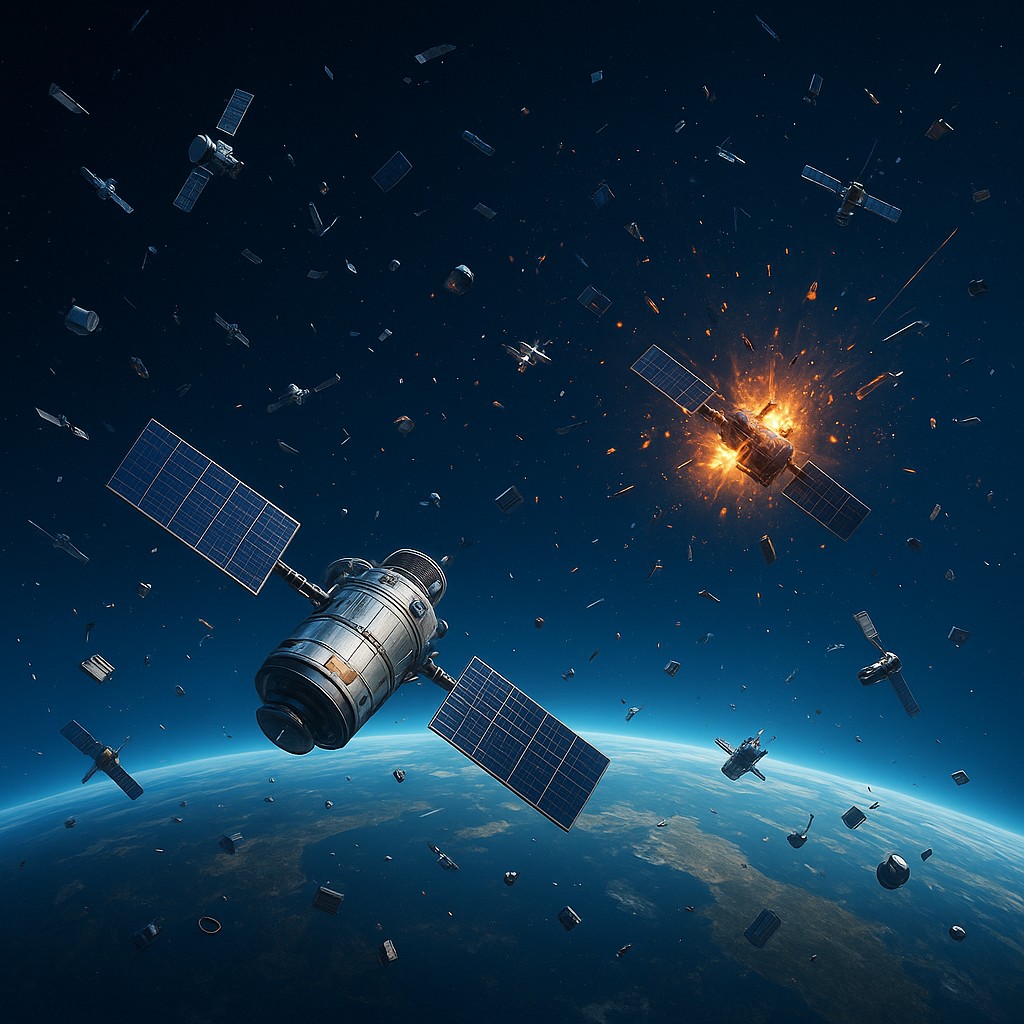
Imagine standing on the balcony of a skyscraper overlooking a highway where every car is traveling at 17,500 miles per hour. Now, imagine that none of those cars have steering wheels, brakes, or drivers. They are simply hurtling forward, fueled by the momentum of their launch. If one happens to tap another, they both explode into a cloud of titanium shrapnel moving just as fast as the original vehicles. This is not a scene from a dystopian sci-fi film; it is the current reality of Low-Earth Orbit (LEO). For decades, we treated space as an infinite void where trash would eventually take care of itself. But as we launch thousands of new satellites every year, that void is starting to look uncomfortably crowded.
The challenge is that space is becoming a victim of its own success. We rely on these high-speed metal boxes for everything from GPS and weather forecasting to high-speed internet in remote villages. However, when a satellite reaches the end of its life, it does not just disappear. It becomes a multi-million-dollar piece of space junk. If we do not find a way to manage the movement of these objects, we faces the very real possibility of the Kessler Syndrome. This is a theoretical scenario where the density of objects in LEO is high enough that a single collision creates a chain reaction of more crashes. Eventually, this could make space travel and satellite technology impossible for generations. To prevent this, the industry is pivoting from a "launch and leave" mindset to a "propulsion-as-a-service" model. This approach treats mobility as a vital utility rather than a luxury.
The Physics of Orbital Gridlock
To understand why sitting still in space is so dangerous, you have to appreciate the sheer energy involved in orbital mechanics. In LEO, satellites are not just floating; they are essentially in a state of constant freefall, moving sideways so fast that they miss the Earth as they fall. At speeds of roughly 7 to 8 kilometers per second, even a tiny screw or a fleck of paint carries the energy of a hand grenade. When two satellites collide, they do not just dent each other, they pulverize one another into thousands of smaller fragments. Each of those fragments then becomes a new projectile, capable of destroying other satellites in nearby orbits.
Traditional satellites were often "dumb" because they had little to no ability to change their path once they were in position. They were placed in a specific orbital slot and stayed there until their fuel ran out or their electronics failed. This worked when there were only a few hundred objects in the sky. However, today, with "mega-constellations" like Starlink and OneWeb adding thousands of units to the mix, there is no longer any room for error. We are moving from a world of "set it and forget it" to one where every satellite must actively participate in traffic management. If a satellite cannot move to avoid a piece of tracked debris, it is not just a loss for the owner; it is a danger to every other nation and company with assets at that altitude.
The shift toward removing debris and disposing of old satellites is driven by both necessity and new laws. Organizations like the FCC have recently shortened the "grace period" for dead satellites. They now require operators to de-orbit their craft (bring them down into the atmosphere) within five years of the mission's end rather than twenty-five. This creates a massive technical hurdle for small, low-cost "CubeSats" that historically lacked the weight or budget for complex engine systems. Without a way to move, these small satellites are essentially ticking time bombs. This is where shared, modular propulsion comes into play, providing a way for even the smallest players to navigate the cosmic highway.
From Chemical Explosions to Precision Plasma
Historically, moving a satellite required chemical propulsion, which uses mini-rocket engines that burn fuel to create thrust. While powerful, chemical engines are heavy, bulky, and dangerous to handle. They require pressurized tanks and complex plumbing, making them difficult to shrink down for the bread-box-sized satellites that now dominate the industry. Furthermore, chemical thrust is often "all or nothing." This makes it hard to perform the tiny, careful adjustments needed to fly in tight groups or to dodge a specific piece of junk by a matter of meters.
The current revolution centers on "electric propulsion," specifically plasma thrusters. Instead of burning a chemical fuel, these systems use electricity from solar panels to turn a gas, like xenon or krypton, into charged particles (ions). These particles are then shot out of a nozzle using magnetic fields. While the actual force produced is tiny (about the weight of a sheet of paper resting on your hand), it is incredibly efficient. Because there is no friction in space, applying that tiny force consistently over days or weeks can move a massive satellite into a completely different orbit. It can also safely push a craft down into the atmosphere to burn up upon reentry.
This efficiency allows for "Propulsion-as-a-Service" (PaaS). Instead of every satellite company spending years designing their own custom engine, they can now purchase standardized, "plug-and-play" modules. These units come pre-set and ready to install. Some companies are even going further by offering "towing" services. In this setup, a dedicated "space tug" hooks onto a powerless satellite and moves it to its destination. This creates a functional market for orbital mobility, where the ability to dodge, weave, and exit is available to anyone with a ticket to ride.
| Feature |
Chemical Propulsion |
Electric (Plasma) Propulsion |
| Thrust Level |
Very High (Instant movement) |
Very Low (Gradual movement) |
| Fuel Efficiency |
Low (Heavy fuel consumption) |
Very High (Uses very little mass) |
| Complexity |
High (Pumps, valves, high pressure) |
Low/Moderate (Solid state, magnetic fields) |
| Ideal Use Case |
Large course corrections, launch |
Long-term positioning, de-orbiting |
| Safety |
High risk (Explosive materials) |
Low risk (Safe gases) |
The Kessler Syndrome and the Risk of Chain Reactions
The nightmare scenario that keeps satellite operators awake at night is the Kessler Syndrome. Proposed by NASA scientist Donald Kessler in 1978, this theory suggests that once the density of objects in orbit reaches a certain "critical mass," collisions will happen so often that they create more debris than the atmosphere can naturally clean out through air resistance. Even if we stopped launching rockets tomorrow, the objects already in space would continue to smash into each other. This would create a self-sustaining cloud of junk that gets thicker and more lethal every year.
We have already seen "spark" events that hint at this future. In 2009, a retired Russian satellite collided with an active Iridium communications satellite, creating over 2,000 pieces of trackable debris. In 2021, a Russian missile test destroyed a satellite, creating a cloud of wreckage that forced astronauts on the International Space Station to hide in their escape pods. These events show that the "big sky" theory, the idea that space is so large we do not need to worry about hitting anything, is officially dead. We are now in an era of "close approaches," where some operators must perform multiple maneuvers every week just to stay safe.
The danger of Kessler Syndrome is not just about losing a few weather satellites. It is a "tragedy of the commons" on a global scale. If the orbital paths closest to Earth become filled with high-speed shrapnel, we lose our ability to use satellites for navigation, global banking, and climate monitoring. Furthermore, it creates a shell of debris that makes launching missions to the Moon or Mars incredibly risky, effectively trapping humanity on the surface of the planet. Propulsion technology is the primary tool we have to prevent this, as it allows us to actively manage the "orbital graveyard."
Turning the Frontier into a Regulated Traffic System
For most of the Space Age, LEO was a lawless frontier. If you could get a rocket up there, you could do whatever you wanted. But as the commercial stakes have risen, the industry is shifting toward a regulated traffic system, similar to how air traffic control manages the crowded skies above airports. This new system relies on three pillars: better tracking, automated communication, and mandatory mobility. We cannot manage what we cannot see, so ground-based radar and telescopes are now joined by sensors in space that can track debris smaller than a marble.
The second pillar, communication, is where software takes the lead. Modern satellites are starting to use automated systems to "talk" to one another. If two satellites are on a collision course, their computers can negotiate which one will move, calculate the best maneuver, and execute the dodge without a human ever having to touch a joystick. This is essential because the sheer volume of "conjunction alerts" (warnings that two things might hit) is now too high for humans to handle manually.
The final pillar is mandatory mobility, which makes the propulsion-as-a-service model a legal necessity. Regulators increasingly demand that any satellite launched into a busy orbit must be able to move out of the way of others. Most importantly, it must be able to lower itself into the atmosphere at the end of its life. If a satellite "dies" while in its working orbit, it becomes a permanent hazard. By making propulsion a standard, third-party service, regulators can ensure that even a small startup can afford the "brakes" and "steering" required to keep the space lanes clear for everyone.
The Future of Living and Working in Orbit
As we look toward the next decade, the ability to maneuver in space will define the winners and losers of the "New Space" economy. We are moving beyond simple "dodge and burn" tactics toward more advanced orbital logistics. Imagine "gas stations" in orbit where satellites can dock to refuel, or "repair bots" that use plasma thrusters to meet damaged craft and swap out parts. This vision of a "circular space economy" depends entirely on precise, reliable propulsion that allows objects to meet and interact without smashing into each other at several miles per second.
This evolution also opens the door for much tighter formations. Currently, satellites must keep a wide "safety bubble" around them because their movements are imprecise. With the high-resolution control offered by modern electric thrusters, we could see "swarms" of hundreds of small satellites flying in perfect sync. These could act as one giant sensor or telescope, allowing us to peer into deep space or monitor Earth's climate with more detail than ever before. This is not just about avoiding disaster; it is about unlocking a level of precision that turns the orbital environment into a high-tech laboratory.
Ultimately, the shift to propulsion-as-a-service is a sign of maturity. We are growing out of our "disposable" phase and realizing that the space around our planet is a limited and precious resource. By giving every craft the power to choose its path, we ensure that the gateway to the stars remains open. Those tiny, moving lights in the night sky are not just dots; they are part of a complex, high-speed ballet, choreographed by some of the most advanced engineering humanity has ever produced. The future of exploration depends not just on how we get up there, but on how gracefully we move once we arrive.