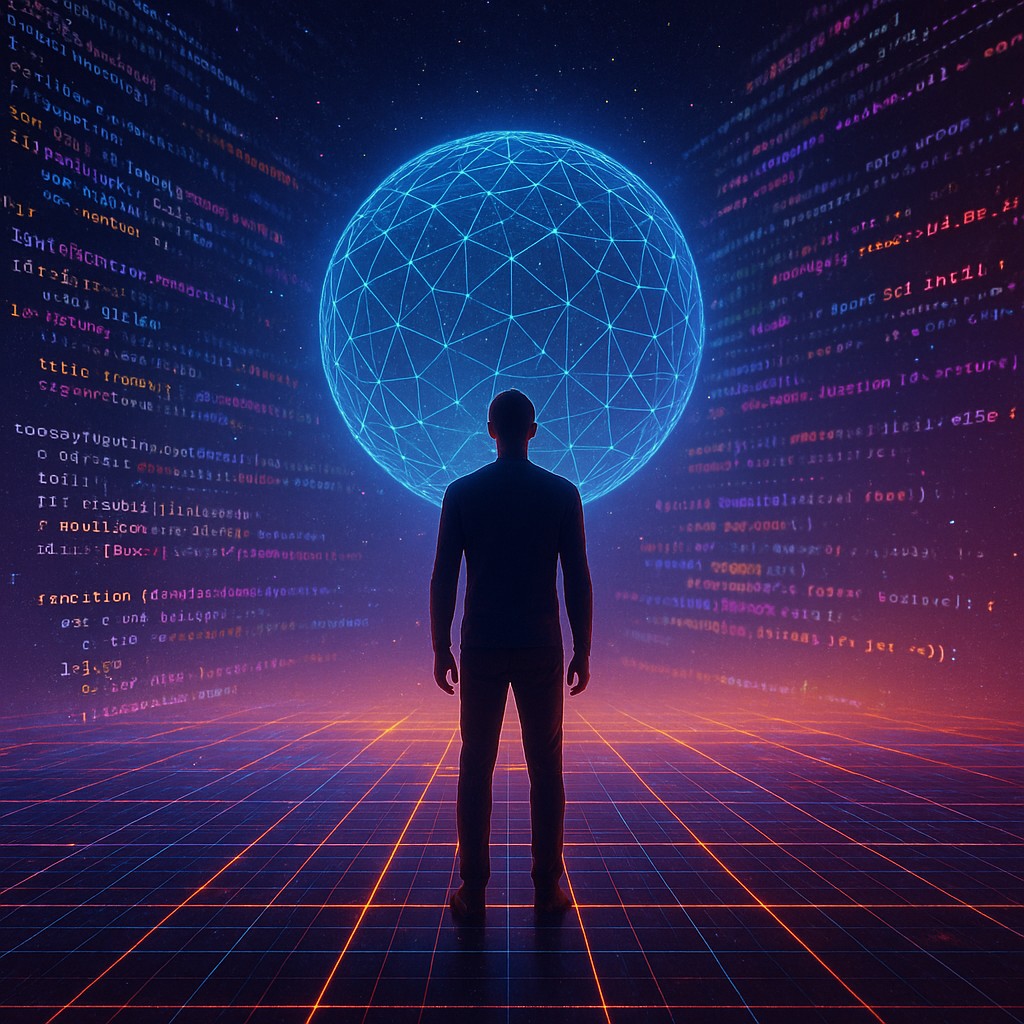
Have you ever had that strange, fleeting feeling that a moment is too perfect, or perhaps too glitchy, to be real? Maybe you were playing a high-end video game and noticed that the water reflections looked just like the lake in your backyard. Or perhaps you experienced a "Mandela Effect" moment, where you and your friends remember a historical detail differently than the way it is recorded online. For most of history, humans looked at the stars and wondered if we were alone. But in the twenty-first century, a new and more unsettling question has emerged: what if the stars, the trees, and even our own bodies are just lines of incredibly complex code?
This isn't just a plot for a Hollywood movie or the talk of a tired conspiracy theorist. Some of the brightest minds in physics, philosophy, and technology are seriously considering the possibility that we live inside a massive computer simulation. As our ability to create virtual worlds evolves from the simple blocks of "Pong" to lifelike VR spaces, logic suggests that if a civilization lasts long enough, they will eventually create a simulation so perfect it cannot be told apart from reality. If that is true, the mathematical odds that we are the "original" biological humans start to look very slim.
The Mathematical Trap of Infinite Progress
The core of the simulation argument, made famous by philosopher Nick Bostrom in 2003, relies on a simple but steady logic. Think about the path of video games over the last forty years. We started with two rectangles and a dot, and now we have massive online worlds with realistic lighting, complex physics, and AI characters that react to our every move. If you assume any level of improvement at all, these games will eventually become identical to reality. even if technology slows to a crawl, the gap between a "game" and "life" will disappear over a thousand or ten thousand years.
Once a civilization reaches this "post-human" stage, they would likely have the computing power to run "ancestor simulations." These would be high-quality recreations of their own history to study how their ancestors lived and evolved. Because a single advanced computer could run millions of these simulations at once, the number of "simulated" people would far outnumber "real" biological people. If there are billions of digital minds and only one original set of biological ones, a simple roll of the dice suggests you are much more likely to be one of the digital ones.
This logic creates a three-way choice: either civilizations go extinct before they reach this tech level, they reach it but decide not to run simulations, or we are almost certainly living in one. Since we see no evidence that advanced civilizations are impossible, and we know humans love to simulate things (like "The Sims" or weather models), the third option starts to look mathematically frightening. It turns the universe from a vast, mysterious void into a very efficient piece of software.
The Pixelated Fabric of Space and Time
If we were living in a simulation, we might find "rules" that look a lot like the limits of a computer program. When a developer builds a game, they have to manage their resources. They don't draw the entire world in high definition all at once; they only render what the player is looking at. Scientists have noticed that our universe behaves in a strangely similar way. In quantum mechanics, certain particles don't seem to have a definite state until they are measured or observed. This sounds remarkably like "lazy loading" in gaming, where the computer only processes data when it is needed.
Furthermore, our universe seems to have a "resolution limit." In digital photos, if you zoom in far enough, you hit pixels. In our reality, if you zoom in to the smallest possible scale, you hit the Planck length. This is a limit where the laws of physics as we know them stop working. There is no such thing as a "half-step" smaller than a Planck unit. If the universe were truly a continuous, infinite flow, there shouldn't be a minimum "grid size" for reality. The fact that space and time are broken into tiny, specific chunks suggests the cosmos might be built on a digital foundation.
| Concept |
Physical Reality View |
Simulation Hypothesis View |
| Speed of Light |
The universal speed limit for matter and energy. |
The maximum processing speed of the hardware. |
| Planck Length |
The smallest measurable unit of distance. |
The pixel size or grid resolution of the simulation. |
| Quantum Superposition |
Particles existing in multiple states at once. |
Data that stays unrendered until a user interacts with it. |
| Mathematical Laws |
Natural patterns found through observation. |
The source code and rules defining the environment. |
| Black Holes |
Points of extreme density where physics break. |
A data compression error or a file system crash. |
The Curious Case of a Fine-Tuned Universe
One of the most common arguments for simulation theory involves the "Goldilocks" nature of our physical laws. There are about twenty to thirty numbers in physics, such as the strength of gravity or the mass of an electron, that seem perfectly set to allow life to exist. If gravity were just a tiny bit stronger, the universe would have collapsed shortly after the Big Bang. If it were a tiny bit weaker, stars would never have formed. The odds of all these settings being "just right" by pure chance are incredibly low.
Skeptics often call this the Anthropic Principle, which says we only see these settings because if they were different, we wouldn't be alive to notice them. However, those who believe in the simulation argue that "fine-tuning" is exactly what a programmer does to create a balanced environment. If you want to run a simulation to see how life evolves, you don't use random numbers that lead to a dead universe; you use specific "developer settings" that make sure the program runs long enough to get results. We might be living in Version 4.0 of a universe that finally stopped crashing.
This "designer" doesn't have to be a god in the religious sense. Instead, the "Grand Architect" could be a bored student in the year 30,000 running a simulation for a history project. This moves the debate from religion to engineering. It suggests that the laws of physics aren't just random luck, but a set of choices made to keep the "game" of the universe stable enough for us to exist.
Glitches and the Mandela Effect
While the math and physics arguments focus on data, many people like the simulation theory because of "glitches." This is where the topic moves from science to the strange stories of everyday life. The "Mandela Effect" is a phenomenon where large groups of people remember things differently than they appear in history. A famous example is the Berenstain Bears book series, which many people insist was spelled "Berenstein" with an "e," or the memory that the Monopoly man wore a monocle (he never did).
While psychologists say this is just how human memory fails, simulation fans have a more creative answer. They suggest these differences are "hotfixes" or "patches" in the software. Perhaps the "admins" changed a piece of data in the past, and while most people's memories were updated, a few "saved" versions of the old data remained in some brains. It is a fun, though not strictly scientific, way to explain why reality sometimes feels like it is shifting.
More scientific "glitches" are being hunted in the study of cosmic rays. Some physicists believe that if we are in a simulation, the grid it is built on might create tiny patterns in the way particles travel. If we could detect a "preferred direction" for these particles, it would be like finding the grain of the wood on a table. It would prove that the universe isn't the same in every direction, but instead follows the physical structure of the hardware it's running on.
Why the Idea Stays With Us
Even without a "Quit Game" button or an "Error 404" message in the sky, the simulation theory has become a popular way to think about our world. It connects the old human feeling that there is "something more" with our modern love of technology. It offers a way to talk about the mysteries of life without needing magic. Instead, it uses things we understand: software, hardware, and data.
For many, this theory isn't scary; it's a source of wonder. It suggests that our lives are part of a grand structure, a masterpiece of engineering that we are just beginning to understand. If we are in a simulation, then "figuring out the laws of physics" is really the same as "hacking the source code." Every time we find a new particle, we are learning how the program works. It turns the human race into a team of cosmic testers, which is an exciting way to see our place in the universe.
Even if we never find a way to talk to the programmers, the simulation theory encourages us to keep questioning reality. It reminds us that what we see is only a small part of what might be true. Whether we are made of atoms or bits, the journey of discovery is the same. So, keep your eyes open for glitches, stay curious about the math, and remember that even if life is a game, it's one worth playing with everything you've got.