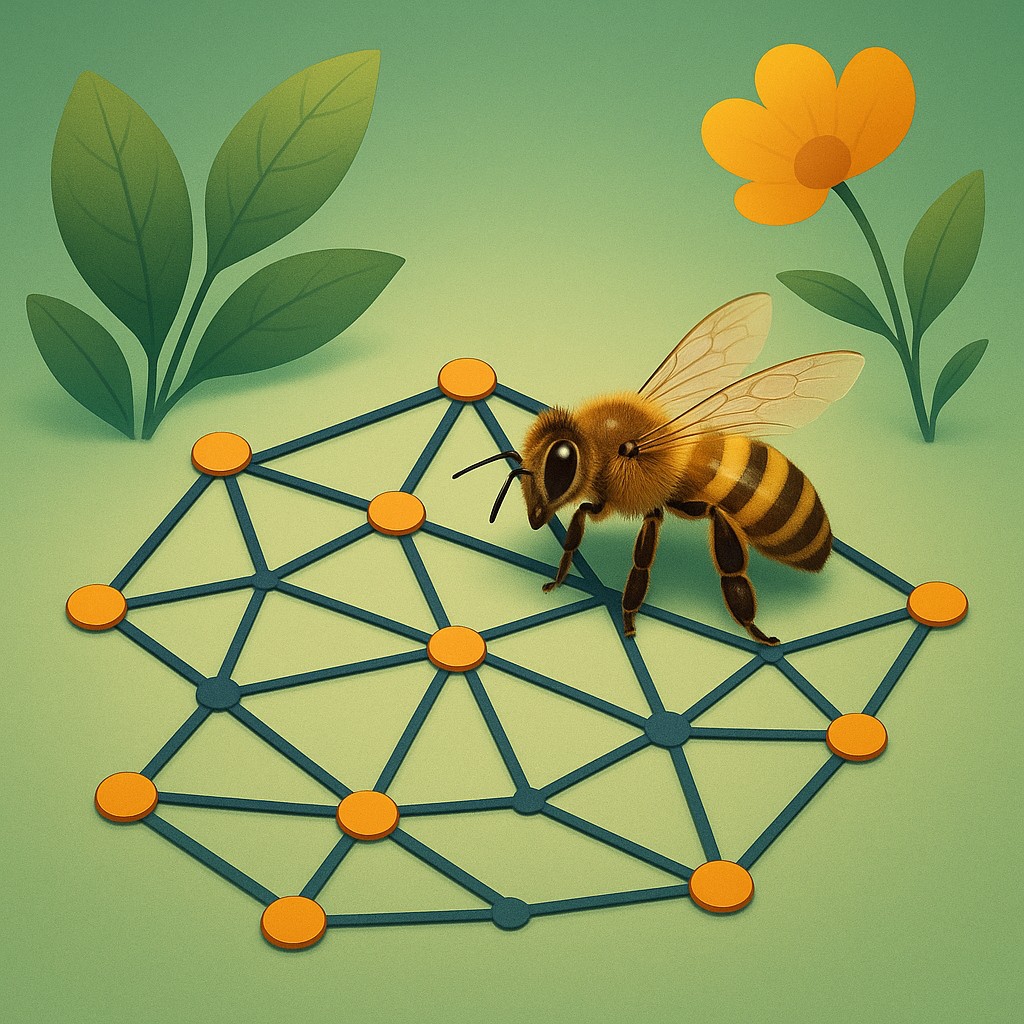
Imagine you are a delivery driver with ten packages to drop off across a sprawling, unfamiliar city. To save on gas and get home in time for dinner, you need to find the absolute shortest path that connects every single one of those addresses. It sounds simple enough until you realize that as you add more stops, the number of possible routes explodes. With just ten stops, there are over 360,000 possible routes. By the time you reach twenty stops, the number of potential paths hits roughly 2.4 quintillion. This is the "Traveling Salesman Problem," a classic mathematical headache that humbles even the world’s most powerful supercomputers. Yet, a bumblebee with a brain the size of a sesame seed solves it every single morning before you’ve even finished your first cup of coffee.
The humble bee doesn't have access to GPS, satellite imagery, or a cloud-based server to crunch complex calculus. Instead, these fuzzy aviators have spent millions of years perfecting a biological algorithm that prioritizes efficiency over perfection. They aren't looking for the mathematically "perfect" route because, in the wild, spending three hours thinking about the best way to fly a ten-minute route is a great way to starve to death. Instead, bees use a series of mental shortcuts that allow them to navigate complex landscapes with startling agility. By looking closely at how a tiny insect manages such massive computing feats, we can learn a great deal about the difference between raw processing power and clever, flexible strategy.
The Mathematical Wall of the Traveling Salesman
To understand the bee’s brilliance, we first have to appreciate the sheer difficulty of the Traveling Salesman Problem (TSP). In the world of computer science, the TSP is classified as "NP-hard." This is a polite way of saying that as the problem grows, it becomes exponentially harder to solve. If you have three flowers - A, B, and C - your options are limited. You can go A-B-C or A-C-B. Easy. But every time a new flower blooms in the meadow, the complexity doesn't just double; it multiplies by the number of existing points. It is a logic puzzle that behaves like a runaway train. If a computer tried to force a solution by checking every single possible combination, it would eventually run out of memory or time as the list of locations grew.
Standard computer algorithms often try to solve this using "global optimization," which means looking at the entire map at once and trying to calculate the total distance of every possible loop. This requires a "map-like" memory where every coordinate is known at the same time. For a long time, scientists assumed bees must have something similar - a literal "mental map" in their tiny heads that allowed them to visualize the meadow from above. However, recent research suggests something far more elegant and much less demanding on their hardware. Bees don't need a map of the world; they just need a reliable set of rules for moving through it.
The Greedy Search and the Power of Local Decisions
Instead of attempting to grasp the entire meadow in one go, a bee begins its day with what researchers call a "greedy search" strategy. If you were a greedy bee, your logic would be very simple: "I am at Flower A. Which is the closest flower I haven't visited yet? Okay, that's Flower B. I'll go there next." Upon arriving at Flower B, you ask the same question: "Where is the nearest unvisited flower now?" This step-by-step approach is "cheap" in terms of brain power. It doesn't require imagining the whole trip; it only requires looking at the immediate surroundings and making the best local choice.
The problem with a pure greedy search is that it can lead to some clumsy mistakes. Sometimes, by always picking the closest neighbor, you end up "painted into a corner" where your final leg of the journey is a long, cross-country trek back to the hive because you saved the furthest flower for last. This is where the bee’s second trick comes into play. They don't just stick with their first draft. Over the course of dozens of foraging trips, bees use a repetitive process to polish their route. They remember how much effort the last trip took and, on the next trip, they experiment with small tweaks. If "Flower B then Flower C" felt shorter than "Flower C then Flower B," they keep that change. Slowly, a chaotic zigzag transforms into a smooth, circular "trapline."
Mental Shortcuts as a Navigational Compass
The "vector-based heuristic" is the secret sauce that makes this repetitive learning possible. A "heuristic" is essentially a mental shortcut or a rule of thumb that usually gives a good result without requiring a deep dive into data. In the case of the bee, a vector is a mental record of both distance and direction. When a bee leaves Flower A to go to Flower B, its brain records a vector: "I flew northeast for three meters." When it leaves Flower B for Flower C, it records another: "I flew west for two meters."
Because the bee’s brain is constantly tracking these vectors, it can perform "vector addition" - combining different paths to find the shortest way back to the hive at any point. This is why a bee doesn't have to retrace its steps to get home. It can calculate the "beeline" even if it has never flown that specific path before. By combining these directional memories with their greedy search, bees build a mental to-do list of vectors. The table below compares how this insect strategy differs from the way a traditional computer or a human might approach the same logistical nightmare.
| Feature |
Brute-Force Computer Logic |
Human Planning (GPS) |
Bee (Vector Shortcut) |
| Primary Goal |
Perfect optimization (the absolute shortest) |
Visual navigation and traffic avoidance |
"Good enough" efficiency for survival |
| Starting Point |
Analyzes all possibilities at once |
Uses a pre-existing top-down map |
Starts with a "greedy" nearest-neighbor choice |
| Refinement |
Fixed calculation before moving |
Real-time rerouting based on outside data |
Improving the path over multiple trips |
| Failure Mode |
High energy and time cost for complex sets |
Over-reliance on tools or known roads |
Can get stuck in a "local optimum" |
| Brain Power |
Massive (requires high-power processors) |
Moderate (requires spatial reasoning) |
Minimal (requires simple vector memory) |
As the table suggests, the bee's method is built for speed and adaptability. While a computer might get stuck trying to calculate the perfect route for a hundred flowers, the bee has already finished its shift and is vibrating its wings to cool down the hive. This tells us that in nature, being 90% efficient right now is often better than being 100% efficient three hours later.
When Shortcuts Fail and the "Local Best" Trap
Despite their brilliance, bees are not perfect. Because they rely on shortcuts, they are susceptible to a phenomenon known as the "local optimum." Imagine you are hiking and you want to get to the highest peak in the range. If you only follow the rule "always walk uphill," you will eventually reach the top of a hill. However, that hill might just be a small peak in the foothills. To reach the actual mountain summit, you might have to first walk downhill into a valley, then back up. Because your rule says "always walk uphill," you are trapped on the smaller peak. You have reached the best local spot, but you’ve missed the best overall solution.
Bees fall into this trap quite frequently. In controlled experiments, researchers have set up flower patches where the "greedy" path (going to the nearest flower) leads to a much longer total trip than a path that requires a long initial flight to a distant flower followed by several short hops. Most of the time, the bees will stick to their local best. They are effectively paralyzed by the "cost" of the long initial jump, even if that jump would save them time in the long run. Interestingly, this isn't necessarily a "bug" in their programming. In a wild environment, flowers are constantly appearing and disappearing. Investing too much time in finding the perfect route is a bad investment because that route might change by tomorrow morning.
Biological Logic as a Model for Modern Tech
Engineers and software developers are increasingly looking at bees to solve human-sized problems. We see this in "Swarm Intelligence" algorithms used to manage phone networks or coordinate fleets of delivery drones. Instead of having one giant "brain" at a central headquarters trying to tell every drone exactly where to go, engineers are experimenting with giving each drone a simple set of bee-like rules. If each drone focuses on local efficiency and shares its shortcut data with its neighbors, the entire fleet becomes a self-correcting system that can adapt to wind, battery drain, or blocked paths without needing a central update.
This shift from "centralized perfection" to "distributed shortcuts" is a fundamental change in how we think about intelligence. We used to define intelligence by how much a system could calculate. Now, thanks to the bee, we are starting to define it by how much a system can ignore. By ignoring the billions of "perfect" combinations and focusing on simple, repeatable loops, the bee remains one of the most successful foragers on the planet. They remind us that the goal of intelligence isn't to solve the math; it's to get the job done with the energy you have.
The next time you see a bumblebee bobbing between the clover and the lavender in your garden, remember that you aren't just looking at a bug. You are looking at a living, breathing solution to a puzzle that defies our greatest machines. There is a profound beauty in the idea that nature doesn't require us to be perfect to be successful. It only requires us to be curious enough to try a new route, smart enough to remember what worked, and humble enough to take the shortcut when it appears. Life is rarely about finding the mathematically flawless path; it is about building a better loop, one flower at a time, and knowing exactly how to find your way back home.