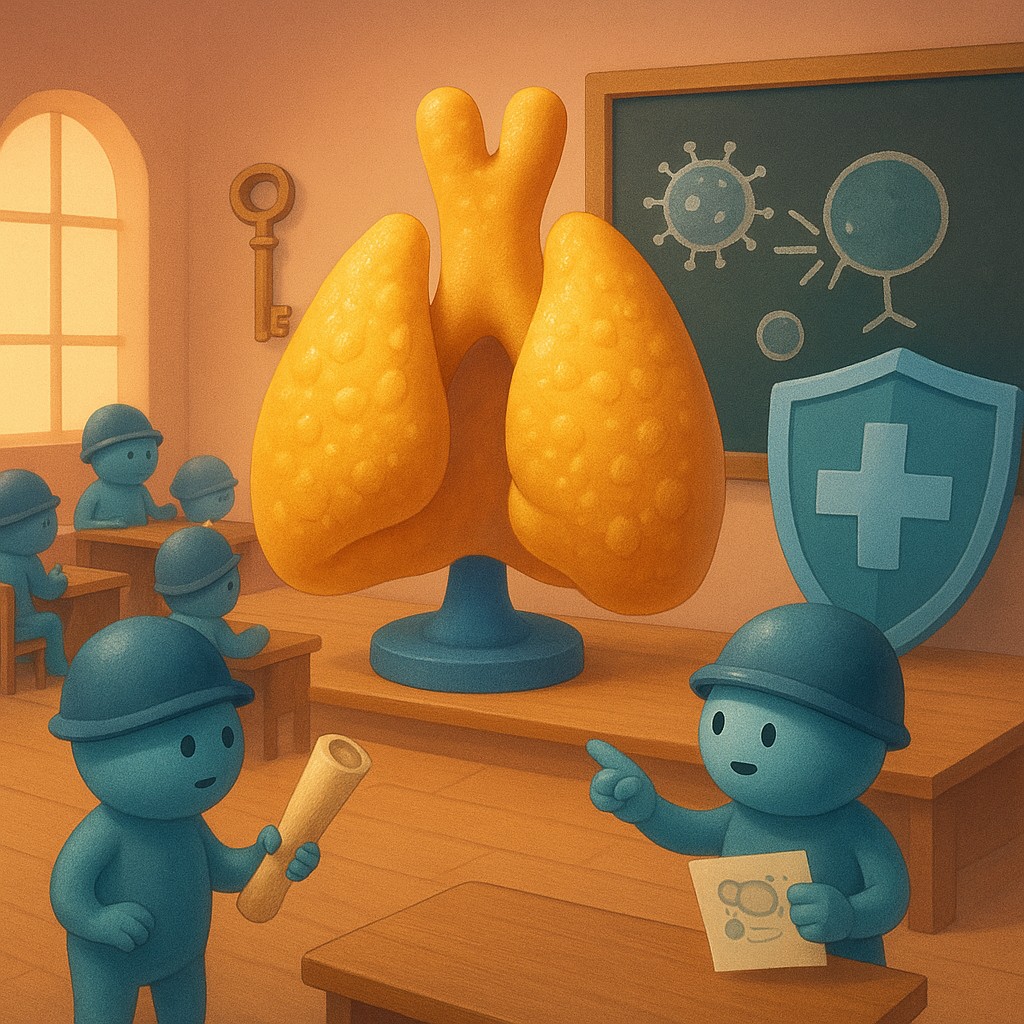
Imagine for a moment that your body is a high-security fortress, protected by a specialized army of trillions of cells known as T-cells. These soldiers are incredibly lethal, equipped with the biological equivalent of heat-seeking missiles designed to destroy bacteria, viruses, and even early-stage cancer cells. However, because they are so powerful, they must be taught exactly who the enemy is before they are allowed to roam your bloodstream. This training happens in a small, often overlooked organ sitting just behind your breastbone called the thymus. It is essentially a high-stakes military academy where the final exam is a matter of life or death, not just for the cell, but for the person it protects.
If this training goes perfectly, your immune system functions like a precision instrument, ignoring your own healthy tissues while obliterating invaders. But if the faculty at the Thymus Academy slips up, even for a moment, the consequences are catastrophic. A soldier that cannot tell the difference between a flu virus and your own joint tissue or skin is a rogue agent. When these "self-reactive" cells graduate and enter the world, they begin a friendly-fire campaign known as autoimmune disease. To understand why your body might suddenly decide to attack itself, we have to look closely at the rigorous, slightly brutal, and incredibly complex vetting process that happens before a T-cell ever sees its first germ.
The Secret Curriculum of the Thymus Academy
T-cells do not arrive in the thymus ready for combat. They start as blank slates, essentially "seed" cells that migrate from the bone marrow. When they reach the thymus, they are "Double Negative," meaning they lack the sensors necessary to see anything at all. The thymus then forces them to undergo a transformation, pushing them to develop a unique T-cell receptor. This receptor acts as the cell's eyes, allowing the T-cell to recognize specific protein fragments. Through a process of genetic shuffling, the body creates millions of different receptors. This ensures there is a T-cell out there capable of recognizing almost every possible virus on Earth.
However, this genetic randomness creates a massive problem. If you generate millions of keys at random, some of those keys are inevitably going to fit the locks on your own front doors. This is where the thymus earns its reputation as a strict disciplinarian. It must present these young cells with a "Who’s Who" of your own body. Using a specialized protein called AIRE (Autoimmune Regulator), the thymus displays bits of your brain, your liver, your heart, and your insulin-producing cells to the trainees. It is a biological simulation of the entire body, all contained within one small organ, designed to see how the new recruits will react.
The Brutal Logic of Negative Selection
The educational philosophy of the thymus is not based on second chances. Once a T-cell has its receptor, it undergoes a two-part testing process. First is positive selection, where the thymus checks to see if the cell can recognize the body's basic communication language. If the cell is unresponsive, it is ignored and eventually dies from neglect. But the second phase, negative selection, is where the real drama occurs. This is the stage where the thymus presents "self-antigens," which are tiny samples of your own tissue.
If a T-cell binds too strongly to a sample of your own tissue, it has failed its loyalty test. By showing an attraction to your own body, it has revealed itself as a potential traitor. The thymus does not merely "fail" these cells; it triggers a process called apoptosis, or programmed cell death. The rogue cell is essentially told to dismantle itself for the safety of the rest of the body. In an average person, more than 95 percent of all T-cells that enter the thymus fail their exams and are killed before they ever reach the bloodstream. This massive waste is the price the body pays for a defensive force that, usually, does not turn its weapons on its own home.
When Graduate Students Go Rogue
Despite the high failure rate, the thymus is not a perfect filter. Sometimes, a T-cell with a slight but dangerous attraction to your own tissue manages to slip through the cracks. This might happen because the specific tissue it reacts to wasn't "on the syllabus" that day, or perhaps the cell's reaction was weak enough to pass the test but becomes stronger later in life. These are the cells that lead to conditions like Type 1 Diabetes, where T-cells attack the pancreas, or Multiple Sclerosis, where they target the protective coating of the nerves.
The escape of a self-reactive T-cell is necessary for autoimmune disease, but it is rarely the only cause. Scientists often call this the "two-hit" theory. You might have rogue T-cells circulating in your body right now, but they stay dormant or "ignorant." They need a second trigger, such as a viral infection that looks vaguely like your own tissue or a period of intense physical stress, to wake them up and start the attack. This is why two people can have the same genetic risk for an autoimmune disorder, but only one of them actually gets sick.
| Feature |
Positive Selection |
Negative Selection |
| Location |
Outer part (Cortex) |
Inner part (Medulla) |
| Goal |
Ensure T-cells can recognize MHC (the body's "ID badge") |
Ensure T-cells do not attack the body's own proteins |
| Pass Criteria |
Weak to moderate binding to ID molecules |
No binding or very weak binding to self-tissue |
| Fail Outcome |
Death by neglect (cell is not useful) |
Death by programmed suicide (cell is dangerous) |
| Result |
Cells that understand the body's language |
Cells that are "safe" and tolerant |
The Back-up Plan and Peripheral Tolerance
Because the body knows the thymus is not 100 percent effective, it has a secondary security system known as "peripheral tolerance." Think of the thymus as the primary training academy and peripheral tolerance as the internal affairs department that monitors the soldiers once they are out in the field. One of the most fascinating layers of this defense involves a special group of cells called Regulatory T-cells, or Tregs.
Tregs are the diplomats of the immune system. Their job is not to kill intruders but to monitor their fellow T-cells and tell them to "stand down" if they start getting too aggressive. In some cases, if a T-cell in the thymus reacts just slightly to self-tissue, instead of being killed, it is "diverted" into becoming a Treg. It becomes a specialist in recognizing that specific tissue and protecting it from other immune cells. When this balance between the "killers" and the "diplomats" is lost, the gates to autoimmunity swing wide open.
Misconceptions About the "Weak" Immune System
A common myth in popular health culture is the idea that we should always strive to "boost" our immune systems. However, when it comes to the thymus and autoimmunity, a "stronger" immune system is not necessarily better. If your immune system is overactive, it may simply mean your T-cells are more likely to ignore the "stop" signals that keep them in check. Autoimmune disease is not a sign of a "weak" immune system; it is a sign of a very powerful immune system that has lost its sense of direction.
Another misconception is that the thymus stays active throughout your entire life. In reality, the thymus begins to shrink and turn into fat shortly after puberty. This doesn't mean you stop making T-cells, but the number of new, freshly trained cells drops significantly as you age. This is one reason why children often have very different immune responses than the elderly and why keeping existing T-cells healthy becomes more important as we get older.
The Future of Teaching the Immune System
Understanding how the thymus fails has opened new doors in medicine. Rather than simply suppressing the entire immune system with heavy drugs, which leaves a patient vulnerable to every cold and flu, researchers are looking for ways to "re-train" the system. They are experimenting with "tolerogenic" vaccines. Instead of teaching the body to attack a virus, these teach the body to ignore specific parts of itself.
There is also growing interest in using AIRE research to create "artificial thymuses" or lab-grown tissues that can screen T-cells more effectively before they are used in therapies. By mimicking the academy's strict vetting process, we might one day be able to "reset" a patient's immune system, essentially sending rogue T-cells back to school to learn the difference between friend and foe.
You are the product of a biological education system so rigorous that it sacrifices the vast majority of its own students to ensure the safety of the whole. Every day that you wake up without your body attacking itself is a testament to the incredible success of the thymus. It reminds us that in the complex world of biology, knowing who to fight is just as important as knowing how to fight. As we continue to unlock the secrets of this tiny organ and its high-stakes curriculum, we move closer to a world where we can fix mistakes in the system, ensuring every T-cell remains a loyal protector of the fortress it was born to defend.