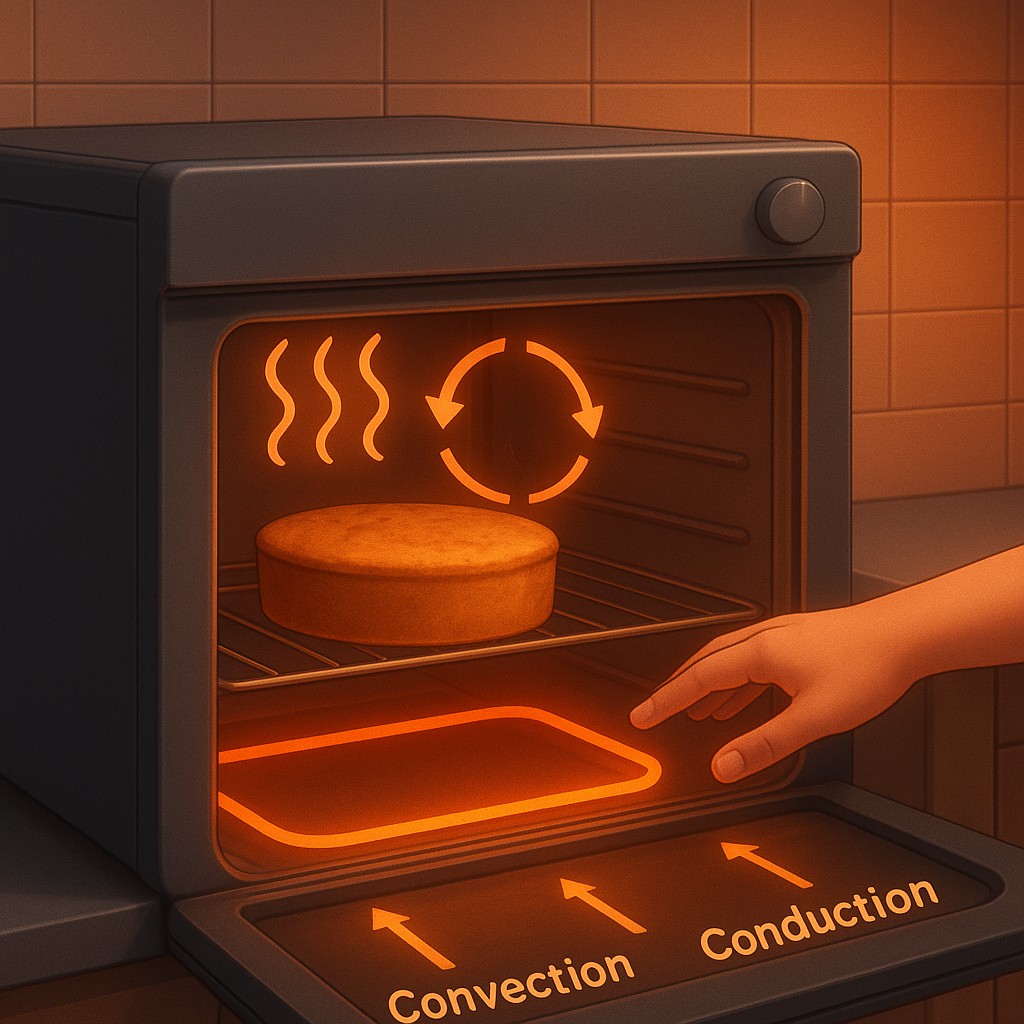
Imagine you are standing in your kitchen, waiting for your oven to preheat to 400 degrees. If you opened the door and stuck your hand inside for three seconds, you would feel a wave of warmth, but your skin wouldn't blister. Now, imagine touching the metal rack inside that same oven for even a fraction of a second. You would suffer a painful burn instantly. This reveals a strange contradiction: even though the air and the rack are both 400 degrees, one feels like a warm bath while the other is a dangerous weapon.
The secret to this difference is that air is a very poor conductor of heat. It is a thin, chaotic collection of molecules that are terrible at passing energy to one another through physical contact. If we relied only on the air to cook our dinner, a three-pound chicken might take twelve hours to reach a safe temperature. Instead, your kitchen oven is actually a high-tech radiation chamber. It doesn't just turn the air into a "hot soup"; it turns the interior walls into glowing sources of energy that target your food like a localized sun.
The Invisible Glow of Your Oven Walls
To understand how a cake actually bakes, we have to look past the digital display and down to the atomic level of the oven's design. Most people assume the red heating element at the bottom works like a space heater, warming the air which then warms the tray. While the air does get hot, the real job of those elements is to pump heat into the heavy metal walls and floor. These surfaces absorb that energy and then beam it back out as infrared radiation. This is exactly how the sun warms your face on a cold winter day. The space between the sun and the Earth is a vacuum, yet you still feel the heat because radiation does not need a medium like air or water to travel.
Inside your oven, this infrared energy travels in straight lines until it hits something solid, like a loaf of bread or a tray of broccoli. This is why the way you arrange things in your oven matters so much. If you put a large baking sheet on the bottom rack, it acts as a shield. It absorbs most of the radiation from the bottom element, leaving the racks above in a "heat shadow." This is also why most oven interiors are dark or speckled with porcelain enamel. These materials are excellent at soaking up and beaming out heat, ensuring the "box" becomes a high-energy environment where heat bounces off every surface.
Moving Air and the Convection Revolution
For decades, the standard oven was a "still air" environment. We accepted that the top of the oven was hotter than the bottom because hot air rises. While it is true that heat makes air move upward, the real reason for uneven cooking in a traditional oven is how close the food sits to those radiating walls. A convection oven changes the game using a simple tool: a fan. This fan might seem like a minor addition, but it fundamentally changes the physics of cooking. To understand why, we have to look at the "boundary layer" of air that clings to your food.
When you put a cold turkey into a hot oven, the air touching the skin cools down immediately. Because air is such a poor conductor, this thin layer of cool air stays put. It acts like a microscopic thermal blanket that protects the turkey from the surrounding heat. In a standard oven, you have to wait for the slow, lazy process of natural air movement to pull that cool air away. A convection fan, however, creates "forced convection." It strips away that protective layer, constantly replacing it with fresh, hot air molecules. This is why convection ovens usually require you to lower the temperature by 25 degrees or cut the cooking time by 20 percent. You aren't just heating the food; you are stripping away its armor.
| Heating Method |
Primary Mechanism |
Speed and Efficiency |
Best Use Cases |
| Traditional Bake |
Infrared Radiation |
Slower; relies on "line of sight" from the walls. |
Delicate cakes, breads, and custards. |
| Convection Bake |
Forced Convection |
Faster; strips away the cool air boundary layer. |
Roasting meats, crispy fries, and multi-rack cookies. |
| Broiling |
Intense Radiation |
Extremely fast; high heat from one direction. |
Searing steaks, melting cheese, or charring peppers. |
| Conduction |
Physical Contact |
Instant energy transfer through solid objects. |
Searing in a cast iron pan or using a baking stone. |
Why Hot Spots Follow the Oven's Shape
Have you ever pulled out a tray of cookies and found that the ones in the back corner are burnt while the ones in the center are doughy? Most people blame the air temperature, but the air in a sealed box eventually levels out. The real culprit is the "view factor," a term engineers use to describe how much of a heated surface an object can "see." Cookies in the corner sit near the junction where two radiating walls meet. They are bombarded with more infrared energy than the cookies in the middle, which are further away from the glowing sources.
The materials you use also dictate these hot spots. A shiny aluminum baking sheet reflects a large portion of that infrared radiation away, which is why it is often recommended for cookies you want to keep soft. On the other hand, a dark cast iron skillet or a ceramic pizza stone is an "energy sponge." It absorbs radiation from the walls and transfers it directly to your food through conduction, which is far more efficient than radiation or convection. This is why a pizza stone is the best way to get a crispy crust; it bypasses the air entirely and delivers energy directly into the dough through physical contact, much like the metal rack that would burn your hand.
The Invisible Fluid Dynamics of Your Kitchen
It helps to think of the air inside your oven not as empty space, but as a very thin, stubborn fluid. Because this fluid is so bad at moving heat, the "preheat" signal is often a bit of a lie. When the beep sounds, it usually just means the air sensor has hit the target temperature. But as we have learned, the air isn't doing the heavy lifting. If the heavy metal walls and floor haven't had enough time to soak up energy, they won't be radiating at full power. This is why many professional bakers suggest preheating for a full hour, even if the light turns off after ten minutes. You are waiting for the "thermal mass" - the physical weight of the machine - to catch up.
This concept of thermal mass is also why "peeking" is so controversial. When you open the door, all the hot air escapes in a second. If you rely only on convection, you just lost your cooking medium. However, because the walls are the primary heat source, a quick five-second peek isn't the disaster people claim. The walls are still glowing with infrared energy, and they will reheat the new, cool air almost immediately. The real danger of peeking is for delicate foods like soufflés, where the physical jolt of the door or a sudden change in pressure can cause them to collapse.
Engineering the Perfect Crunch
To master the oven, you must become a tactical commander of energy. If you want roast chicken with skin that shatters like glass, you need convection to strip away moisture and the protective boundary layer of air. If you want a tall, fluffy sponge cake, you want the gentle, directional heat of a traditional oven so the cake can rise before the crust is "set" by intense radiation. Understanding that your oven is a radiation chamber allows you to manipulate placement - choosing the middle rack to stay away from the elements, or the bottom rack to intentionally char the bottom of a tart.
The next time you look through the glass door, don't just see a box of hot air. See a complex dance of infrared waves bouncing off porcelain walls. See the invisible struggle of the air trying to protect your dinner and the fan trying to tear that protection away. By moving beyond the temperature dial and thinking about how energy actually moves, you transform from someone following a recipe into a true master of the kitchen. You are no longer just cooking; you are conducting a symphony of physics, one radiant photon at a time.