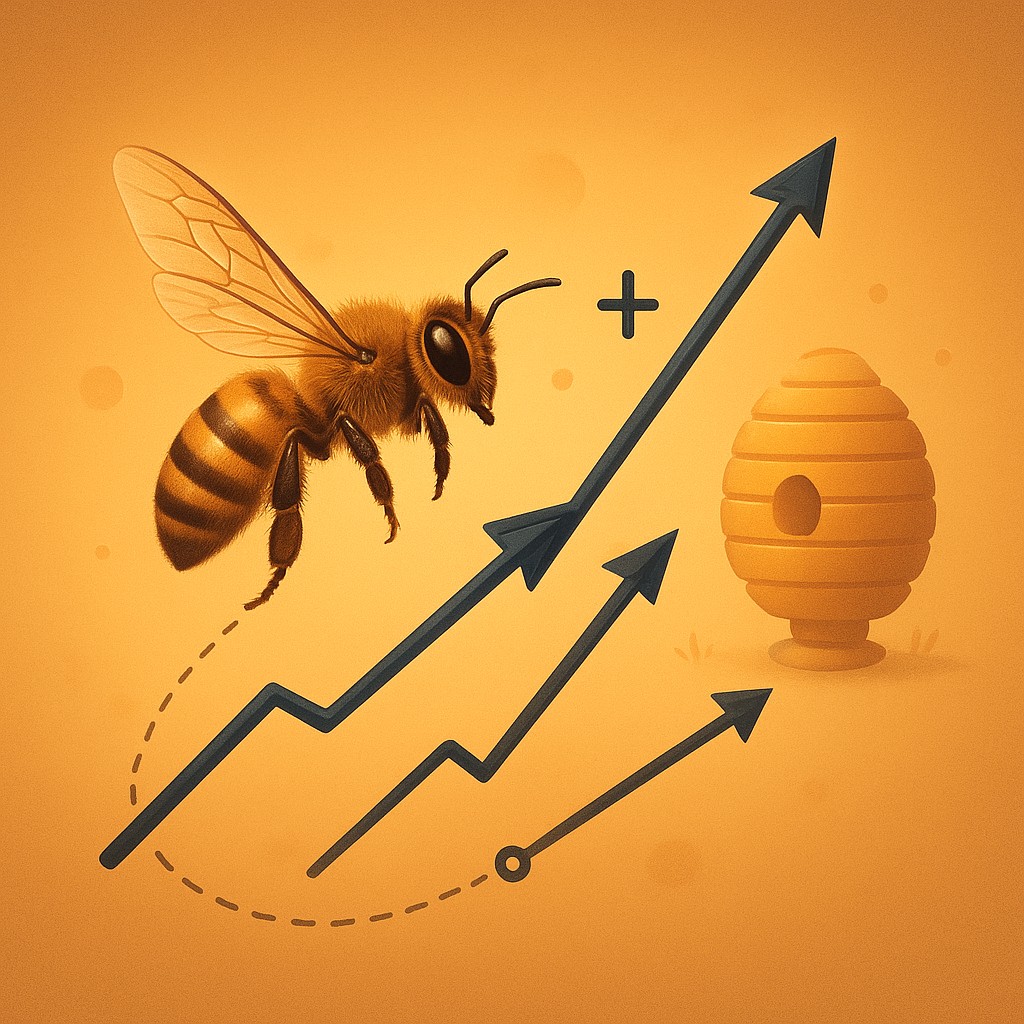
Imagine you are a honeybee. You have just spent the last forty minutes weaving through a chaotic maze of garden gnomes, swaying lavender bushes, and the occasional terrifying shadow of a neighborhood cat passing overhead. You did not fly in a straight line, you did not follow a map, and you certainly did not stop to ask for directions. Yet, the moment your nectar stomach is full, you do not retrace your steps or wander aimlessly. Instead, you turn your tiny, fuzzy body toward a specific point on the horizon and fly a "beeline" straight back to the hive. To a person watching, it looks like magic. To the bee, however, it is the result of a rigorous, real-time mathematical calculation that would make a trigonometry professor sweat.
This internal GPS is known as path integration. It is the biological version of a sailor using a sextant and a stopwatch to navigate the open ocean, but with the added challenge of doing it while flying at fifteen miles per hour. The bee is essentially performing vector addition - a branch of math where dozens of individual movements, each with its own direction and distance, are combined into a single arrow pointing home. While humans often struggle to find their car in a crowded parking lot, a bee stays oriented across miles of changing terrain by turning every flap of its wings into a data point for its internal biological computer.
The Mental Compass and the Solar Clock
To calculate a "home vector," or a direct line back to the nest, a bee needs two main pieces of information: which way it is going and how far it has traveled. The "which way" part is solved by an internal compass that relies on the sun. However, the sun is a moving target, drifting across the sky throughout the day. To account for this, bees possess an incredible internal clock that allows them to adjust their heading based on the time. They do not just see the sun as a bright light; they understand its path. This means they can keep a steady course even as their landmark in the sky moves.
Even on a cloudy day, a bee is rarely lost. Their eyes are sensitive to polarized light, which creates a pattern in the sky that is invisible to humans but perfectly clear to insects. This pattern lets them find the sun's position even through thick clouds. This celestial compass provides the "angle" for the bee's math. Every time the bee turns to check out a new flower, its brain registers the new angle relative to the sun. This is not a one-time snapshot, but a continuous stream of data that the bee processes as it moves, ensuring the "compass needle" in its head is always pointed toward the hive.
Measuring Distance through a Living Windshield
Knowing the direction is useless if you do not know how far you have gone. While a person might use a step-counter or a car’s odometer, a bee uses a technique called optic flow. As a bee flies, the image of the world moves across its eyes, much like the way white lines on a highway seem to zip past a car window. The faster the scenery moves past, the further the bee thinks it has traveled. This is a way of measuring "visual distance" rather than physical distance. If a bee flies through a narrow tunnel where the walls are close, its brain thinks it has traveled much further than if it flew the same distance across an open, empty field.
This system is surprisingly reliable, but it does have its quirks. Because it relies on moving images, a bee flying into a strong wind will flap much harder but move slower across the ground. Its internal odometer counts the "image flow," not the effort of its muscles, which keeps it from overestimating the distance. By combining this visual motion data with the direction from its solar compass, the bee creates a "displacement vector." Every few seconds, the bee adds a new little arrow to the end of the previous one. The sum of all these tiny arrows is the "home vector," a single mental line that tells the bee exactly where it is in relation to its starting point.
The Geometry of the Hive Return
Path integration is effectively a biological version of coordinate geometry. If we imagine the hive as the starting point (0,0) on a graph, every movement the bee makes can be plotted as a series of coordinates. While the bee does not think in terms of X and Y, its brain cells fire in patterns that represent these values. When the bee is ready to return, it does not need to remember the specific path it took; it only needs the final "sum" of its movements. This efficiency is vital for survival, as it cuts down the time spent in the air where the bee is at risk from predators or exhaustion.
| Feature |
Human Navigation (Traditional) |
Bee Navigation (Path Integration) |
| Main Reference |
Landmarks and Map Reading |
Solar Compass and Polarized Light |
| Distance Measurement |
Pedometer or GPS Satellite |
Optic Flow (Visual Motion) |
| Mathematical Logic |
Recognizing shapes and routes |
Continuous Vector Addition |
| Error Correction |
Correcting based on "feeling lost" |
Constant updates via flight and flow |
| Main Weakness |
Losing sight of landmarks |
Sharp changes in altitude (3D) |
One of the most fascinating parts of this system is that it allows for "shortcuts." If a bee finds a patch of clover and then wanders off to find some daisies, it does not have to go back to the clover first to find its way home. Because its internal math is constantly updating, it can fly directly from the daisies to the hive. This "global" sense of position is what makes path integration different from just following landmarks. Landmarks are still useful for the "final approach" near the hive, but the heavy lifting of the journey is done by the math happening in the bee's central complex, a specialized region of its tiny brain.
Limitations of the Flat Earth Model
While the bee’s navigation system is a masterpiece of evolution, it is not perfect. The biggest "bug" in the bee's code involves height. Bees evolved mainly to navigate over flat landscapes. Their motion-sensing system is tuned to the ground moving beneath them. When a bee has to fly over a sudden, sharp ridge or deep into a canyon, the change in distance from the ground can trick its odometer. If the ground drops away suddenly, the visual flow slows down, making the bee think it is moving slower than it actually is.
Recent studies on bumblebees have shown that while they can estimate height, their accuracy drops the further they get from the ground. This 3D calculation adds a layer of difficulty that the bee’s brain sometimes struggles to handle. In high-altitude or mountainous areas, bees rely more on the "skyline," using the silhouettes of mountains and trees against the sky to help their math. This multi-layered approach ensures that even when the math gets fuzzy due to the terrain, the bee has a backup system to keep it from wandering off.
The Efficiency of a Mind Moving in Lines
The beauty of the "home vector" strategy is that it saves energy. A bee that has spent the morning zig-zagging through a meadow has already burned a lot of its fuel - the sugar from nectar. If it had to retrace its exact path, winding around every bush and flower it visited, it might run out of energy before reaching home. By calculating the shortest possible route back, the bee finds the most direct path. This allows the colony to search for food across a much wider area, sometimes up to five miles away, while still being highly productive.
This mathematical skill also plays a role in the famous "waggle dance." When a scout bee returns home, it uses its internal math to tell its sisters exactly where the food is. It converts its private "home vector" into a set of instructions, dancing at an angle that shows the direction relative to the sun and shaking for a specific time to show the distance. Essentially, the bee is sharing its math homework with the rest of the class. This social sharing of data is what allows a honeybee colony to work as one unit, harvesting resources from the environment with incredible precision.
Next time you see a bee hovering for a moment before darting off in a straight line, remember that you are seeing the result of a complex series of calculations. Behind those eyes is a brain smaller than a grain of rice that is effortlessly solving geometry problems. This elegant blend of sun-tracking, motion sensing, and math allows the bee to conquer the landscape. It proves that you do not need a massive brain to master your world; you just need a very good sense of direction and the ability to add your arrows correctly.