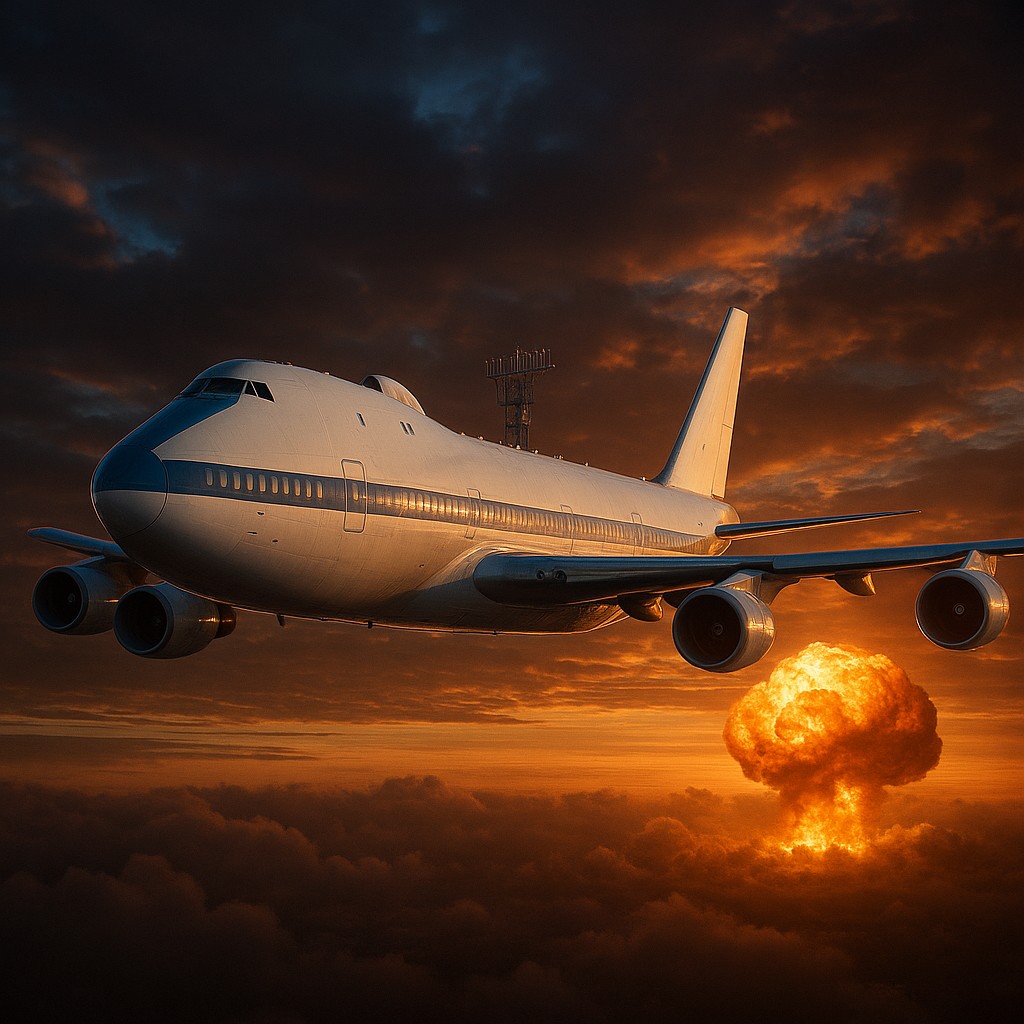
Imagine a catastrophe so severe that the traditional seats of power, the White House, the Pentagon, and even deep underground bunkers, are no longer safe or usable. In the high-stakes world of global strategy, this is not just a Hollywood movie plot; it is a crisis the United States government has spent billions of dollars preparing for since the height of the Cold War. At the center of these preparations is a specialized fleet of aircraft officially known as the E-4B Nightwatch. However, most people know it by a much more chilling name: the Doomsday Plane. This aircraft is essentially a flying fortress for data and communication, designed to act as a mobile Pentagon in the sky if a nuclear strike or a massive natural disaster wipes out ground-based infrastructure.
While most people see a Boeing 747-200 and think of tropical vacations or long business trips, the E-4B is a completely different beast under the skin. It is a masterpiece of engineering that prioritizes survival and connectivity over legroom and movies. These planes are always on standby, with at least one kept in a state of constant readiness 24 hours a day, 365 days a year. They represent the ultimate insurance policy for the American chain of command. They ensure the President, the Secretary of Defense, and the Joint Chiefs of Staff can maintain control over the nation's massive nuclear arsenal and military forces even if the world below falls into total chaos.
A Flying Command Center for the Worst Day Ever
The primary job of the E-4B Nightwatch is to serve as the National Airborne Operations Center (NAOC). In simpler terms, it is a sturdy, mobile platform that allows the highest levels of U.S. military and civilian leadership to lead troops and issue emergency war orders. If a small conflict turns into a global catastrophe, the ground becomes a dangerous place to stay. Fixed locations like the Pentagon are stationary targets, meaning an enemy knows exactly where they are. By taking to the sky, the leadership becomes a moving target that is much harder to track and hit, especially since the plane is equipped with advanced defensive systems.
This mission is part of what experts call Nuclear Command, Control, and Communications, or NC3. The goal is to ensure there is never a gap in leadership. If the President needs to authorize a counterattack or negotiate a ceasefire during a nuclear conflict, they need a way to talk to submarines at the bottom of the ocean, missile silos in the Midwest, and bombers currently in the air. The Doomsday Plane provides the technology to make that happen. It is packed with 13 different communication systems, ranging from standard satellite links to specialized low-frequency antennas that can trail behind the plane for miles to talk to underwater vessels.
The crew on board is far more than just a few pilots. An E-4B can carry up to 112 people, the largest crew of any aircraft in the U.S. Air Force. This group includes battle staff, intelligence analysts, communication technicians, and maintenance crews. They work in a windowless, high-tech environment divided into specialized sections like the War Room. The goal is to copy the functions of the Pentagon's most secure rooms while flying at 30,000 feet. It is a busy, high-pressure hub where the fate of the world could theoretically be decided over a cup of coffee and a glowing computer monitor.
Engineering Against the Invisible Pulse
One of the most fascinating features of the Doomsday Plane is how it handles the unique physics of a nuclear explosion. When a nuclear weapon goes off, it releases an Electromagnetic Pulse (EMP). This is a burst of energy that can fry electronic circuits for hundreds of miles, turning modern computers, smartphones, and even car engines into expensive paperweights. If a standard commercial airplane were caught in an EMP, its navigation and flight systems would likely fail instantly. The E-4B, however, is built to survive this invisible wall of energy through a process called hardening.
The aircraft's electronics are shielded with specialized materials, and most of its systems use analog parts rather than digital ones where possible. You might notice that the cockpit of an E-4B looks remarkably old-fashioned, with dials and switches from the 1970s instead of the sleek touchscreens found in a modern jet. This is not because the Air Force is being cheap; it is because those old-school analog instruments are much more resistant to electromagnetic interference. Additionally, the plane is protected by a specialized heat shield to deflect the intense warmth of a nearby blast, and the windows are covered in a fine wire mesh to keep radiation and pulses out of the cabin.
Maintaining these planes is a massive undertaking. Because the technology is older and highly specialized, parts are not always easy to find. The Air Force keeps the fleet in perfect condition through a strict schedule of heavy maintenance, where the planes are essentially taken apart and rebuilt to ensure every bolt and wire is perfect. Below is a comparison of how the E-4B differs from the standard Boeing 747-200 passenger jet it was built upon.
| Feature |
Standard Boeing 747-200 |
E-4B Nightwatch (Doomsday Plane) |
| Windows |
Large and numerous for passengers |
Very few, mostly shielded with wire mesh |
| Wiring |
Standard copper and fiber |
Miles of EMP-hardened shielded cabling |
| Fueling |
Ground-based only |
Capable of specialized mid-air refueling |
| Communications |
Standard radio and Wi-Fi |
13+ systems including long trailing wires |
| Flight Time |
~12 to 14 hours |
Up to 72 hours (with mid-air refueling) |
| Crew Size |
~15 (including flight attendants) |
Up to 112 specialized military personnel |
Maintaining Control Through Global Reach
A command center is only useful if it can stay in the air long enough to finish the job. While a standard 747 has a good range, the E-4B is built for extreme endurance. It has a refueling port on the nose, allowing it to take on fuel from a tanker plane while flying. Theoretically, the only thing that limits how long the Doomsday Plane can stay up is the amount of oil the engines use and the physical limits of the crew. In practice, the E-4B has been tested to stay airborne for up to 72 hours straight, though it could likely stay up even longer in a real emergency.
To support these long missions, the interior of the plane includes a rest area with bunks, a dining area, and a kitchen capable of feeding over a hundred people for several days. This is not luxury travel; the bunks are cramped and the food is simple, but it allows the brain of the military to keep working without needing to land in a potentially dangerous or contaminated area. The plane even has its own staircase that can be lowered from the belly, ensuring the leaders do not need a working airport terminal or a ground crew to get on or off the plane in a disaster zone.
Beyond nuclear scenarios, the E-4B also plays a more routine but critical role. It often travels with the Secretary of Defense on overseas trips. If the Secretary visits a foreign capital, the Doomsday Plane is often parked nearby on the runway. This ensures that even halfway across the world, the Secretary has access to the same secure communications found at the Pentagon. This mobile command post function serves as a dress rehearsal for a worst-case scenario, keeping the crew sharp and the equipment tested in the real world.
Sorting Fact from Fiction
Whenever the Doomsday Plane is spotted on flight tracking apps or seen taking off from its home base in Nebraska, the internet often goes into a frenzy. Many people believe that if the E-4B is in the air, the world is about to end. This is one of the most common myths about the aircraft. In reality, these planes fly almost every day for training, transport, or to support high-ranking officials. Just because a Doomsday Plane is flying does not mean a crisis is happening; it usually just means the crew needs practice hours or the Secretary of Defense has a meeting in Europe.
Another common myth is that there is only one Doomsday Plane. In fact, there are four E-4B aircraft in the fleet. This allows one to be on 24-hour alert, one to be in maintenance, and the others to be used for training. This backup system is vital because you cannot simply call a timeout during a national emergency to fix a leaky hose. The Air Force is also currently developing a successor to the E-4B, ensuring this capability exists for decades to come.
It is also important to distinguish the E-4B from Air Force One. While they look similar and are both Boeing 747s, their missions are very different. Air Force One is designed for the President’s comfort, safety, and general work, acting as a flying office and home. The E-4B is a military machine. While the President can certainly use the E-4B, it is primarily designed for military leaders to conduct a war. If Air Force One is the limousine, the E-4B is the tank.
Staying One Step Ahead of the Shadows
Understanding the Doomsday Plane helps us appreciate the layers of invisible protection that surround modern government. We often take for granted that our leaders can communicate and that our military remains under control, but those certainties require incredible technology. The E-4B is a reminder that even in an age of satellites and digital clouds, there is still a need for physical, rugged, and low-tech solutions to survive high-tech threats. It is a symbol of resilience, a 230-foot-long insurance policy that hopefully will never be used for its primary purpose.
The next time you hear a rumble in the sky or see a report about a secretive military plane, you can feel a bit more confident knowing exactly what is happening up there. These aircraft represent the ultimate Plan B, a testament to human ingenuity in the face of our own destructive power. By learning about the E-4B, we aren't just learning about a plane; we are learning about the lengths a society will go to ensure that even in the darkest times, the lights of leadership stay on. It is impressive to realize that while we go about our daily lives, a dedicated crew is somewhere in the sky, ready to keep the world turning when everything else stops.