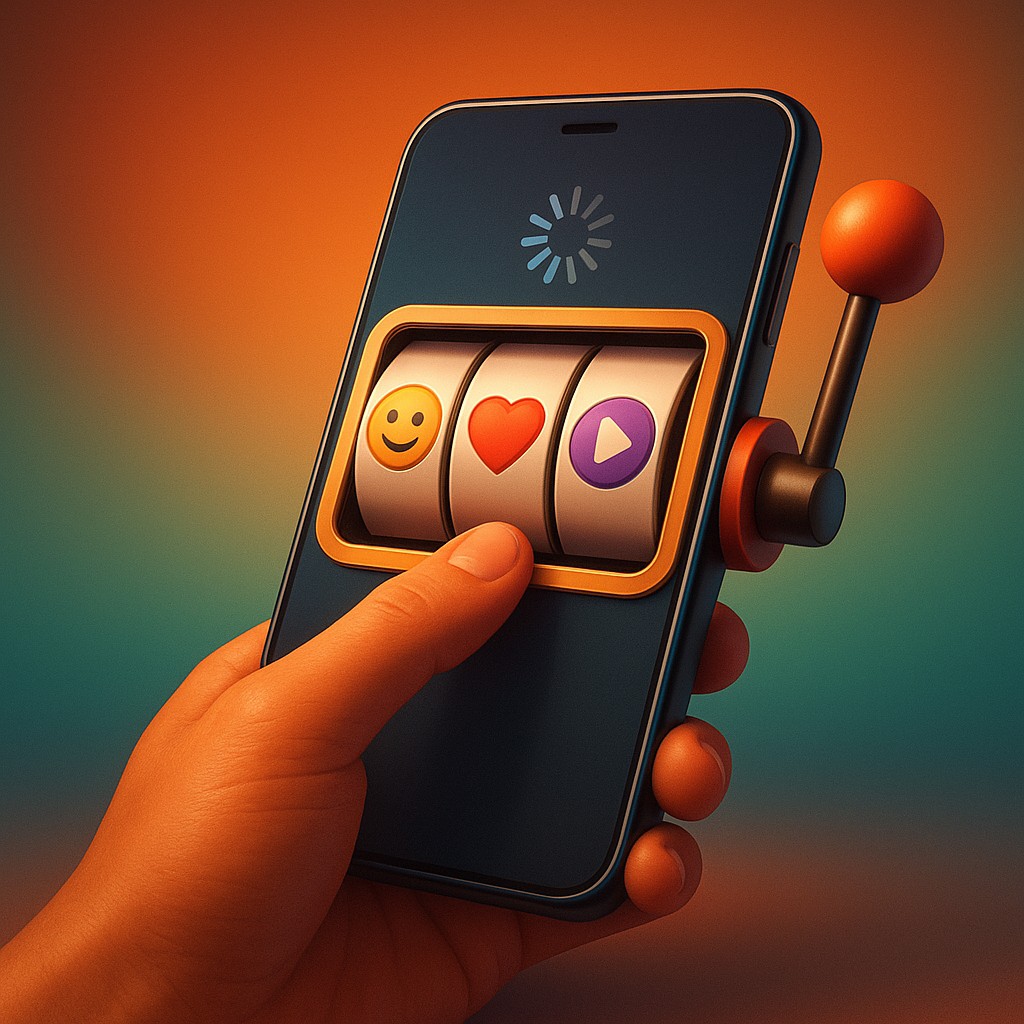
Have you ever caught yourself staring at your phone, mindlessly dragging your thumb down the screen to refresh a feed you just checked thirty seconds ago? It is a strange, almost hypnotic ritual that millions of people perform every day without a second thought. You pull, a little spinning icon appears, and for a split second, you wait with bated breath to see if something new, exciting, or scandalous has popped up. This interaction feels natural, almost like a digital heartbeat. Yet beneath the smooth animations and colorful interfaces lies a clever psychological trap designed to grab your attention and hold it hostage for as long as possible.
The magic, or perhaps the mischief, of this design is that it copies the mechanics of a Las Vegas casino. Engineers and designers have spent decades studying human behavior to understand what keeps us coming back for more. They discovered that we aren't actually motivated by the reward itself, but by the anticipation of getting it. When that refresh animation plays, your brain is essentially pulling the handle of a digital slot machine. Sometimes you "win" with a hilarious meme or a message from a friend; other times you "lose" with an ad or a post you’ve already seen. This exact lack of predictability is what makes the habit so incredibly hard to break.
The Secret Language of Micro-interactions
To understand why we are so hooked, we first have to look at the "micro-interactions" that fill our digital lives. A micro-interaction is a tiny, functional animation or response that happens when you use an app. It is the "like" heart that pops and changes color, the "read" receipt that appears under a message, or the subtle vibration your phone gives when you enter the wrong password. These are not just artistic choices made by bored graphic designers. They are feedback loops that tell your brain your actions have real consequences in the digital world.
These tiny moments provide a feeling of control. Without them, using an app would feel like shouting into a void, never quite sure if the computer heard you. However, when these interactions are polished to a mirror shine, they become deeply satisfying. The "click" of a keyboard or the "whoosh" of a sent email provides a physical pleasure that mimics touching real objects. Designers call this "delight," but in the world of habit formation, it serves as the bait that keeps you glued to the screen.
When these micro-interactions are paired with specific behavioral triggers, they stop being helpful tools and start becoming part of a compulsion loop. The goal of many platforms is to maximize "Time Spent," and micro-interactions are the grease on the wheels of that mission. By making the search for information feel like a game, apps transform the boring task of checking the news into a high-stakes hunt for social validation and novelty. Every tiny animation is a breadcrumb leading you deeper into the forest of endless scrolling.
Randomness and the Power of Variable Ratios
The main engine driving our digital persistence is something psychologists call a Variable Ratio Reinforcement Schedule. While this sounds like laboratory jargon, the concept is simple. It was popularized by B.F. Skinner, a famous psychologist who spent his time watching pigeons and rats press levers for food. He discovered that if a rat got a food pellet every single time it pressed a lever, it would eventually get bored and stop once it was full. However, if the food came out at unpredictable intervals, the rat would press the lever incessantly, sometimes even ignoring its own health, because it could never be sure when the next "hit" was coming.
Social media apps are built on this exact principle. If you got exactly five interesting posts every time you refreshed your feed, the experience would be predictable and eventually dull. You would check the app, see your five posts, and go about your day. But because the quality and quantity of content are unpredictable, your brain stays on high alert. This creates a dopamine-fueled feedback loop where the uncertainty of the reward is actually more stimulating than the reward itself.
Dopamine is often misunderstood as the "pleasure chemical," but it is more accurately described as the "craving chemical." It spikes when you are about to get something, not necessarily when you actually have it. When you see that loading spinner after you pull to refresh, your brain is flooded with dopamine in anticipation of what might be there. This is why you can spend forty minutes scrolling through nonsense you don't even like. You aren't looking for what is on the screen right now; you are looking for what might be on the screen next.
Comparing Reward Styles in Daily Life
To better visualize how these psychological tricks differ from standard interactions, we can look at how different types of rewards affect our behavior over time. While some systems are designed to be reliable, others are designed to be addictive.
| Reward Type |
Predictability |
Behavioral Result |
Real-World Example |
| Fixed Ratio |
Very High |
Consistent, but stops once goal is met |
Getting a free coffee after 10 stamps |
| Fixed Interval |
High |
Procrastination followed by a burst of effort |
Studying only the night before a scheduled exam |
| Variable Interval |
Low |
Steady, persistent activity |
Checking your email for an important reply |
| Variable Ratio |
Very Low |
High intensity, very hard to stop |
Slot machines and social media feeds |
As the table shows, the Variable Ratio is the undisputed king of creating habits. Because there is no set time or number of actions required to get the reward, the subject (in this case, the user) keeps performing the action indefinitely. This is the logic of the "infinite scroll." By removing natural stopping points, like the end of a page or a "Next" button, and replacing them with a continuous stream of unpredictable rewards, apps bypass our natural signals that tell us we've had enough. We don't feel "full" of content because we are always looking for the next "win."
The Physical Toll of Digital Slot Machines
While this design is incredibly effective at keeping users engaged, it comes with a significant cost. Humans are not built to be in a constant state of high-alert anticipation. Constantly being "on" and searching for the next hit of dopamine leads to a phenomenon known as digital fatigue or "technostress." After a while, the brain begins to get used to the triggers. The once-exciting red notification bubble or the "pop" of a new like begins to lose its shine, requiring more and more stimulation to achieve the same feeling of satisfaction.
This creates a cycle of diminishing returns. Users find themselves spending more time on their devices but enjoying them less. You might recognize this feeling as the "zombie scroll," where you are looking at your phone not because you are interested, but because you are caught in the physical habit of the gesture. When the variable rewards stop feeling like rewards and start feeling like obligations, the experience turns sour. This is often when people decide to go on "digital detoxes" or delete their accounts entirely, as the mental energy required to filter through the noise becomes too taxing.
Furthermore, this constant state of anticipation can ruin our ability to focus on deep, meaningful tasks. Our brains become conditioned to expect a reward every few seconds. When we sit down to read a long book or work on a complex project, the lack of immediate, unpredictable feedback feels agonizing. We have effectively trained our brains to prefer the smartphone slot machine over the slow, steady satisfaction of real-world accomplishments. This shift in attention span is one of the most significant long-term impacts of variable ratio design.
Redesigning the Relationship with Our Tools
Awareness is the first step in breaking the spell of these psychological hooks. Once you realize that the pull-to-refresh animation is an intentional friction point designed to mimic a gambling mechanic, it loses some of its power over you. Many users are now looking for ways to "de-gamify" their phones. This includes turning off non-essential notifications, setting the screen to grayscale to make the visuals less stimulating, or using apps that recreate the natural pauses of the physical world.
Designers are also starting to face an ethical crossroads. There is a growing movement toward "humane technology," which advocates for design that respects human boundaries rather than exploiting biological weaknesses. This might include "slow" interfaces that encourage reflection, or "zen modes" that hide social validation scores like view counts and likes. By shifting the focus from "engagement" to "well-being," the tech industry could turn our devices back into tools that serve us, rather than the other way around.
Ultimately, the goal is not to abandon technology altogether, but to develop a "digital literacy" that include an understanding of our own biology. When you know why your thumb wants to pull down that screen, you regain the power to decide whether you actually want to see what's underneath. We can enjoy the convenience and connection of social media without becoming the pigeons in Skinner's box, as long as we stay mindful of the strings being pulled behind the glass.
The next time you reach for your phone to check a feed you just closed, take a moment to pause and notice the impulse. Recognize the dopamine rising in anticipation of a reward that might not even be there. By shining a light on these hidden mechanics, you move from being a passive participant in a psychological experiment to an intentional user of a powerful tool. You have the ability to master your digital environment, turning the "slot machine" back into a library and reclaiming your time, your focus, and your curiosity for the world beyond the screen.