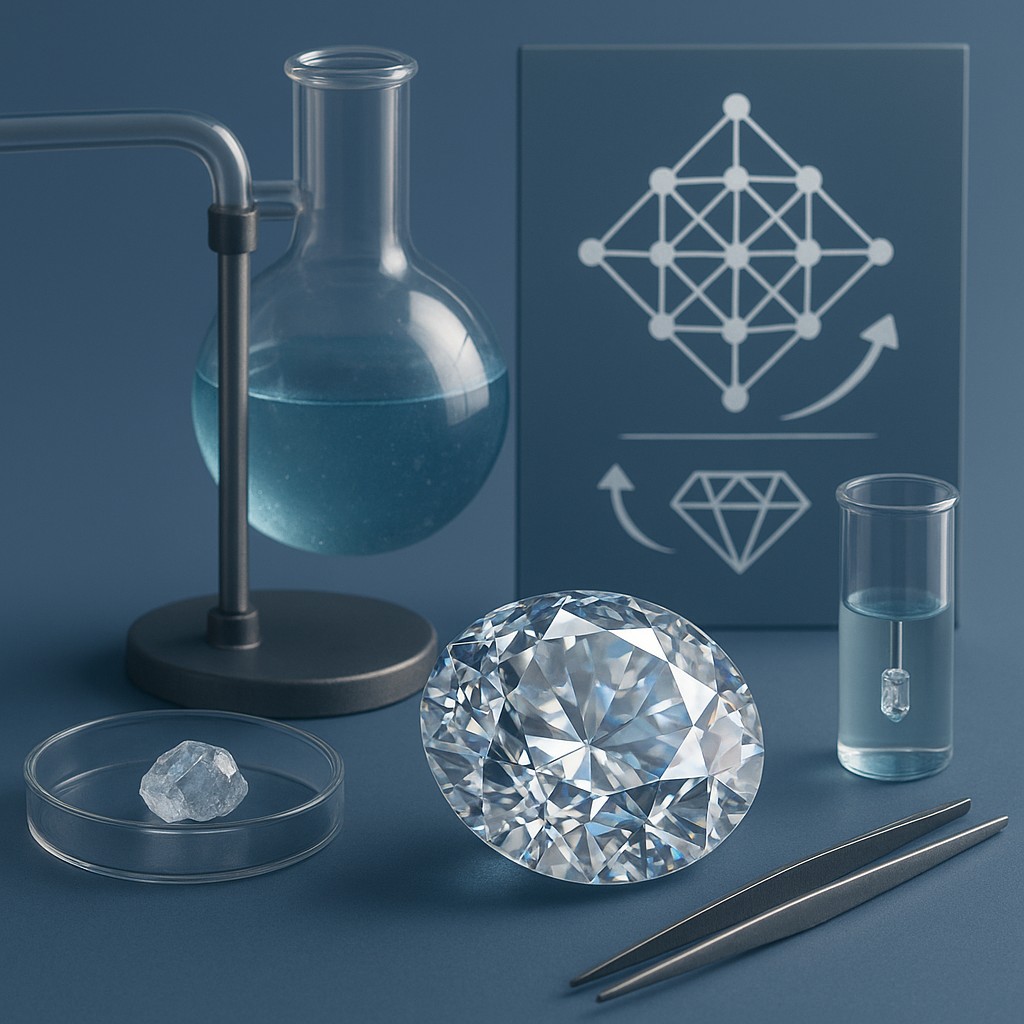
Diamonds have a reputation for being rare, ancient, and a little bit magical. That reputation is not entirely wrong, but the "magic" is mostly physics, chemistry, and a lot of patience. The truly surprising part is this: we can make real diamonds on Earth, on purpose, in a lab, without waiting a billion years for deep-planet geology.
Learning how lab diamonds are made is like getting a backstage tour of nature’s workshop. You learn what a diamond actually is (spoiler: it is not "compressed coal"), what conditions make carbon atoms snap into the diamond pattern, and how scientists reproduce those conditions with clever machines. You also get a new way to look at materials: structure matters, and atoms are picky about how they arrange themselves.
By the end of this guide, you will know the two main lab methods, how a tiny seed becomes a crystal you can hold, what the process looks like step by step, and how experts tell lab-grown and mined diamonds apart. You will also pick up enough vocabulary to sound calm and competent if someone tries to sell you "lab diamond dust infused with moon energy" or other nonsense.
Diamond basics: carbon atoms doing immaculate choreography
A diamond is carbon, but not just any carbon. What makes it a diamond is how each carbon atom bonds to four neighbors in a rigid three-dimensional network (a tetrahedral structure). This tight arrangement is why diamonds are extremely hard and why they conduct heat so well. If carbon atoms join in flat sheets, you get graphite, the soft material in pencil lead that smudges easily.
The key point is that diamonds are about structure, not ingredients. "Carbon" is like flour, and "diamond versus graphite" is like "croissant versus pancake." Same ingredient, very different result, because atoms can organize into different patterns depending on temperature, pressure, and their surroundings.
Another important point: diamonds form when carbon has the right conditions and enough time to settle into that stable arrangement. In nature, that usually means very high pressure and temperature deep inside Earth, plus a geological elevator ride — volcanic eruptions — that carry the crystals closer to the surface. In labs, we skip the volcano and recreate the conditions, using either brute-force pressure or clever chemistry.
The two main ways labs grow diamonds (and how they compare)
There are two dominant techniques for making gem-quality lab diamonds:
- HPHT (High Pressure High Temperature): This copies Earth’s deep interior. Carbon dissolves in a molten metal and crystallizes onto a diamond seed under intense pressure and heat.
- CVD (Chemical Vapor Deposition): This grows diamond from a carbon-containing gas. A plasma breaks the gas apart, and carbon atoms deposit onto a diamond seed, layer by layer.
Both produce real diamonds with the same crystal structure as mined stones. They differ in environment, equipment, growth rate, and the typical "fingerprints" the stones may carry.
A quick comparison table
| Feature |
HPHT (High Pressure High Temperature) |
CVD (Chemical Vapor Deposition) |
| Core idea |
Recreate deep-Earth conditions |
Grow diamond from carbon-rich gas |
| Typical conditions |
Very high pressure (gigapascals) and high heat (over 1,000 °C) |
Lower pressure, high heat, plasma environment |
| “Feedstock” carbon source |
Solid carbon (often graphite) dissolved in metal flux |
Methane or similar gas mixed with hydrogen |
| Growth style |
Carbon crystallizes from melt onto seed |
Carbon atoms deposit layer-by-layer onto seed |
| Common uses |
Gem diamonds, industrial diamonds, also useful for some color treatments |
Gem diamonds, large plates for tech applications |
| Typical telltales (not always) |
Metal inclusions possible, certain nitrogen patterns |
Layered growth features, silicon-related defects possible |
If you remember one thing, remember this: HPHT is like a pressure cooker for crystals, and CVD feels like "diamond 3D printing" at the atomic level (not literally printing, but the idea fits).
HPHT diamonds: the “Earth simulator” approach
HPHT starts with a simple truth: diamond is the stable form of carbon under high pressure. So you build a machine that can squeeze materials as if they were 150 to 200 kilometers underground. These presses are serious engineering, often using belt presses, cubic presses, or BARS systems. The machine’s job is not subtle. It pushes with enough force to make your car look like a polite suggestion.
Inside the press is a capsule with three key ingredients: a carbon source (often graphite), a metal solvent-catalyst (usually iron, nickel, cobalt, or alloys), and a tiny diamond seed crystal. The molten metal is crucial because carbon will not turn into diamond on command. The metal dissolves carbon at high temperature, moves it through the melt, and delivers it to the seed where it crystallizes as diamond.
Think of it like making rock candy, except the "sugar water" is molten metal, the sugar is carbon, and the kitchen is the mantle. Carbon atoms leave the source, travel through the melt, and lock into place on the seed’s diamond lattice. If conditions stay steady, the crystal grows in an orderly way.
What the HPHT process looks like, step by step
HPHT growth is not a single button press. It is a controlled sequence:
- Prepare the cell: Place graphite, metal catalyst, and the diamond seed in a compact assembly.
- Pressurize: Raise pressure into the diamond-stable region (measured in gigapascals).
- Heat: Increase temperature until the metal melts and can dissolve carbon.
- Grow: Keep conditions steady so carbon moves through the melt and deposits on the seed.
- Cool and depressurize: Slowly lower temperature and pressure to avoid cracking.
- Extract and clean: Remove the diamond crystal, then clean off metallic residues and other materials.
Growth can take days to weeks depending on the size and quality desired. The dull part — holding stable pressure and temperature — is actually where skill matters. Small fluctuations can create defects, stress, or unwanted inclusions.
Color and clarity: what HPHT tends to do well (and what can show up)
HPHT diamonds can be colorless or fancy-colored, depending on impurities and post-growth treatment. Nitrogen is a common impurity and often gives stones a yellow tint. Under certain conditions, boron can create blue diamonds, which also give the crystal semiconducting properties. Metal solvent inclusions can sometimes remain trapped, which is one reason gem labs look for metallic traces when identifying growth origin.
A subtle point: HPHT is also used to treat diamonds (including some mined ones) to change color by rearranging defects. That does not make HPHT diamonds fake; it just means the same tool can both grow diamonds and modify them. The diamond world likes reusing equipment for multiple stories.
CVD diamonds: growing crystals from a carbon “mist” you can’t see
CVD feels more like science fiction because instead of squeezing carbon, you persuade it to assemble itself from a gas. The basic setup is a vacuum chamber with a diamond seed plate, usually a thin slice of diamond. You introduce gases, typically hydrogen plus a small amount of methane or another carbon-containing gas.
Then comes the star: a plasma. Using microwaves or another energy source, the chamber turns the gas into an energized mix of fragments and radicals. Hydrogen plays an outsize role here. It helps stabilize diamond growth and prevents carbon from forming graphite, diamond’s looser cousin.
Carbon atoms and small carbon fragments land on the seed and attach to the diamond lattice, building the crystal layer by layer. If the conditions are right, you get a uniform, high-quality diamond film that can grow into a thick diamond suitable for cutting into gems.
The CVD process in plain language
You can imagine CVD like painting a wall, but your brush is physics and your paint is carbon atoms. The wall is the diamond seed, and the goal is to make every new stroke align with the crystal pattern.
A typical CVD growth sequence goes like this:
- Seed preparation: Clean and sometimes polish the diamond seed to encourage orderly growth.
- Load chamber and pump down: Create low pressure so gases behave predictably.
- Introduce gases: Flow hydrogen and a small fraction of methane.
- Ignite plasma: Use microwaves or hot filaments to energize the gas.
- Grow: Maintain temperature, pressure, and gas ratios to deposit diamond carbon.
- Cool down: Carefully stop growth and cool to avoid thermal stress.
- Post-processing: Cut, polish, and sometimes treat to adjust color.
CVD is famous for control. You can tweak gas chemistry, pressure, and temperature to influence growth rate and quality. It is also used to make diamond plates for tech uses like heat spreaders in electronics and optical windows, not just jewelry.
Common CVD quirks (and how they get handled)
Because CVD builds diamond in layers, it can sometimes show growth striations or layered structures under specialized imaging. Silicon can also sneak in from chamber materials and form silicon-vacancy defects, which are useful for quantum tech but not always desired for gems. Manufacturers often use post-growth heat treatment (sometimes HPHT treatment) to improve color or reduce certain defects.
This is a good place to squash a misconception: CVD diamonds are not coated. They are diamond all the way through. The growth happens on a seed, yes, but the grown material is a continuous diamond crystal, not a thin shell. If anyone tells you "lab diamonds are just diamond-plated," you can politely file that under "confidently incorrect."
Seeds, growth, and the art of not messing up a perfect lattice
Whether you use HPHT or CVD, the seed crystal is the quiet hero. A diamond seed gives new carbon atoms a template so they know exactly where to go. Without a proper template and the right conditions, carbon is perfectly happy to form graphite, soot, or other unremarkable carbon structures.
Crystal growth is a negotiation between thermodynamics (what is stable) and kinetics (how fast things happen). You want carbon atoms to arrive at the growing surface at a manageable pace, settle into the right positions, and avoid getting trapped in awkward arrangements. If growth is too fast, you get more defects, internal stress, or non-diamond carbon. If it is too slow, production becomes costly and impractical.
Some of the most important control knobs across both methods include:
- Temperature stability: Fluctuations can change which form of carbon is favored.
- Purity of materials and gases: Trace impurities become visible defects at crystal scale.
- Growth rate: Faster is not always better, especially for high clarity.
- Pressure (HPHT) and gas chemistry (CVD): These determine whether diamond is encouraged or discouraged.
- Post-growth treatment: Heat and pressure can reorganize defects and shift color.
A fun image: diamond growth is like building a stadium out of identical bricks while the wind is blowing and someone keeps handing you slightly different bricks. Your job is to keep the pattern perfect anyway.
Clearing up myths that refuse to retire
A few diamond myths keep showing up, so let’s clear them up.
First, "Diamonds are made from coal." Not really. Coal forms from plant material near Earth’s surface. Most natural diamonds formed much deeper and much earlier, long before the plants that became coal existed. Lab diamonds also do not use coal. They use purified carbon sources or gases, because random lumps of coal would just bring contamination.
Second, "Lab diamonds are fake." Lab diamonds are real diamonds. They have the same crystal structure and the same chemical composition (carbon) as mined diamonds. What differs is origin, not identity. Ice from your freezer is still ice, even though a glacier has a better backstory.
Third, "Lab diamonds are always perfect." They can be very high quality, but they can also have inclusions, strain, and color issues, just like mined stones. Perfection is not automatic. It is engineered, and engineering takes skill.
Fourth, "You can always tell by looking." Often you cannot reliably distinguish lab-grown from mined with the naked eye. Identification usually requires specialized instruments that examine growth patterns, fluorescence, trace elements, and defect structures.
How experts identify lab-grown diamonds (without guessing)
Gem labs use a toolkit of methods rather than a single test. The goal is not to decide whether a diamond is real, but whether it grew in a lab or in nature. This matters for disclosure and pricing, not because one is made of better carbon.
Common identification methods include spectroscopy (looking at how the diamond absorbs light), fluorescence imaging, and examining inclusions. HPHT diamonds may show metallic inclusions or specific nitrogen aggregation states. CVD diamonds may show layered growth features and certain defect signals. Technologies keep improving, and producers adjust methods to reduce these fingerprints, so identification is an active, evolving field.
If you are buying a lab diamond, the practical advice is simple: buy from sellers who provide reputable grading reports (for example, from well-known gemological laboratories) and clear disclosure of origin and treatments. "Trust me, it sparkles" is not a grading standard.
From rough crystal to sparkling gem: the part people forget
When a lab grows a diamond, it does not emerge already shaped like a jewelry-store dream. It usually comes out as a rough crystal or a block, then goes through the same cutting and polishing journey as mined diamonds. Cutting is where brilliance is born, because sparkle depends on how light bounces inside the stone, not on whether it came from a mine or a machine.
Cutters study the rough, plan how to maximize beauty and minimize visible flaws, and then shape facets with extreme precision. The angles matter so much that tiny changes can make a stone look bright or dull. That is why two diamonds with identical size and clarity grades can look different in person. Geometry is the secret sauce.
After cutting, diamonds are graded by the familiar "4Cs": cut, color, clarity, and carat. Those apply to lab-grown diamonds too. In other words, lab creation is the beginning of the story, not the ending.
Learning to “think like a diamond grower”
If you want to really understand lab diamond creation, focus on a few core ideas that tie everything together:
- Diamond is a structure: Carbon atoms must lock into a specific lattice.
- Conditions decide outcomes: Pressure, temperature, and chemistry steer carbon toward diamond or away from it.
- Growth needs a template: Seeds guide atoms into the right positions.
- Control beats force: The best diamonds come from stable, carefully tuned environments.
- Defects tell stories: Tiny impurities and lattice quirks reveal how a diamond formed.
Once you see diamonds as engineered crystals rather than mysterious rocks, the field becomes less intimidating. You start noticing parallels with other materials: silicon wafers, sapphire crystals, even snowflakes. Nature and labs both build wonders by repeating simple rules billions of times.
Closing: a modern kind of alchemy you can actually explain
Lab-grown diamonds are a satisfying example of people learning nature’s playbook and running the experiment themselves, carefully and with safety. What once required deep Earth and geologic time can now happen in a chamber or press because we understand the conditions that make carbon choose diamond. There is something empowering about that, not because it replaces nature, but because it shows how much clarity comes from asking good questions and measuring carefully.
If you keep going, you can explore the engineering of HPHT presses, the plasma physics behind CVD, or the gemology methods used to identify growth origins. Or you can simply enjoy the fact that "a diamond is forever" now has a sequel: "and sometimes it is also scheduled." Either way, you have taken a glittery object and turned it into a story you can explain, which is the smartest kind of sparkle.